No products in the cart.

Diamond Carat Guide 2026 – Find Your Perfect Diamond
Walk into any jewelry store, and there is one word that gets asked about before anything else. Not cut. Not clarity. Carat.
It makes sense. Carat is the number people repeat at engagement parties. It is the number that goes on the appraisal. Also, quietly, the number most people misunderstand – because carat is not a measure of size at all. It is a measure of weight, and two diamonds with the same weight can look noticeably different on a finger.
This guide clears that up. We have pulled together current 2026 pricing, the millimeter charts we actually use on the trade counter at 47th Street, and the buying logic our team walks clients through every day-no fluff, no scare tactics – just the numbers and what they mean for your budget.
Once read what is a diamond before buying any diamond.
What Is a Diamond Carat, Exactly?
One carat equals 200 milligrams – exactly 0.2 grams. It is divided into 100 points, which is why the trade calls a 0.50 ct stone a “fifty pointer” and a 0.25 ct a “quarter.”
That is the whole definition. Notice what is missing: any mention of width, diameter, or how big the stone looks. A diamond can carry its weight up in the crown and down in the pavilion, hidden below the setting where nobody will ever see it. Or it can spread that weight across the top, where your eye actually lives.
The number that governs how big a diamond looks is not carat – it is the face-up diameter, measured in millimeters, and it depends entirely on cut quality.
For a round brilliant, the proportions that keep weight visible rather than buried are a depth percentage of roughly 59-62.5% and a table of about 53–58%. Push depth past 64%, and the stone starts hiding weight in its belly; a 1.00 ct cut that deep can face up more like a 0.90 ct. Go shallower than 58%, and it spreads wider, but leaks light, giving that glassy, watery look through the middle.
Carat vs. Millimeters: The Chart That Matters
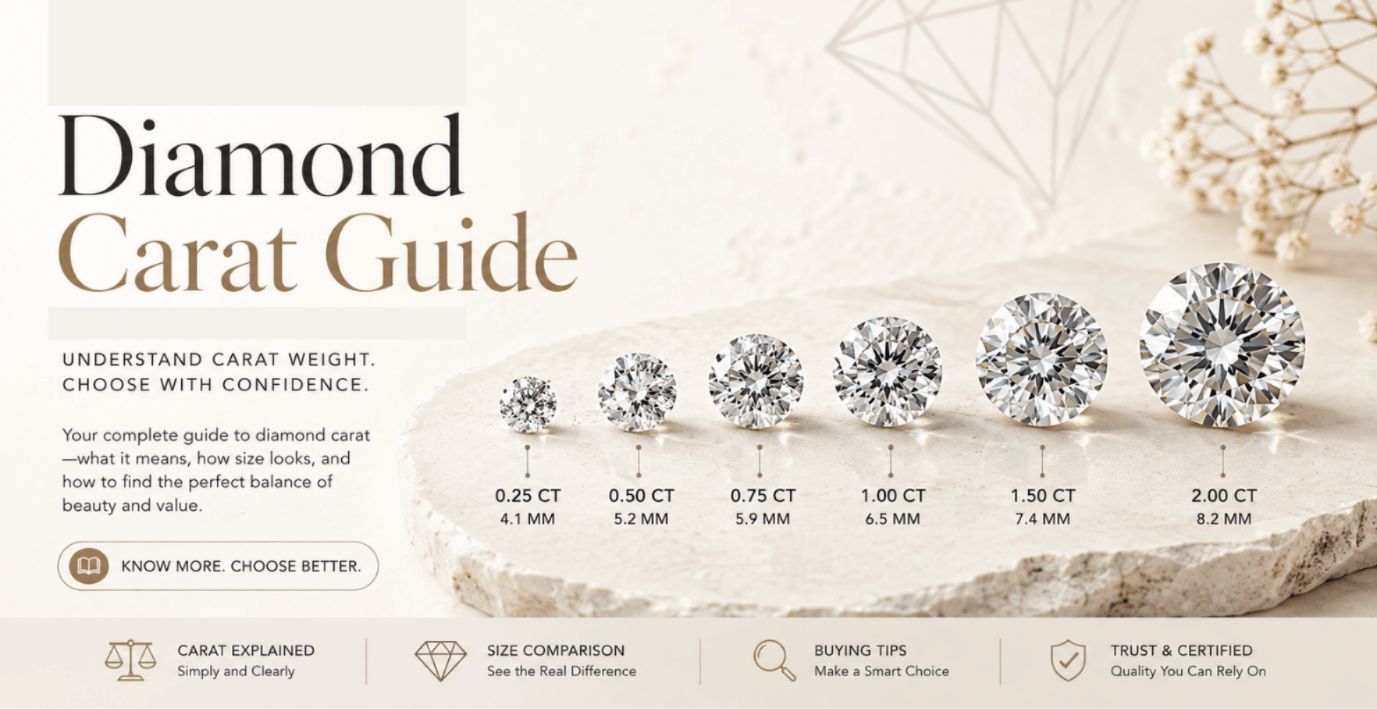
Here is the reference chart, based on well-cut round brilliants within ideal proportions. Print it, screenshot it, bring it shopping.
| Carat Weight | Round Diameter (mm) | How It Reads on the Hand |
| 0.25 ct | ~4.1 mm | Delicate accent, pavé, side stones |
| 0.50 ct | ~5.2 mm | Petite but clearly a solitaire |
| 0.75 ct | ~5.8 mm | Balanced everyday size |
| 0.90 ct | ~6.2 mm | Reads as a “one carat” to almost everyone |
| 1.00 ct | ~6.4–6.5 mm | The industry benchmark |
| 1.25 ct | ~6.9 mm | Noticeably fuller than a one carat |
| 1.50 ct | ~7.4 mm | Substantial without feeling loud |
| 2.00 ct | ~8.1–8.2 mm | Unmistakably a statement stone |
| 3.00 ct | ~9.3 mm | Commands the whole hand |
| 4.00 ct | ~10.2 mm | Rare-air territory |
Look closely at that chart and something jumps out. Doubling the weight from 1.00 ct to 2.00 ct only increases the diameter from about 6.5 mm to 8.2 mm – roughly 26% wider. Weight scales with volume; visible size scales with width. That single piece of geometry explains most of the value decisions in this guide.
Diamond Price by Carat in 2026
Diamond price per carat rises as weight rises, because large rough crystals are exponentially rarer than small ones. The table below gives realistic 2026 US retail ranges for certified, well-cut stones in the popular G-I color, VS–SI clarity band. Natural and lab-grown are shown side by side, because in 2026 they are genuinely two different markets.
| Carat | Natural Diamond (USD) | Lab-Grown Diamond (USD) |
| 0.50 ct | $900 – $2,200 | $200 – $450 |
| 0.75 ct | $1,700 – $3,800 | $350 – $700 |
| 0.90 ct | $2,400 – $5,000 | $500 – $900 |
| 1.00 ct | $3,000 – $6,500 | $800 – $1,500 |
| 1.50 ct | $6,000 – $13,000 | $1,200 – $2,400 |
| 2.00 ct | $12,000 – $28,000 | $1,800 – $3,600 |
| 3.00 ct | $28,000 – $60,000 | $3,000 – $6,500 |
| 4.00 ct | $55,000 – $120,000+ | $4,500 – $9,000 |
Estimated retail ranges for GIA– or IGI-certified stones, August 2026. Actual pricing depends on cut grade, fluorescence, shape, diamond certification, and origin. Fancy shapes typically sit 15–30% below round brilliants of equal weight and quality.
The 2026 Market: Where Prices Are Actually Moving
This is the part most carat guides skip, and it is the part that saves you money.
Natural diamonds: soft in the middle, strong at the top
Natural diamond pricing corrected hard through 2025. The Rapaport index closed the year down about 11.3% for one-carat naturals, and the smaller commercial sizes took the worst of it – 0.30 ct goods fell over 20%, and half-carat goods dropped roughly 26% across the year. Tracking wholesale asking prices from July 2024 onward, nothing in the 0.70 to 1.99 ct band has climbed back to where it started.
Above three carats, the picture flips completely. The 4.00–4.99 ct range is the one weight class showing a net gain over the same two-year window, with top-color, top-clarity stones up 50–70% since 2024. Global rough production has slipped to multi-decade lows near 100 million carats a year as major mines in Botswana, Canada and Russia mature. Big, clean, well-cut naturals are getting harder to source, and the market knows it.
Lab-grown: the floor has arrived
For years the lab-grown story was one long price slide, and buyers learned to wait for next quarter. That era has closed. Wholesale lab-grown prices are down roughly 74% since 2020, but the most recent year moved only about 2.6% – the smallest annual decline in two years. Premium 1 ct stones in D–E colour and VS clarity have hit a functional production-cost floor. No grower can price a certified stone below what it costs to grow, cut and grade it.
The practical takeaway: if you are buying lab-grown, waiting no longer pays. If you are buying natural in the one-to-two carat range, current conditions are about as buyer-friendly as they have been in five years.
Magic Sizes and the Price Jumps Nobody Warns You About
Diamond pricing does not climb in a smooth line. It steps. At every round number – 0.50, 0.70, 0.90, 1.00, 1.50, 2.00 – the price per carat jumps, because cutters preserve those weights and buyers ask for them by name. These are the “magic sizes.”
The opportunity sits just below each step:
- 0.90 ct instead of 1.00 ct – roughly 0.3 mm smaller, frequently 15-20% cheaper.
- 1.40 ct instead of 1.50 ct – a difference you would need calipers to prove.
- 1.80 ct instead of 2.00 ct – 7.9 mm versus 8.2 mm, visually identical at normal viewing distance.
There is one caveat worth stating plainly. A shy stone only wins if the cut is excellent. A 0.95 ct cut too deep faces up smaller than a well-cut 0.90 ct. Always check the diameter on the certificate, not just the weight.
Shape Changes Everything: Same Carat, Bigger Look
Cut a carat of rough into a different silhouette and the visible footprint changes dramatically. Elongated shapes spread weight across the finger; deeper shapes hide it underneath.
| Shape (1.00 ct) | Typical Dimensions | Perceived Size |
| Marquise | ~10.5 × 5.3 mm | Largest face-up of any shape |
| Oval | ~7.7 × 5.7 mm | Elongates the finger; the 2026 favourite |
| Pear | ~8.7 × 5.7 mm | Long and flattering |
| Emerald | ~7.0 × 5.0 mm | Looks generous; shows clarity honestly |
| Round Brilliant | ~6.5 mm | Benchmark brilliance, highest price per carat |
| Cushion | ~5.8 × 5.8 mm | Compact but soft and fiery |
| Princess | ~5.5 × 5.5 mm | Smallest face-up of the popular shapes |
That range is enormous. A marquise shows close to 85% more surface area than a princess at identical weight. If maximum presence per dollar is the goal, an elongated oval or marquise does more for you than chasing an extra tenth of a carat – and it usually costs less per carat too, since rounds carry the highest premium of any shape.
What Buyers Are Really Choosing in 2026
The engagement market has changed shape in the last two years, and the data is genuinely interesting.
- The blended US average total carat weight now sits near 1.9 ct, with average spend around $4,600 – a bigger stone for less money than a decade ago.
- Lab-grown centre stones account for roughly 61% of US engagement rings, which is exactly why that average carat figure looks so large.
- For natural diamonds alone, the average centre stone is closer to 1.1–1.2 ct.
- Oval has overtaken round in market share for the first time in over half a century.
- Natural stones have clawed back bridal share, moving to about 57% of engagement ring sales – commoditised lab-grown appears to be reinforcing the prestige of mined stones for milestone purchases.
Read those together, and a clear split emerges. Buyers who want size are getting it through lab-grown and elongated shapes. Buyers who want rarity and long-term value are buying natural, often in the 1.2 ct-and-up band where the market has held firmest.
How to Choose Your Carat Weight: A Practical Method
Here is the sequence our team uses with clients, in order.
Start with the finger, not the budget. A 1.00 CT round reads as generous on a size 4½ hand and modest on a size 8. Setting style matters too – a hidden halo or a slim cathedral band makes a stone read larger; a wide cigar band absorbs it.
Fix your total budget, then work backwards. Allocate to cut first. An Excellent or Ideal cut is the only grade that affects how a diamond behaves in real light, and it is the one thing you cannot fix later.
Buy shy of magic sizes. Ask specifically for 0.90–0.98 ct or 1.80–1.95 CT Most retail sites will not surface these unless you filter for them.
Choose colour and clarity by shape. Round brilliants hide inclusions and warmth well – G-H colour, VS2–SI1 is a strong value zone. Emerald and Asscher cuts are step cuts and show everything, so move up to VS1 and F–G.
Verify the millimetres on the report. Two 1.00 ct stones can differ by half a millimetre in diameter. That is the difference between a stone that looks like a carat and one that does not.
Five Carat Mistakes We See Every Week
- Paying for a full carat and accepting a Good cut. A well-cut 0.90 ct outshines a mediocre 1.05 ct in every lighting condition that matters.
- Ignoring depth percentage. It is printed right on the certificate, and it directly controls face-up size.
- Assuming double the carat means double the look. It is about 26% wider, not 100%.
- Buying lab-grown as an investment. Resale currently sits around 10–15% of purchase price, and some jewelers decline buy-backs entirely. Buy lab-grown for beauty and size – not for resale.
- Comparing prices without comparing certificates. GIA and IGI grade to different standards in places. An uncertified “bargain” is not a bargain.
Frequently Asked Questions
How big is a 1 carat diamond in mm?
About 6.4–6.5 mm in diameter for a well-cut round brilliant. A 1 ct oval measures roughly 7.7 × 5.7 mm and looks distinctly larger on the hand despite identical weight.
How much does a 1 carat diamond cost in 2026?
A natural 1 ct in popular grades typically runs $3,000–$6,500 at retail, with high-clarity, high-colour stones going well past that. A comparable lab-grown 1 ct sits around $800–$1,500.
Is a 0.90 carat diamond noticeably smaller than a 1 carat?
No. The diameter gap is about 0.3 mm – invisible to the naked eye – while the price gap is very visible. It is the single best value move in diamond buying.
Which diamond shape looks biggest per carat?
Marquise, followed by oval and pear. Elongated silhouettes spread carat weight across a larger visible surface. Princess and cushion cuts face up smallest.
Is now a good time to buy?
For natural diamonds in the 1.00–1.99 ct range, yes – prices are soft with no clear rebound signal yet. Above 3 ct, supply pressure is real and waiting for a discount is not a reliable strategy. For lab-grown, the price floor has arrived, so waiting no longer earns you anything.
Talk to OM Jewels Inc
OM Jewels Inc delivers trusted diamond wholesaler natural and lab-grown diamonds with quality, transparency and global expertise. From the heart of New York’s Diamond District, we supply loose certified stones, matched pairs, layouts, fancy shapes, salt-and-pepper diamonds and black diamonds to retailers, designers and private clients worldwide.
Our gemologists track wholesale pricing weekly. Tell us your budget and the look you want, and we will show you the exact stones that fit – with certificates, real measurements, and honest guidance on where to spend and where to save.
| Contact OM Jewels Inc. Address: 20 W 47th St, Suite 405, New York, NY 10036, USA Phone: +1 201 680 1878 | +1 917 639 3354 WhatsApp: +1 917 639 3354 Email: info@omjewelsinc.com Website: www.omjewelsinc.com Wholesale enquiries welcome – ask about our trade account access. |
Related posts
When people talk about diamonds, they often focus on carat, color, and clarity. But the way a diamond is cut can have an equally important... Continue reading
Why Fancy Shape Diamonds Are the Growth Story of 2026 For most of the last century, the round brilliant was the default. It still holds... Continue reading
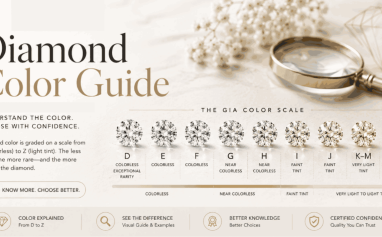
What Diamond Color Actually Measures Diamond color is one of the 4Cs, and it is the one buyers most often misunderstand. For white diamonds, the... Continue reading
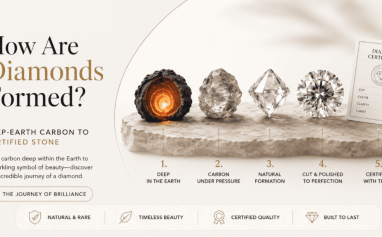
Every natural diamond you have ever seen began as carbon buried between 150 and 700 kilometres beneath your feet, crushed under pressures that would flatten... Continue reading
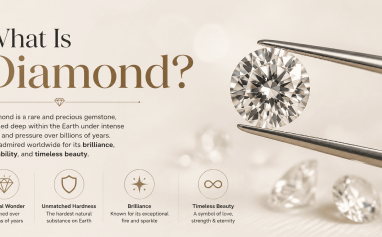
What Is a Diamond? A diamond is a mineral made of a single element – carbon – in which every carbon atom is covalently bonded... Continue reading