No products in the cart.

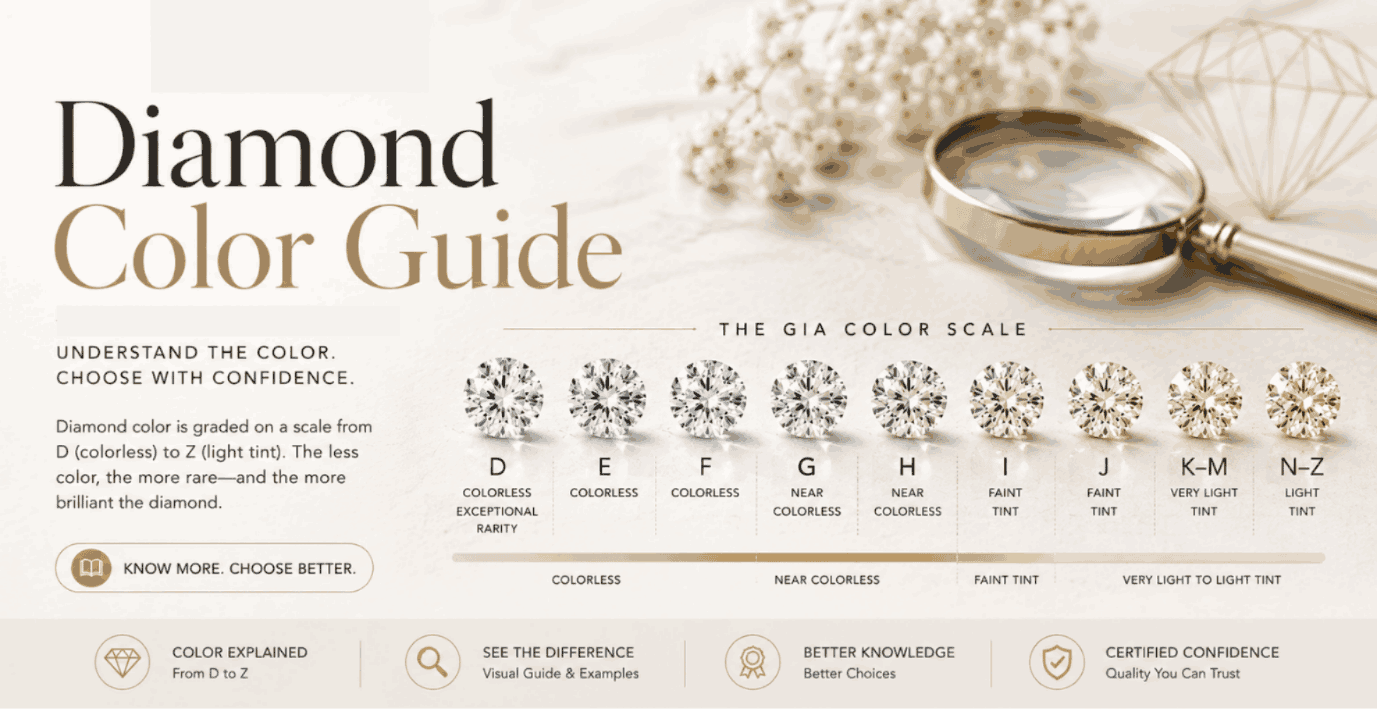
Diamond Color Guide Complete D-to-Z Scale
What Diamond Color Actually Measures
Diamond color is one of the 4Cs, and it is the one buyers most often misunderstand. For white diamonds, the grade does not describe a colour the stone has – it describes how little colour it has. The less body tint a diamond shows, the rarer it is, the higher it grades, and the more it costs per carat.
That tint comes mostly from trace nitrogen trapped in the carbon lattice as the crystal formed. Tiny variations in nitrogen concentration produce the faint yellow, brown or grey casts that separate one grade from the next. The differences are real and measurable, but many of them are invisible to an untrained eye, especially once the stone is mounted.
This is why colour is simultaneously the easiest place to overspend and the easiest place to save. Understanding where visible difference begins – and where it stops mattering – is the single most useful thing a buyer or a trade professional can learn about this C.
Why the Scale Begins at D, Not A
Before GIA standardised diamond grading, the trade used a patchwork of overlapping systems: letters such as A, AA and AAA, Arabic and Roman numerals, and loose marketing terms like “blue white” or “gem blue.” The same stone could be described three different ways by three different sellers, and none of the descriptions were verifiable.
When GIA introduced its colour scale in the 1950s, it deliberately started at D so that no one could confuse the new system with any of the old A-B-C ones. The clean break worked: D-to-Z is now the international standard for grading the depth of colour in white diamonds, from D (colourless) through Z (light yellow, brown or grey).
E vs F vs G Color Diamond Guide
The GIA D-to-Z Colour Chart
The 23 letter grades are grouped into five practical bands. Each letter covers a defined narrow range rather than a single fixed point, which is why two stones with the same grade can still look slightly different side by side.
| Grade | Band | Appearance | Best Suited To |
| D | Colourless | No detectable tint even under expert examination; icy white | Collectors, investment pieces, platinum settings |
| E–F | Colourless | Visually identical to D once set; trace colour only a grader detects | High-end bridal, D-F premium look at slightly lower cost |
| G–H | Near colourless | Reads white face-up; warmth invisible without a comparison stone | The value sweet spot for most engagement rings |
| I–J | Near colourless | Faint warmth possible from the side; disappears in most settings | Budget-conscious buyers, larger carat weight for the money |
| K–M | Faint | Gentle warm cast, often desirable in antique-style pieces | Yellow and rose gold, vintage and bezel designs |
| N–R | Very light | Noticeable tint face-up in white metal | Rustic and alternative designs, warm-toned settings |
| S–Z | Light | Clear yellow or brown body colour | Character stones; beyond Z the stone becomes fancy yellow |
How Colour Is Graded in a Laboratory
Colour grading is a comparison exercise, not a machine reading. A grader places the unmounted diamond table-down in a white tray, under standardised lighting, next to a set of master stones with known, fixed grades. Judging the stone from the side rather than face-up removes the distraction of brilliance and makes body tint far easier to read.
Environment matters enormously. Ambient light, the colour of the grader’s clothing, the tray background and the stone’s own scintillation can all shift perception. That is why a grade issued in a controlled laboratory carries weight and a grade estimated across a shop counter does not.
- Grading is done unmounted – a setting can shift apparent colour by a grade or more.
- Stones are viewed table-down against a neutral white background.
- Master stone sets are used for every call; no grade is assigned from memory.
- Fluorescence is assessed and disclosed separately from the colour grade.
SI1 vs SI2 Diamond Quality Guide
What Changed in 2025–2026: Lab-Grown Diamonds Left the D-to-Z Scale
This is the most important recent development in diamond colour, and it still catches buyers off guard. From 1 October 2025, GIA stopped issuing individual colour and clarity grades for laboratory-grown diamonds. In their place it introduced the GIA Laboratory-Grown Diamond Quality Assessment, which sorts a stone into one of two descriptive tiers: Premium or Standard.
GIA reasoned that the overwhelming majority of lab-grown production lands in a very narrow band of colour and clarity, so applying nomenclature developed for natural diamonds implied a precision that carried little practical meaning. The published thresholds are strict, and any stone that falls below the Standard minimum receives no assessment at all.
| Tier | Colour & Clarity Requirement | Finish Requirement |
| Premium | D-colour equivalent with VVS clarity or better | Excellent polish and symmetry; Excellent cut grade for round brilliants |
| Standard | Roughly E to J colour with VS clarity or better | Very Good polish and symmetry (Good symmetry allowed on some fancy shapes); Very Good cut on round brilliants |
| No assessment | Anything failing the Standard minimums | Not issued |
Three practical consequences follow. First, natural diamonds are unaffected – they still receive full diamond 4Cs grading, and every report issued before the change remains valid. Second, other laboratories, including IGI, continue to issue letter grades for lab-grown stones, so the market now runs two parallel vocabularies at once. Third, if you buy lab-grown and you care about the specific colour, ask your supplier for the underlying grading rather than relying on a two-word descriptor. At OM Jewels Inc we continue to publish carat weight, colour, clarity, measurements and certification detail on individual stones for exactly this reason.
Colour and Price: What Each Grade Costs
Colour accounts for roughly a fifth of a natural diamond‘s value – meaningful, but less than cut. The figures below are indicative retail ranges reported across the market in 2026 for a one-carat round brilliant at VS clarity with an excellent cut. Actual wholesale pricing varies by shape, certification, origin and market conditions.
| Grade | Indicative 1ct Range | Saving vs D | Notes |
| D | $6,500 – $7,500 | – | Rarity premium; strongest resale narrative |
| E | $6,000 – $7,000 | approx. 5–8% | Indistinguishable from D once set |
| F | $5,500 – $6,500 | approx. 10–15% | Last grade in the colourless band |
| G | $4,800 – $5,600 | approx. 25–30% | Widely regarded as the best value grade |
| H | $4,400 – $5,200 | approx. 30% | Reads white in white metal at typical sizes |
| I | $3,800 – $4,600 | approx. 35–40% | Excellent in yellow gold or halo settings |
| J | $3,400 – $4,200 | approx. 40–45% | Warmth visible only against a whiter stone |
Two patterns are worth noting. Every single step up the scale adds roughly 5 to 15 percent, and the increments accelerate sharply inside the colourless band. And the gap between D and G has widened over the past fifteen years – driven by demand for the top grades rather than by any change in how the stones look. Roughly three-quarters of white diamonds sold sit in the G-to-J range, which tells you where the market has already voted.
Setting, Shape and Size Change What You See
A colour grade is assigned to a loose stone in a laboratory. Your customer sees a mounted stone in daylight. Those are different viewing conditions, and the gap between them is where smart buying decisions live.
| Variable | Effect on Perceived Colour | Practical Guidance |
| Metal | Yellow and rose gold reflect warmth into the stone; platinum and white gold expose it | J–L performs beautifully in yellow gold; specify G or better for white metal |
| Carat weight | Greater depth means a longer light path, so tint concentrates | Under 1ct, H–J is safe; above 2ct, step up one grade |
| Shape | Round brilliants disperse light and mask tint; step cuts show body colour openly | Emerald and Asscher cuts benefit from G or higher |
| Setting style | Bezels and halos introduce contrast against neighbouring stones | Match halo melee to the centre stone’s band, not its exact grade |
| Lighting | Fluorescent office light flattens; warm domestic light hides tint | Always view a stone in more than one light source before committing |
Fluorescence: The Variable That Sits Beside Colour
Fluorescence is a diamond’s tendency to glow, usually blue, under ultraviolet light. It is graded and disclosed separately from colour, but it can influence how a stone reads face-up.
In the lower colour grades, roughly I through M, blue fluorescence can offset a yellow cast and make a stone appear a touch whiter than its letter suggests – a genuine value opportunity, since fluorescent stones typically trade at a discount. In the colourless range, very strong fluorescence is occasionally associated with a hazy or oily appearance, though GIA has found this in well under one percent of fluorescent diamonds. The sensible rule is not to avoid fluorescence on principle, but to look at any strongly fluorescent stone in person before buying.
Fancy Colour Diamonds Use a Different Scale Entirely
Once a diamond’s colour is more saturated than the Z end of the scale, or falls outside the yellow-brown-grey range altogether, it leaves D-to-Z and becomes a fancy colour diamond. Here the logic inverts: more colour means more value, not less. Grading is based on hue, tone and saturation, and expressed in descriptive terms rather than letters.
| Fancy Grade | Meaning |
| Faint / Very Light / Light | Subtle colour, only slightly beyond the Z threshold; the most affordable fancies |
| Fancy Light | Clearly present but gentle colour |
| Fancy | Definite, easily seen colour saturation |
| Fancy Intense | Strong, rich saturation; highly sought after |
| Fancy Vivid | The brightest, most saturated grade; commands the highest premiums |
| Fancy Deep / Fancy Dark | Comparable saturation to Vivid but darker in tone |
Salt & Pepper, Black and Character Diamonds
A growing share of contemporary design uses diamonds that the D-to-Z scale was never built to describe. Salt and pepper diamonds carry visible black and white inclusions throughout the stone; black diamonds are opaque; rustic and galaxy stones are prized precisely for the characteristics a traditional grade would penalise.
For these, colour is judged descriptively – density and distribution of inclusion, overall tone, evenness across the face – rather than by letter grade. Consistency becomes the buying criterion. When you are sourcing six salt and pepper kites for a single ring, what matters is that they read as a family, not that any one of them scores well. This is one of the areas OM Jewels Inc specialises in, alongside conventional certified goods.
Colour Matching for Pairs, Layouts and Production
For jewellery professionals, the harder problem is rarely a single stone. It is thirty stones that must look like one another. A pair of earrings with a G and an I next to each other will read as mismatched even though both grades are perfectly respectable in isolation.
- Specify a maximum spread, such as G-H, rather than a single minimum grade, so every stone in the assembled piece reads consistently.
- Match melee and side stones to the centre stone’s band; a whiter halo makes a warm centre look warmer.
- For calibrated layouts, agree colour tolerance in writing alongside dimensions and total carat weight.
- Request stones be viewed together, face-up and mounted-simulated, before the layout is finalised.
- Keep a repeat-order reference so a collection produced across several months stays visually uniform.
Which Colour Grade Should You Choose?
| If Your Priority Is… | Recommended | Reasoning |
| Absolute top quality | D–F | Rarity, prestige and the strongest documentation |
| Best overall value | G–H | Visually near-identical to colourless at 25-35% less |
| Maximum size per budget | I–J | Redirect the saving into carat weight or cut |
| Yellow or rose gold setting | I-L | Warm metal absorbs faint tint completely |
| Emerald or Asscher cut | G or better | Step cuts display body colour openly |
| Stones above 2 carats | One grade higher | Depth amplifies any tint present |
| Vintage or antique styling | K–M | Warmth is period-appropriate and intentional |
If you take one rule away: never trade cut quality for colour. A superbly cut H will outperform a poorly cut E in every lighting condition you will ever stand in. Cut governs how a diamond behaves with light, and that is what people actually see.
Five Persistent Myths
- “D is the only real colourless grade.” D, E and F are all colourless; the distinction requires master stones and controlled light.
- “Lower colour means a lower quality diamond.” It means a different appearance. A K in rose gold can be more beautiful than an E in the wrong setting.
- “Lab-grown diamonds have no colour variation.” They do, which is why the trade still grades them even where GIA now uses descriptive tiers.
- “Fluorescence always hurts value.” In warmer grades it can help appearance, and it usually lowers the price.
- “You can judge colour in a shop.” Without master stones, neutral lighting and an unmounted view, nobody can – including experts.
Frequently Asked Questions
Can the naked eye tell D from G?
In a mounted stone under normal viewing conditions, rarely. The difference emerges only in a side-by-side comparison against a whiter reference under grading light.
Does colour affect resale value?
It contributes, but certification, carat weight and cut quality carry more weight in the secondary market than a one-grade colour difference.
Why does my lab-grown GIA document not show a colour grade?
Because it is a Quality Assessment issued under the format introduced in October 2025, which uses Premium or Standard instead of letter grades. Ask your supplier for the underlying colour if you need it.
Is a warmer stone ever the better choice?
Frequently. In yellow gold, in vintage designs, and in any piece where the metal supplies the warmth, a K or L can look more harmonious than a D.
How do I verify a stone’s colour grade?
Check the laser inscription on the girdle against the report number on the issuing laboratory’s online verification portal.
Related posts
When people talk about diamonds, they often focus on carat, color, and clarity. But the way a diamond is cut can have an equally important... Continue reading
Why Fancy Shape Diamonds Are the Growth Story of 2026 For most of the last century, the round brilliant was the default. It still holds... Continue reading
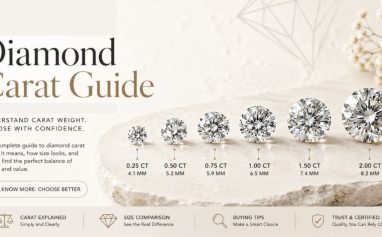
Walk into any jewelry store, and there is one word that gets asked about before anything else. Not cut. Not clarity. Carat.It makes sense. Carat... Continue reading
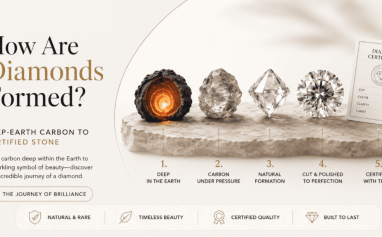
Every natural diamond you have ever seen began as carbon buried between 150 and 700 kilometres beneath your feet, crushed under pressures that would flatten... Continue reading
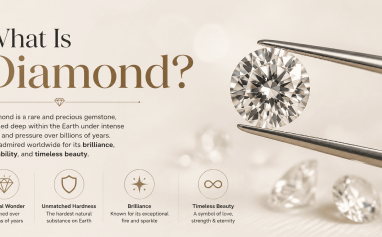
What Is a Diamond? A diamond is a mineral made of a single element – carbon – in which every carbon atom is covalently bonded... Continue reading