No products in the cart.

What Is a Diamond? Complete 2026 Guide
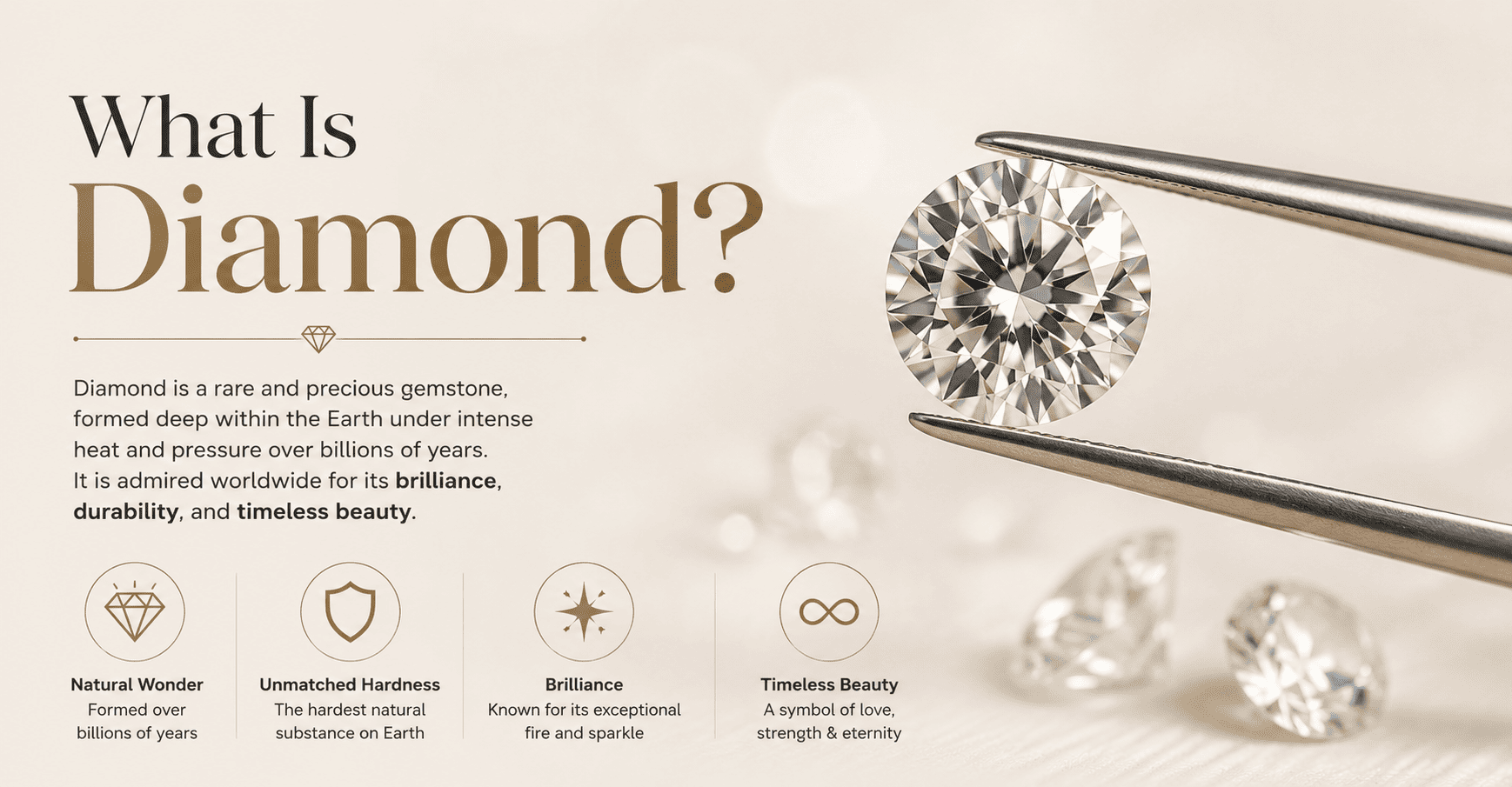
What Is a Diamond?
A diamond is a mineral made of a single element – carbon – in which every carbon atom is covalently bonded to four neighbouring carbon atoms in a rigid, three-dimensional tetrahedral lattice. That structure is the reason a diamond is the hardest known natural material, rated 10 on the Mohs scale, and the reason it handles light the way it does.
Diamonds occur in two commercial forms today, and both are genuine diamonds:
- Natural diamonds – crystallised deep in the Earth’s mantle over roughly one to three billion years and carried to the surface by volcanic eruptions.
- Lab-grown diamonds – produced in weeks in controlled reactors using High Pressure High Temperature (HPHT) or Chemical Vapour Deposition (CVD), with the same chemical composition, crystal structure, hardness and optical behaviour.
The difference between them is origin, rarity and price – not authenticity. A lab-grown diamond is not a simulant. Cubic zirconia and moissanite are simulants; they are different materials that merely look similar.
The Scientific Definition of a Diamond
Mineralogically, diamond is a crystalline allotrope of carbon. Graphite, graphene, and fullerenes are also pure carbon, yet graphite is soft enough to write with. The entire difference is how the atoms are joined.
Why the Structure Matters
In graphite, carbon atoms bond to three neighbours in flat sheets that slide over one another. In diamond, each atom bonds to four neighbours in a tetrahedron, and those tetrahedra repeat in a face-centred cubic arrangement. There is no weak direction in that lattice and no plane to slide along, so the crystal resists deformation extraordinarily well.
The same tight lattice gives diamond a very high refractive index of about 2.42 and strong dispersion of about 0.044. Light entering a well-cut diamond slows sharply, bounces internally off the pavilion facets, and exits through the crown – producing brightness (white light return), fire (spectral colour), and scintillation (sparkle in motion).
In short: a diamond is not rare because it is beautiful. It is beautiful because of an atomic arrangement that also happens to be difficult for nature to produce.
How Natural Diamonds Form
Natural diamond formation requires a narrow set of conditions that exist in very few places on the planet.
| Condition | Requirement | Why It Matters |
| Depth | 140–200 km below the surface | Only the lithospheric mantle sustains the required environment |
| Pressure | Approx. 45-60 kilobars | Forces carbon into the dense cubic lattice rather than graphite |
| Temperature | Approx. 900-1,300 °C | Hot enough for atoms to reorganise, cool enough to stay stable |
| Time | Roughly 1–3.5 billion years | Most diamonds are older than the majority of surface rock |
| Delivery | Kimberlite/lamproite eruptions | Magma carries crystals upward fast enough to prevent reversion to graphite |
That last point is underrated. Diamonds are only metastable at surface conditions – the eruption that delivers them must travel at speed, sometimes estimated in the tens of kilometres per hour, or the crystals would convert back toward graphite on the way up. Vertical kimberlite pipes are the resulting ore bodies, and they are the basis of most primary diamond mining in Botswana, Russia, Canada, South Africa and Angola.
Secondary deposits – alluvial diamonds – occur where erosion has released stones from their host rock and rivers have concentrated them downstream. Namibia’s marine deposits are the best-known example.
Diamond Properties at a Glance
| Property | Value | Practical Consequence |
| Composition | Carbon (C), typically 99.95%+ | Trace elements create colour: nitrogen → yellow, boron → blue |
| Crystal system | Cubic (isometric) | Symmetrical growth; octahedral rough crystals |
| Mohs hardness | 10 (highest of any natural mineral) | Only a diamond scratches a diamond; ideal for daily wear |
| Toughness | Good, not perfect | Cleavage planes mean a sharp knock can chip a stone |
| Specific gravity | 3.52 | Used in rough sorting and separation |
| Refractive index | 2.417 | High brilliance and total internal reflection |
| Dispersion | 0.044 | The rainbow “fire” seen in well-cut stones |
| Thermal conductivity | Up to ~2,200 W/m·K | Best of any bulk material; used in diamond testers and electronics |
| Electrical conductivity | Insulator (boron-doped types conduct) | Basis of emerging semiconductor research |
| Melting point | ~3,550 °C (under pressure) | Burns in oxygen above ~700 °C |
The 4Cs of Diamond Quality
The diamond 4Cs are the universal grading framework introduced by the Gemological Institute of America (GIA) in the 1950s. They remain the language of the trade for natural diamonds.
| The C | Scale | What It Controls | Buyer Priority |
| Cut | Excellent → Poor | Proportions, symmetry and polish – how efficiently light returns | Highest. Cut governs beauty more than any other factor |
| Colour | D (colourless) → Z (light yellow) | Absence of body tint in white diamonds | G–I offers near-colourless appearance at meaningful savings |
| Clarity | FL → I3 | Size, number and position of inclusions and blemishes | VS2–SI1 is usually eye-clean; paying for FL rarely shows |
| Carat | Weight, 1 ct = 0.20 g | Mass, not size – spread depends on cut | Buy just under milestones (0.90, 1.90 ct) for better value |
The Fifth C: Certification
Many in the trade now treat certification as a fifth C. An uncertified stone is priced on trust; a certified stone is priced on evidence. For anything above roughly 0.30 ct, insist on a report from GIA or IGI.
Cut is Where Most Buyers Get the Trade-off Wrong
If your budget forces a compromise, protect Cut first. A D-colour, flawless stone with poor proportions will look duller than a G-colour, SI1 stone cut to excellent proportions – and it will cost considerably more. Colour and clarity are graded under magnification in controlled lighting; cut is what you actually see across a dinner table.
Diamond Shapes and Cuts
“Shape” describes the outline; “cut” describes the faceting and proportions. Round brilliants have the most researched light performance; fancy shapes trade some brilliance for individuality and, usually, a lower price per carat.
| Shape | Character | Notes |
| Round brilliant | 57–58 facets, maximum brilliance | Highest demand, therefore highest price per carat |
| Oval | Elongating, appears larger per carat | Watch for the “bow-tie” shadow across the centre |
| Emerald | Step-cut, hall-of-mirrors clarity | Inclusions show – favour VS2 or better |
| Pear | Asymmetric, distinctive | Symmetry of the point is critical |
| Cushion | Soft square, strong fire | Popular in vintage and halo settings |
| Marquise | Maximum apparent size per carat | Efficient use of elongated rough |
| Radiant | Brilliant faceting in a rectangle | Hides inclusions better than emerald |
| Princess | Sharp square brilliant | Corners need protective settings |
| Asscher | Square step-cut, art-deco | Rewards high clarity and colour |
| Rose cut / rustic | Flat back, domed facets | Common in salt & pepper and antique-style jewellery |
Natural vs Lab-Grown Diamonds in 2026
This is now the single most consequential decision a diamond buyer makes, and it is worth being precise about what actually differs.
| Factor | Natural Diamond | Lab-Grown Diamond |
| Chemical composition | Carbon | Carbon – identical |
| Hardness | 10 Mohs | 10 Mohs – identical |
| Optical behaviour | Identical brilliance and fire | Identical brilliance and fire |
| Formation time | 1-3.5 billion years | Weeks to a few months |
| Method | Mantle crystallisation, volcanic delivery | HPHT or CVD reactor |
| Detection | Requires specialist equipment | Growth patterns and strain identify origin |
| Supply | Finite, mining at multi-decade lows | Effectively unlimited industrial capacity |
| 1 ct benchmark (2026) | Roughly $4,000–6,000 retail (G/VS2) | Roughly $800–1,500 retail (G/VS2) |
| Price trajectory | Stabilising after correction | Still falling, approaching a production floor |
| Resale | Historically ~20-60% of retail | Typically ~10-40% of retail |
| Best suited to | Heirloom value, rarity, scarcity narrative | Maximum size and quality per dollar |
Read Next:- Natural Vs Lab Diamond – the full comparison.
The size effect nobody predicted
The most visible consequence of lab-grown pricing is not savings – it is scale. Average lab-grown centre stones have moved from roughly 1.3 ct in 2019 to 2.5 ct and above by 2026. Buyers largely did not pocket the difference; they bought bigger. Lab-grown stones now sit in roughly half of new engagement rings in the United States, depending on the survey.
Which should you choose?
There is no universally correct answer, and any supplier who gives you one is selling rather than advising. Choose natural if provenance, geological rarity and long-horizon value retention matter to you. Choose lab-grown if you want the largest, cleanest, best-cut stone your budget allows, and you regard jewellery as something to wear rather than something to liquidate. OM Jewels Inc supplies both, and we will quote both against the same specification so you can compare honestly.
Types of Diamonds Beyond White
The colourless round brilliant dominates the mainstream, but it represents a narrow slice of what diamonds actually are. This is the part of the market OM Jewels Inc has specialised in since 2018.
Salt and Pepper Diamonds
Salt and pepper diamonds contain visible black and white inclusions distributed through the stone – carbon, graphite, and mineral crystals that conventional grading treats as flaws. Under a different aesthetic, they read as galaxies, static or smoke. No two are alike; each stone is genuinely one of one, and they have become the defining material of alternative bridal and independent designer jewellery. Our salt and pepper diamond guide covers pricing and selection in detail.
Black Diamonds
Also called carbonado in its polycrystalline natural form, black diamond owes its opacity to dense graphite and mineral inclusions rather than a body colour. Polished black diamonds have a metallic lustre rather than transparency, and pair strikingly with white metals and with white diamond accents.
Rustic and Icy Diamonds
Rustic diamonds are heavily included, translucent to opaque stones – often rose-cut or hexagonal – with a soft, frosted, “icy” appearance. They sit between salt and pepper and traditional white in look and price.
Fancy Coloured Diamonds
| Colour | Cause | Rarity |
| Yellow / canary | Nitrogen substitution in the lattice | Most common fancy colour |
| Brown/champagne | Lattice distortion (plastic deformation) | Widely available |
| Blue | Boron impurities | Very rare in nature |
| Pink | Structural distortion; cause still debated | Extremely rare; Argyle closure reduced supply |
| Green | Natural radiation exposure near the surface | Rare, often surface-limited colour |
| Red | Same mechanism believed as pink, intensified | The rarest – a few dozen known stones |
Diamond Certification: GIA, IGI and the 2025 Rule Change
A grading report is an independent laboratory’s assessment of a stone. It is the difference between buying a diamond and buying a description of one.
| Laboratory | Position in the market | Notes |
| GIA | The reference standard for natural diamonds | Created the 4Cs; strictest and most conservative grading |
| IGI | Dominant for lab-grown certification | Very widely used in India and for LGD inventory |
| AGS | Historic cut-grading authority | Cut science now integrated into GIA operations |
| HRD | European laboratory (Antwerp) | Common in EU trade |
| In-house/seller reports | Not independent | Treat as marketing, not verification |
Before you buy: read our guide on how to verify a diamond certificate and match the report to the stone in front of you.
The change you need to know about
On 1 October 2025, GIA stopped applying 4Cs nomenclature to laboratory-grown diamonds. Instead of colour and clarity letter grades, lab-grown submissions are now described using broader descriptive tiers. The reasoning was that lab-grown production has become so consistent that the vast majority of stones cluster into a very narrow grading band, so letter grades were no longer meaningfully separating one stone from another – and were encouraging false equivalence with natural pricing.
Practical effect: if you are comparing a GIA-reported lab-grown stone issued after October 2025 against an older IGI report using traditional letter grades, you are not comparing like with like. Ask your supplier to explain exactly which system a given report uses.
Diamond Market Update 2026
Any honest guide written in 2026 has to address the fact that the diamond industry is in the middle of the most significant structural change in its modern history. Here is the current position, as of August 2026.
De Beers is being sold
Anglo American, which holds an 85% stake in De Beers, has been running a divestment process since 2024. Reporting in July 2026 identified a preferred bidder – a consortium led by former De Beers chief executive Gareth Penny, reported to include the governments of Namibia and Angola alongside major diamond traders. The structure discussed publicly is around $1 billion, with roughly $750 million upfront and a further $250 million later. Botswana, which holds the remaining 15%, is reported to be seeking a larger share. Anglo American has said it is not in exclusive talks with any single party and is targeting completion by the end of 2026.
Check also Diamond price in 2025-2026
For context on the scale of the repricing: De Beers carried a book value of about $2.3 billion at the end of 2025, after three consecutive years of write-downs totalling roughly $6.8 billion. Anglo American paid close to $13 billion for the Oppenheimer family stake in 2011.
Production and trading conditions
| Metric | Latest reported figure | Comparison |
| De Beers H1 2026 revenue | $1.6 billion | Down from $2.0 billion in H1 2025 |
| H1 2026 rough diamond sales | $1.3 billion | Down from $1.7 billion |
| H1 2026 EBITDA loss | $113 million | Loss narrowed roughly 40% year on year |
| H1 2026 rough production | 14.9 million carats | Up 46% from 10.2 million carats |
| FY2025 avg. realised rough price | $142 per carat | Down 7% year on year |
| 2026 production guidance | 21-26 million carats | Cut from 26-29 million carats |
| Global mine production | Roughly 100 million carats a year | Multi-decade low |
| Venetia mine (South Africa) | Two-year production pause | Announced 13 July 2026 |
The bifurcation
The pattern running through all of this data is a split, not a collapse. Large, high-quality and genuinely rare natural stones have held their value. Small and commercial-grade natural goods – the segment lab-grown diamonds directly substitute for – have been squeezed hard. De Beers itself has described demand for larger, higher-quality natural diamonds as resilient while smaller and lower-quality goods face pricing pressure from synthetics.
On the lab-grown side, production capacity expanded dramatically between 2020 and 2023, wholesale inventories built up, and prices fell accordingly. A 1 ct lab-grown stone that averaged around $3,410 per carat in 2020 was averaging in the mid-hundreds by mid-2026 on major retail analytics platforms. Most analysts now believe premium lab-grown pricing has reached or is approaching a production-cost floor, which is why the “wait, and it will get cheaper” strategy has largely stopped working.
One further signal worth noting: the 1 ct Rapaport index was flat in July 2026, breaking a run of consecutive monthly declines. One month is not a trend, but it is the first sign of stabilisation the natural market has had in some time.
Diamond Prices in 2026
Prices below are indicative retail benchmarks for round brilliants in the G-H colour, VS clarity, excellent cut range, in USD, as of Q3 2026. Actual pricing depends on certification, origin, shape, fluorescence, and supply channel. Wholesale pricing is materially lower – contact us for current inventory quotes.
| Size | Natural (indicative retail) | Lab-Grown (indicative retail) | Approx. gap |
| 0.50 ct | $1,400 – $2,200 | $350 – $600 | ~75% |
| 1.00 ct | $4,000 – $6,000 | $800 – $1,500 | ~80% |
| 1.50 ct | $8,000 – $12,000 | $1,200 – $2,200 | ~82% |
| 2.00 ct | $14,000 – $22,000 | $1,700 – $3,000 | ~85% |
| 3.00 ct | $30,000 – $55,000 | $2,800 – $5,500 | ~88% |
Note: these are guide ranges compiled from published 2026 market analysis, not a quotation. Fancy shapes typically price 10–30% below rounds at equivalent specification. Salt and pepper, rustic and black diamonds are priced by character and rarity rather than by the 4Cs, and are quoted individually.
Diamonds Beyond Jewellery
Roughly 30% of the volume of mined diamonds and a growing share of lab-grown output never enter jewellery at all. The properties that make diamond attractive in a ring make it indispensable in industry.
- Cutting, grinding and drilling – diamond-tipped saws, drill bits and abrasives for stone, concrete, ceramics and metals.
- Semiconductors and thermal management – diamond’s exceptional thermal conductivity makes it a candidate substrate for high-power electronics, an application many analysts expect to underpin long-run lab-grown demand.
- Optics – diamond windows for high-power lasers and infrared systems that would destroy conventional materials.
- Quantum technology – nitrogen-vacancy centres in diamond are used in quantum sensing and quantum computing research.
- Medical and surgical – diamond-edged scalpels and precision instruments.
- Scientific research – diamond anvil cells generate the extreme pressures used to study planetary interiors.
How to Buy a Diamond: A 7-Step Checklist
- Fix your budget and your non-negotiable first. Decide whether size, certification, origin, or setting quality matters most before you look at any stone.
- Choose natural or lab-grown deliberately. Decide based on what you want from the stone, not on which one a salesperson leads with.
- Protect the cut. Buy Excellent or Ideal cut on rounds, and check for bow-tie shadows and even light return on fancy shapes.
- Buy eye-clean, not flawless. VS2 to SI1 is usually invisible without magnification and saves a substantial percentage.
- Insist on independent certification. GIA or IGI for anything above roughly 0.30 ct, and confirm which grading system the report uses.
- Check the report against the stone. Match the laser inscription on the girdle to the report number. Reputable suppliers expect this request.
- Confirm returns, insurance, and the setting. Ask about the return window, appraisal for insurance, and whether the setting protects vulnerable points and corners.
We would recommend working through the complete diamond buying guide before you approach any seller, as the channel you choose affects the price as much as the stone itself.
Diamond Care and Cleaning
A diamond is the hardest natural material, but hardness is not the same as indestructibility. Diamonds have cleavage planes, and a hard knock at the wrong angle can chip one.
- Clean with warm water, a drop of mild dish soap and a soft toothbrush; rinse and dry with a lint-free cloth.
- Avoid chlorine, bleach and abrasive cleaners – these attack the metal in the setting rather than the stone.
- Remove rings for gym sessions, heavy lifting, gardening and cleaning.
- Store pieces separately. A loose diamond in a jewellery box will scratch every other gemstone it touches.
- Have prongs checked professionally once a year – most stone losses are setting failures, not stone failures.
- Use ultrasonic cleaners with caution; heavily included stones, including salt and pepper diamonds, are better cleaned by hand.
Frequently Asked Questions
Is a lab-grown diamond a real diamond?
Yes. A lab-grown diamond is chemically, physically, and optically identical to a mined diamond. It differs in origin, not in substance. Simulants such as cubic zirconia and moissanite are different materials entirely.
Can you tell a lab-grown diamond apart by eye?
No. Neither can a jeweller with a loupe. Identification requires specialist instruments that read growth patterns, strain and trace elements, which is exactly why certification matters.
Why are natural diamonds more expensive?
Geological scarcity and extraction cost. Global mine production has fallen to roughly 100 million carats a year, major deposits are maturing with declining ore grades, and discoveries are increasingly difficult. Lab-grown production, by contrast, scales with reactor capacity.
Do diamonds hold their value?
Natural diamonds retain value better than lab-grown, but neither should be bought as a financial investment. Retail markup means most stones resell well below purchase price. Large, rare, and high-quality natural stones are the exception.
What is a salt and pepper diamond?
A natural diamond with visible black and white inclusions throughout. Traditional grading treats those inclusions as flaws; the alternative bridal market treats them as the point. Every stone is unique.
What does carat actually measure?
Weight, not size. One carat is 0.20 grams. Two stones of identical carat weight can look noticeably different in size depending on cut proportions and shape.
Are diamonds rare?
Small, included, commercial-grade diamonds are not especially rare. Large, high-colour, high-clarity natural stones genuinely are – and that is where natural pricing has held up best through the recent correction.
What is the most important of the 4Cs?
Cut. It determines how much light the stone returns to the eye and therefore how beautiful it looks. Colour and clarity differences are frequently invisible without magnification; a poor cut is visible immediately.
Is now a good time to buy?
For natural diamonds, prices have corrected significantly from their 2022 peak and are showing early signs of stabilising, so current pricing is favourable relative to recent years. For lab-grown, prices have largely reached a production floor, so waiting for a further collapse is no longer a sound strategy.
What certification should I insist on?
GIA or IGI. Verify the report number online, and match the laser inscription on the girdle to the certificate.
About OM Jewels Inc
Established in 2018, OM Jewels Inc is a first-generation diamond import company founded by Navneet Suhagiya. The company began by importing diamonds from India and expanded globally, and in mid-2019 partnered with a leading Indian diamond manufacturer. That partnership led to our defining capability: customising diamonds to individual customer specifications.
Demand grew quickly from jewellery designers, jewellery manufacturers and independent jewellers across the United States. Today OM Jewels Inc is a supplier of polished and rough diamonds with both wholesale and retail operations, based in the New York Diamond District.
What we supply
| Category | Detail |
| Natural diamonds | Round and fancy shapes, pairs inventory, layouts, loose diamonds |
| Salt and pepper diamonds | Our specialty – one of the few dedicated dealers in the market |
| Black diamonds | Polished black and carbonado-character stones |
| Rustic diamonds | Icy, translucent and heavily included character stones |
| Lab-grown diamonds | Fancy shapes, pairs inventory, layouts, loose diamonds |
| Certified & non-certified | GIA and IGI certified stones plus non-certified inventory |
| Services | Custom diamond sourcing to specification, matched pairs, layouts, wholesale supply |
Our Vision
Envisioning brilliance: elevating trust, knowledge and quality in diamonds. We are committed to putting customer contentment, education and community enrichment at the centre of how we operate – and to comprehensive diamond education that lets customers make decisions aligned with their own taste rather than someone else’s sales target.
Our Mission
We are proud to be among the leading dealers in the salt and pepper diamond sector, one of the very few specialists in the market. As direct manufacturers, we offer an extensive selection spanning salt and pepper, matched pairs, white, rustic, round, and fancy diamonds. We understand that diamond pricing fluctuates, and we are committed to giving our customers the most competitive rates available.
Why buy from OM Jewels Inc
- Direct manufacturer pricing – we source and manufacture rather than resell through layers of intermediaries. (150$ OFF ON UPTO 1500$ PURCHASE)
- Ethically sourced, high-quality diamonds at budget-friendly prices.
- Genuine specialisation in salt and pepper, black and rustic diamonds, not a token selection.
- Both natural and lab-grown supplied – we quote both against the same specification.
- Wholesale and retail facilities, with a dedicated wholesale account channel.
- Leadership by Navneet Suhagiya and Ajay Suhagiya, Co-CEOs.
Contact OM Jewels Inc
Looking for a specific stone, a matched pair, a layout, or wholesale supply? Our team will source to your specifications.
| Details | |
| Company | OM Jewels Inc |
| Founded | 2018 — Founder: Navneet Suhagiya |
| Leadership | Navneet Suhagiya, CEO | Ajay Suhagiya, CEO |
| Address | 20 W 47th St, Suite 405, New York, NY 10036, United States |
| Phone | +1 201 680 1878 |
| Phone (alt) | +1 917 639 3354 |
| +1 917 639 3354 | |
| info@omjewelsinc.com | |
| Website | https://omjewelsinc.com |
| Wholesale accounts | https://omjewelsinc.com/my-account/ — select “Continue as Wholesaler” |
| instagram.com/omjewelsinc | |
| facebook.com/profile.php?id=61551914615436 | |
| linkedin.com/company/om-jewels-inc | |
| in.pinterest.com/omjewelsinc | |
| YouTube | youtube.com/@omjewelsinc |
Related posts
When people talk about diamonds, they often focus on carat, color, and clarity. But the way a diamond is cut can have an equally important... Continue reading
Why Fancy Shape Diamonds Are the Growth Story of 2026 For most of the last century, the round brilliant was the default. It still holds... Continue reading
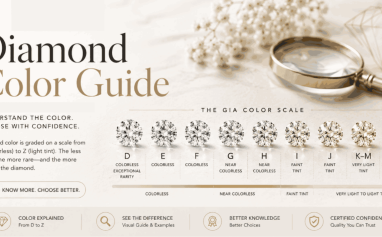
What Diamond Color Actually Measures Diamond color is one of the 4Cs, and it is the one buyers most often misunderstand. For white diamonds, the... Continue reading
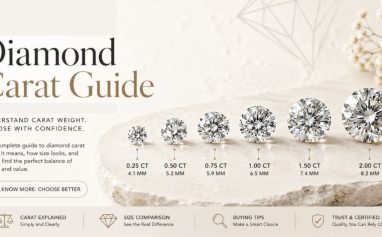
Walk into any jewelry store, and there is one word that gets asked about before anything else. Not cut. Not clarity. Carat.It makes sense. Carat... Continue reading
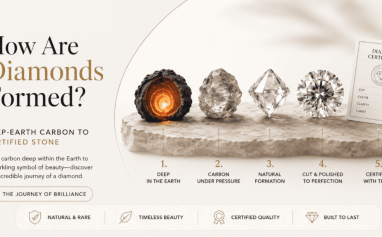
Every natural diamond you have ever seen began as carbon buried between 150 and 700 kilometres beneath your feet, crushed under pressures that would flatten... Continue reading