
No products in the cart.

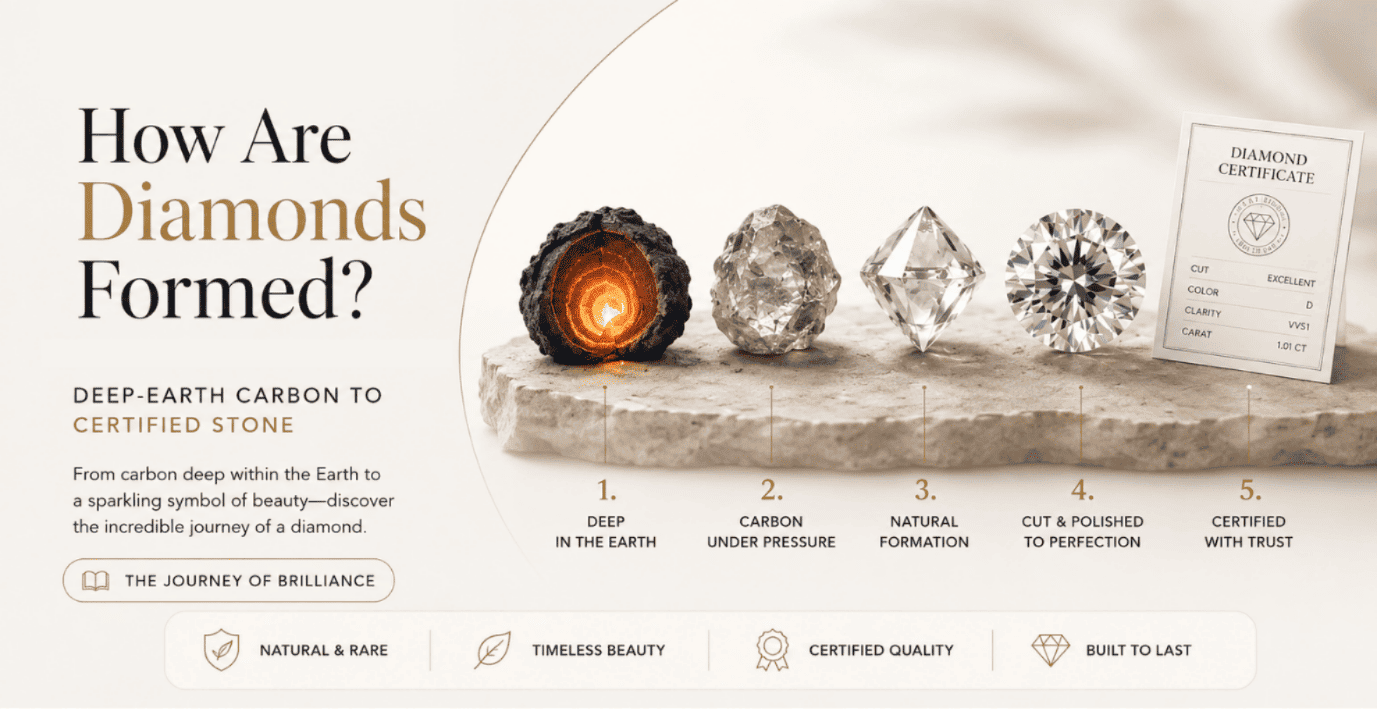
How Are Diamonds Formed? Deep-Earth Carbon to Certified Stone
Every natural diamond you have ever seen began as carbon buried between 150 and 700 kilometres beneath your feet, crushed under pressures that would flatten a submarine and heated to temperatures above the melting point of steel. Most of them are older than the continents they were found under. Some are older than complex life itself.
This guide explains exactly how that happens – the geology, the chemistry, the violent volcanic ride to the surface, and what brand-new research published in 2026 has just revealed about the origins of the world’s largest gems. We also cover how laboratory diamonds compress the same chemistry into a matter of weeks, and why formation history quietly determines the price on the tag.
What a Diamond Actually Is
A diamond is one element and nothing else: carbon. What separates it from the graphite in a pencil is not composition but architecture. In graphite, carbon atoms bond in flat sheets that slide over one another. In diamond, every carbon atom bonds covalently to four neighbours in a rigid three-dimensional tetrahedral lattice, with no weak direction anywhere in the structure.
That lattice is why diamond sits at 10 on the Mohs hardness scale and refracts light with the fire that makes it a gemstone. It is also why diamond only forms where nature can supply extraordinary pressure: the arrangement is dense, and density costs energy. For a broader primer on the mineral itself, see our guide to what a diamond is, or the GIA diamond description.
The Four Conditions Diamonds Require
Natural diamond formation is not a single event but a narrow window of conditions that must all hold at once. Miss any one, and you get graphite, carbonate, or nothing at all.
| Condition | Requirement | Why It Matters |
| Pressure | 45–60 kilobars and above (roughly 50,000× surface pressure) | Forces carbon into the dense tetrahedral lattice instead of flat graphite sheets |
| Temperature | 900–1,300 °C in the lithosphere; up to ~2,000 °C deeper | Too cold and carbon will not reorganise; too hot and the crystal dissolves back into melt |
| Carbon source | Carbonate melts, methane-rich fluids, or subducted organic carbon | Supplies the raw atoms – often recycled from ancient seafloor |
| Time & stability | Millions to billions of years in undisturbed mantle | Crystals grow slowly, layer by layer; tectonic disturbance destroys them |
Radiometric dating of mineral inclusions places most gem diamonds between roughly 1 billion and 3.5 billion years old. The rock that carried them upward is, by comparison, geologically young – often less than 150 million years.
Where Diamonds Form: Earth’s Cratonic Keels
Diamonds are not distributed evenly. The overwhelming majority of gem-quality natural stones form beneath cratons – the ancient, thick, cold cores of continents that have resisted deformation for billions of years. Beneath each craton hangs a deep root of rigid mantle called a keel, extending 150 to 250 kilometres down.
These keels are the ideal nursery: cold enough to keep diamond stable, old enough to allow slow growth, and rigid enough to shield crystals from convecting mantle. This is why productive mines cluster on Archean cratons in Southern Africa, Siberia, Western Australia and northern Canada – and why most of the planet will never yield a diamond mine.
The Three Depth Zones
| Zone | Depth | What Forms There |
| Lithospheric mantle | ~150-200 km | The bulk of commercial gem diamonds; peridotitic and eclogitic types |
| Mantle transition zone | ~410-660 km | Sublithospheric “superdeep” diamonds, including CLIPPIR giants like the Cullinan |
| Lower mantle | ~660-800 km | Rare superdeep stones carrying minerals never found intact at the surface |
How Carbon Becomes Diamond: The Four Pathways
Pathway One – Mantle Fluid Crystallisation
The dominant route. Carbon-bearing fluids – carbonate-rich, methane-rich, or saline brines – migrate through mantle rock. Where they meet host rock at the right pressure, temperature and oxidation state, carbon precipitates as diamond, growing in fits and starts. Growth layers within a single stone can be separated by hundreds of millions of years.
Pathway Two – Subduction Recycling
Where oceanic plates dive beneath continents, they drag down seafloor sediment, altered basalt and carbonate shells. That surface carbon descends into the mantle and can recrystallise as diamond. Carbon isotopes confirm it: many eclogitic and superdeep diamonds carry the light-carbon fingerprint of once-living organisms. In a real sense, some diamonds are recycled biology.
Pathway Three – Impact Shock
A large meteorite strike generates instantaneous pressures far beyond mantle conditions, converting graphite in the target rock directly to diamond within microseconds. Siberia’s Popigai crater holds vast quantities – but they are tiny, polycrystalline and industrial rather than gem material.
Pathway Four – Extraterrestrial Formation
Nanodiamonds occur in meteorites and in interstellar dust, formed in stellar outflows and supernova shocks. They predate the Solar System. Scientifically extraordinary; commercially irrelevant.
Explore the category further in our salt and pepper diamond guide, or browse black diamond inventory.
The Ride to the Surface: Kimberlite Eruptions
Forming a diamond is only half the story. Diamond is metastable at the surface – given enough heat and time at low pressure, it will revert toward graphite. For a diamond to survive the trip up, the ascent must be extraordinarily fast.
That transport is provided by kimberlite, a volatile-charged magma that rises from the deep mantle through narrow fractures, tearing loose fragments of mantle rock – and any diamonds inside them – on the way. As dissolved carbon dioxide and water exsolve near the surface, the magma accelerates violently, punching a carrot-shaped pipe through the crust.
Estimated ascent speeds run from several to tens of metres per second, carrying cargo from 150 kilometres down to the surface in hours. Slower magmas, such as most basalts, cook their diamonds into graphite en route. Hence the rarity of diamond deposits: they need both a stable ancient keel to grow the crystals and a fast, volatile-rich eruption to deliver them intact.
Learn diamond ratio – length to width for every shape
What New Research Revealed in 2025–2026
Diamond genesis is an unusually active research field right now, largely because high-resolution instruments can finally analyse mineral inclusions only microns across. Several findings published in the past eighteen months have changed the picture.
The Origin of the World’s Largest Diamonds
In April 2026, a University of Cape Town-led team publishing in Nature Communications, working with the Carnegie Institution for Science and the China University of Geosciences, resolved a long-standing puzzle about CLIPPIR diamonds – the Cullinan-like, large, inclusion-poor, pure, irregular, resorbed category that includes the most valuable rough ever recovered.
By using olivine chemistry in kimberlite as a window into the deep mantle, the team found that CLIPPIR-bearing kimberlites consistently sample unusual iron-rich domains at the base of the lithosphere, more than 150 kilometres down. Those domains carry light-oxygen and heavy-iron isotopic signatures characteristic of hydrothermally altered oceanic crust – seafloor that was subducted, carried deep, and then accreted beneath the continent by buoyant mantle upwelling.
The diamonds themselves crystallised in that iron-rich substrate at pressures above 11 GPa, within the mantle transition zone. The finding also offers explorers a chemical signature to prospect against, with under-characterised kimberlites in regions such as Sierra Leone and Angola flagged as promising.
Recommended for you: our complete Diamond Price Guide 2025–2026
Water as a Diamond Catalyst
Experimental work published in the Journal of Geophysical Research: Solid Earth in 2026 subjected carbon-13-enriched dolomite to conditions spanning 14–120 GPa and 1,500–2,800 K. Compared with dry conditions, where carbonate breakdown is sluggish, hydrous environments dramatically accelerated decarbonation and actively promoted diamond formation. Water, in other words, is not incidental to deep diamond growth – it is a catalyst.
Buy Wholesale Diamond Enjoy $150 OFF
Diamonds as Deep-Earth Data Recorders
Two further 2026 results underline why geologists prize diamonds as sealed sample capsules. Work presented at the Goldschmidt 2026 Conference described super-deep diamonds containing tuite and stishovite, showing that phosphorus can reach roughly 700 kilometres depth – but only through unusually cold subduction zones near 1,100 °C rather than the typical 1,700 °C.
And in August 2026, researchers reported a super-deep diamond preserving an isolated inclusion of goethite with hematite and magnetite, evidence that water-bearing iron oxyhydroxide can survive lower-mantle conditions.
| Finding | Published | Significance |
| CLIPPIR diamonds grew in an iron-rich substrate from subducted oceanic crust | Nature Communications, April 2026 | Explains the origin of the largest gems and provides an exploration signature |
| Water accelerates carbonate breakdown and promotes diamond growth | J. Geophys. Res.: Solid Earth, 2026 | Reframes hydration as an active driver of deep diamond formation |
| Phosphorus reaches ~700 km only via cold subduction | Goldschmidt Conference, June 2026 | Links slab temperature to deep carbon and nutrient cycling |
| Goethite inclusion preserved in a super-deep diamond | Reported August 2026 | Shows water-bearing minerals persist into the lower mantle |
Lab-Grown Diamonds: The Same Chemistry, Compressed
A laboratory-grown diamond is a real diamond. Same carbon, same lattice, same hardness, same optical behaviour. What differs is the timeline and the address. Two methods dominate production.
HPHT – High Pressure, High Temperature
A press reproduces mantle conditions directly at roughly 5–6 GPa and 1,300–1,600 °C. A diamond seed sits in molten metal flux saturated with carbon; carbon atoms migrate to the cooler seed and crystallise. Growth takes days to weeks.
CVD – Chemical Vapour Deposition
In a low-pressure chamber, methane and hydrogen are energised into plasma. Carbon atoms rain onto a flat seed plate, building the crystal layer by atomic layer. CVD offers finer control over purity and produces most large, high-clarity lab stones today; many receive post-growth HPHT treatment to improve colour.
| Factor | Natural Diamond | Lab-Grown Diamond |
| Formation time | 1–3.5 billion years | Days to a few weeks |
| Location | 150–700 km below cratons | HPHT press or CVD reactor |
| Pressure | 45–60+ kilobars | ~5–6 GPa (HPHT); near-vacuum (CVD) |
| Carbon source | Mantle fluids, recycled crust | Graphite flux or methane gas |
| Composition | 100% carbon | 100% carbon (identical) |
| Identification | Growth patterns, inclusions, N aggregation | Growth striae, fluorescence, detectable by lab screening |
| Supply | Finite and geologically constrained | Scalable industrial production |
Both are graded by laboratories such as GIA and IGI, and every reputable certificate explicitly states the origin. Confusion in the market is a disclosure problem, never a physics problem. For a full breakdown of the trade-offs, read our natural vs lab-grown diamond comparison.
Why Formation History Affects What You Pay
Geology is not an abstraction on the sales floor. It shows up in four concrete ways.
- Clarity. Inclusions are minerals trapped during growth – garnet, olivine, sulphides. Fewer trapped minerals means a higher clarity grade, and clarity is a direct product of how undisturbed the growth environment was.
- Colour. Nitrogen substituting into the lattice produces yellow tints; boron produces blue. Type IIa diamonds, which are nearly nitrogen-free, are exceptionally rare and command significant premiums – and CLIPPIR stones are almost exclusively type IIa.
- Size. Large rough requires an uninterrupted growth environment over vast timescales. The 2026 CLIPPIR research explains why such environments are geographically restricted, which is precisely why 100-carat-plus rough is so scarce.
- Character. Salt and pepper diamonds, black diamonds, and fancy shapes cut to preserve unusual rough all owe their appearance to formation conditions. Increasingly, buyers seek these stones for exactly the traits that were once treated as flaws.
Frequently Asked Questions
How long does it take for a diamond to form?
Natural diamonds form over one to three and a half billion years in Earth’s mantle. Laboratory diamonds achieve the same crystal structure in days to weeks using HPHT presses or CVD reactors.
How deep underground do diamonds form?
Most gem diamonds form between 150 and 200 kilometres deep in the lithospheric mantle beneath ancient cratons. Rare super-deep diamonds, including the largest gems ever found, form between roughly 360 and 800 kilometres down.
Are diamonds made from coal?
No – this is gemology’s most persistent myth. Coal is a surface deposit of compressed plant matter, and most coal is far younger than most diamonds. Diamond carbon comes from mantle fluids and carbon recycled by subduction, not from coal seams.
What is a kimberlite pipe?
A kimberlite pipe is the carrot-shaped volcanic conduit created when volatile-rich magma erupts rapidly from the deep mantle, carrying diamonds to the surface. Kimberlites are the primary commercial source of natural diamonds worldwide.
Are lab-grown diamonds real diamonds?
Yes. They are chemically, physically, and optically identical to natural diamonds. The difference is origin and timescale – which is why laboratory screening equipment, not the naked eye, is required to tell them apart, and why certification matters.
Why are large diamonds so rare?
Large diamonds require an unusually stable, carbon-rich growth environment sustained over very long periods, plus an eruption fast enough to deliver them intact. The 2026 Nature Communications study showed these conditions occur in iron-rich mantle domains found in only a handful of locations globally.
About OM Jewels Inc
OM Jewels Inc is a New York diamond house supplying trusted natural and lab-grown diamonds with quality, transparency, and global expertise. Operating from the heart of the Diamond District on West 47th Street, we serve retail clients, designers, and trade wholesalers worldwide.
- Natural diamonds – loose stones, fancy shapes, matched pairs inventory, and full layouts
- Lab-grown diamonds – certified CVD and HPHT stones across all major shapes and specifications
- Specialty categories – salt and pepper diamonds and black diamonds for designers seeking distinctive character
- Trade services – wholesale accounts, matched pairs, and consistent layout sourcing for production runs
- Education – in-house gemologists tracking market pricing weekly, with published guides on the 4Cs, lab-grown selection, and diamond identification
Our position is straightforward: the best diamond purchase is an informed one. We provide certification, transparent pricing, and honest guidance on the trade-offs between natural and lab-grown stones so you can choose on the basis of facts rather than marketing.
Contact Us
| Company | OM Jewels Inc – Natural & Lab-Grown Diamond Dealer |
| Showroom | 20 W 47th St, Suite 405, New York, NY 10036, United States |
| info@omjewelsinc.com | |
| Telephone | +1 201 680 1878 | +1 917 639 3354 |
| +1 917 639 3354 | |
| Website | www.omjewelsinc.com |
| Wholesale | Trade accounts available – request wholesale access via the website |
| Social | Facebook | Instagram @omjewelsinc | Pinterest | LinkedIn | YouTube |
Related posts

When people talk about diamonds, they often focus on carat, color, and clarity. But the way a diamond is cut can have an equally important... Continue reading

Why Fancy Shape Diamonds Are the Growth Story of 2026 For most of the last century, the round brilliant was the default. It still holds... Continue reading

What Diamond Color Actually Measures Diamond color is one of the 4Cs, and it is the one buyers most often misunderstand. For white diamonds, the... Continue reading

Walk into any jewelry store, and there is one word that gets asked about before anything else. Not cut. Not clarity. Carat.It makes sense. Carat... Continue reading

What Is a Diamond? A diamond is a mineral made of a single element – carbon – in which every carbon atom is covalently bonded... Continue reading