No products in the cart.

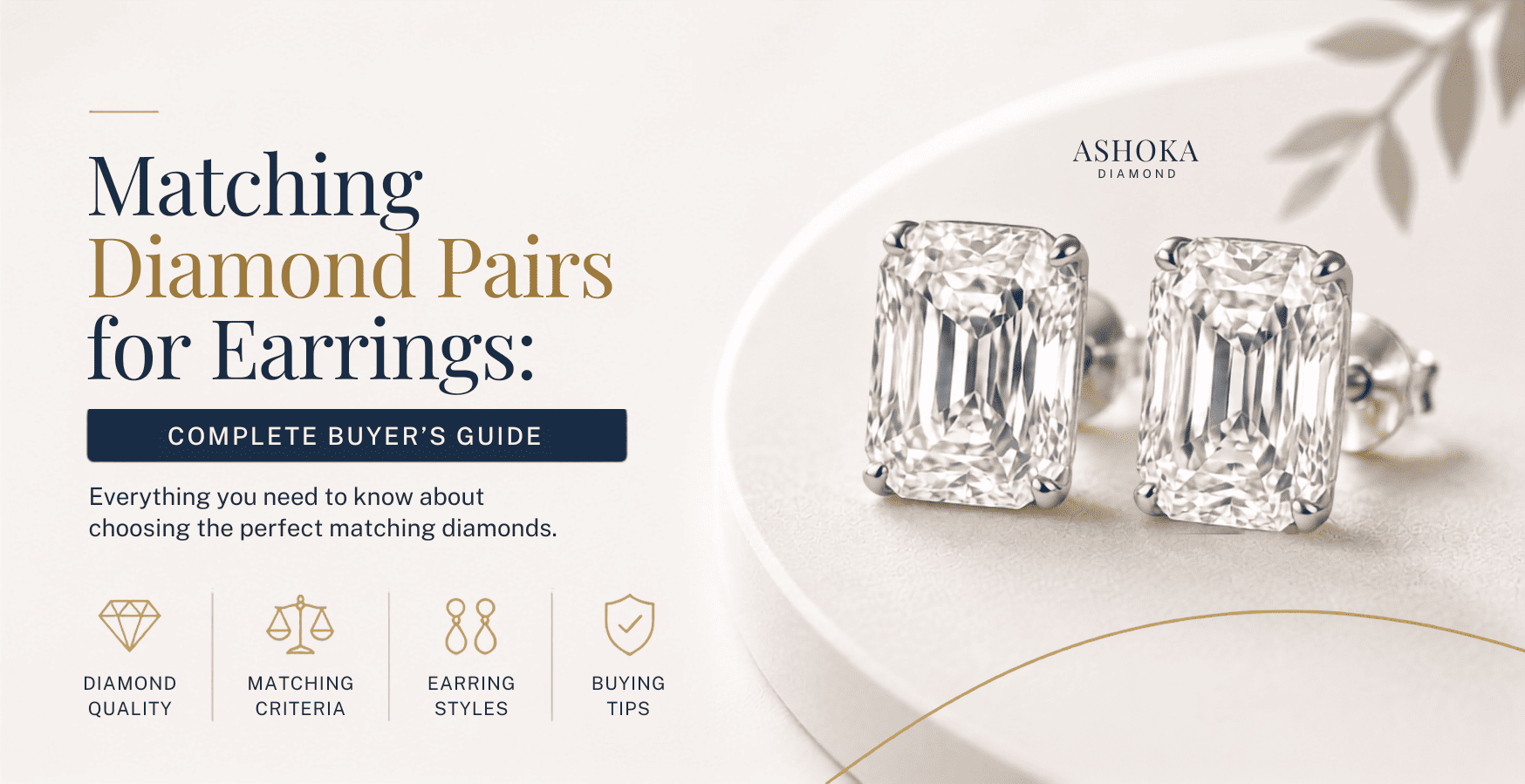
Matching Diamond Pairs for Earrings: Complete Buyer’s Guide
A pair of diamond earrings looks effortless when it is done right – two stones that face up identically, sparkle in unison, and sit perfectly level on the ear. Behind that effortless look is one of the most demanding disciplines in the diamond trade: pair matching. Finding two diamonds that agree on shape, size, color, clarity, cut, and personality is far harder than finding one beautiful stone.
This guide explains everything a buyer, jewelry designer, or manufacturer needs to know about selecting matched diamond pairs for earrings in 2026 – from the technical matching criteria to current style trends – with real inventory examples from the OM Jewels Inc Natural Diamond Pairs Inventory.
| Quick Answer: A well-matched diamond pair should be within 0.02–0.05 carats in weight, within 0.1-0.2 mm in length and width, no more than one color grade apart, and cut to the same faceting style so both stones return light identically. For earrings, face-up appearance and dimensional symmetry matter more than paper grades – which is why precision-matched pairs from a specialist inventory outperform two stones bought separately. |
Why Matched Pairs Are Harder to Source Than Single Diamonds
Every diamond is unique. Even two stones cut from the same rough will differ slightly in proportions, color saturation, and inclusion pattern. To assemble a true pair, a cutter or dealer must sift through dozens – sometimes hundreds – of candidates to find two that behave as visual twins. That is why matched pairs typically command a premium of roughly 5–15% over the combined price of two comparable single stones, and why fancy-shape pairs (kites, shields, half moons, trapezoids) are rarer still.
Specialist suppliers solve this by matching at the source. At trusted diamond dealer OM Jewels Inc, pairs are hand-selected for consistency in color, clarity, cut, and millimeter dimensions before they ever reach the catalog – the natural pairs inventory alone holds 450+ precision-matched pairs across nearly 30 shapes, from classic rounds and ovals to kite, shield, hexagonal, lozenge, half moon, trapezoid, Ashoka, and trilliant cuts.
The 6 Matching Criteria That Actually Matter
1. Shape and Outline
Both stones must share not just the same shape name but the same outline character – the same shoulder curve on pears, the same wing angle on marquises, the same belly on ovals. With geometric cuts like kites and shields, even a fraction of a degree of asymmetry is visible when the stones sit side by side on the ear.
2. Carat Weight and Millimeter Dimensions
Weight should match within 0.02–0.05 ct, but millimeter spread matters more: earrings are viewed face-up, so two stones of identical spread look matched even if their weights differ slightly. Professional pair listings always state precise dimensions – for example, a 1.49 ct I VVS2 oval pair at 6.05 × 4.45 × 3 mm – so designers can verify both stones will sit flush in identical settings.
3. Color
Stay within one grade on the GIA D-to-Z color scale (e.g., G/H). Because earrings are worn apart rather than side by side under a loupe, one-grade tolerance is invisible in wear, but two or more grades apart will read as one ‘whiter’ earring, especially in white metal settings.
4. Clarity
Clarity is the most forgiving criterion for earrings. Eye-cleanliness is the real standard: a well-placed VS2/SI1 pair looks identical to a VVS pair from conversational distance, at a meaningfully lower price. What matters is that neither stone has a visible inclusion that the other lacks.
5. Cut Style and Light Performance
Both stones must share the same faceting architecture – two brilliant cuts, two step cuts, or two rose cuts. Mixing a brilliant-cut and step-cut stone of the same shape produces obviously different sparkle. Depth percentages should also be close, so neither stone looks ‘sleepier’ than its twin.
Read the 4Cs diamond guide for detailed information about diamonds.
6. Fluorescence and Tint
Fluorescence should match (both none, or both similar strength), and undertones should agree – a faint brown tint next to a faint yellow tint is noticeable even when both stones carry the same letter grade.
| Criterion | Ideal Tolerance for Earrings | Why It Matters |
| Carat weight | Within 0.02–0.05 ct | Keeps visual mass and hang identical |
| Dimensions (L×W) | Within 0.1–0.2 mm | Face-up size is what the eye compares |
| Color | Same or adjacent grade (max 1 apart) | Prevents one earring from reading whiter |
| Clarity | Both eye-clean; same family (VS/SI) | Visible inclusions break the twin effect |
| Cut/faceting | Identical style; similar depth % | Ensures matching sparkle pattern |
| Fluorescence | Same rating (ideally none/faint) | Avoids mismatch under UV or daylight |
Diamond Matching Pairs For Unique Engagement Ring
Choosing a Shape: What’s Available and What’s Trending in 2026
Round brilliants remain the perennial choice for studs, but 2026 is decisively the year of geometric and vintage-inspired shapes. Fashion coverage this year highlights diamond earrings evolving from quiet staples into everyday statement pieces, with elongated drops, sculptural silhouettes, and antique-style cuts – emerald, marquise, and old-cut faceting with milgrain and yellow-gold settings – leading the movement. Buyers are also treating diamond earrings as daily wardrobe staples rather than occasion-only pieces.
This trend plays directly to fancy-shape pairs. Kite, shield, half moon, hexagonal, and lozenge pairs – long the domain of bespoke designers – are now among the most requested inventory categories.
| Shape | Best For | Style Character | Pair-Matching Difficulty |
| Round | Classic studs, halos | Timeless, maximum brilliance | Easiest |
| Oval | Elongated studs, drops | Elegant, finger/face-lengthening | Moderate |
| Pear | Drops and dangles | Romantic movement | Moderate–hard |
| Kite | Modern geometric studs, climbers | Architectural, edgy | Hard |
| Shield | Statement studs, deco designs | Bold, protective symbolism | Hard |
| Half Moon | Side-stone look, toi-et-moi | Soft vintage geometry | Hard |
| Hexagonal | Bezel-set minimalist studs | Clean, contemporary | Hard |
| Trapezoid | Deco drops, paired accents | Structured, linear | Hard |
| Trilliant | Sparkly geometric studs | Fiery, distinctive | Hard |
| Ashoka / Old cuts | Heirloom & vintage designs | Antique romance | Very hard |
| 2026 Trend Watch Geometric & vintage cuts: kite, hexagon, shield, and old-cut pairs pair perfectly with the milgrain and Art Deco revival. Bezel settings: the defining setting aesthetic of 2026 – full metal rims that favor clean-outlined shapes like hexagons and octagons.Elongated drops: oval and pear pairs deliver the movement-driven silhouettes dominating this year’s styling.Everyday diamonds: matched pairs are being worn casually – with denim and tees – not saved for occasions.Curated ear stacks: a matched primary pair anchored by huggies and cuffs remains the ‘ear as canvas’ formula. |
Real Examples from the OM Jewels Inc Pairs Inventory
The table below shows a representative cross-section of the live natural-diamond pairs inventory at OM Jewels Inc – note how each listing specifies total carat weight, color, clarity, and exact millimeter dimensions, the data a buyer needs to verify a true match.
| Pair | Weight | Color / Clarity | Dimensions (mm) |
| Triangular High Precision Pair | 1.60 ct | I / VVS2 | 8 × 7.5 × 1.75 |
| Octagon High Quality Pair | 1.53 ct | H / VS2 | 5.35 × 5.35 × 3.15 |
| Oval High Quality Pair | 1.49 ct | I / VVS2 | 6.05 × 4.45 × 3.0 |
| Octagon Step-Cut Premium Pair | 1.00 ct | G / VS1 | 4.6 × 4.6 × 2.7 |
| Kite Luxury Precision Pair | 0.97 ct | I / VS1 | 7.1 × 4.7 × 2.9 |
| Pentagonal High Precision Pair | 0.87 ct | F / VVS2 | 5.05 × 5.05 × 2.2 |
| Criss-Cut Ashoka Premium Pair | 0.84 ct | H / VS1 | 5.6 × 3.55 × 2.1 |
| Kite High Quality Pair | 0.80 ct | E / VVS2 | 7.4 × 4.25 × 2.8 |
| Half Moon Premium Pair | 0.76 ct | I / VVS2 | 5.8 × 3.75 × 2.15 |
| Shield Premium Pair | 0.70 ct | H / VVS2 | 7.05 × 4.1 × 2.05 |
| Hexagonal Luxury Precision Pair | 0.71 ct | G / VS2 | 4.9 × 4.3 × 2.3 |
| Trapezoid Precision Matched Pair | 0.73 ct | H / VS1 | 5.95 × 3.45 × 2.2 |
Inventory changes frequently – the pairs collection currently lists 450+ matched natural pairs, filterable by shape, carat, color (D–N plus fancy yellow), clarity, cut style, dimensions, and price. Pricing is available on request, with a wholesaler program for trade buyers.
Easy Way to Identify a Diamond
Natural vs. Lab-Grown Pairs: Which Should You Choose?
Both options are readily available as matched pairs in 2026, and both are chemically and optically identical diamonds. The decision comes down to budget, values, and long-term intent.
| Factor | Natural Diamond Pairs | Lab-Grown Diamond Pairs |
| Price | Higher; rarity-driven | Typically 50–70% less for the same look |
| Rarity & resale | Finite supply; better value retention | Abundant; minimal resale value |
| Best for | Heirlooms, investment pieces, bespoke luxury | Larger looks on a budget, trend pieces, stacks |
| Availability at OM Jewels | Dedicated natural pairs inventory (450+) | Dedicated lab-grown pairs inventory |
Step-by-Step: How to Buy a Matched Pair with Confidence
- Fix your design first. Studs, drops, halos, and climbers each favor different shapes and depths – choose the setting concept before the stones.
- Set a total budget for the pair. Remember pairs price as a unit, and fancy shapes often deliver more spread per dollar than rounds.
- Shortlist by millimeter dimensions, not just carats. Match length and width within 0.2 mm for a seamless look.
- Verify the paperwork. Ask for grading details or certificates, and confirm the color, clarity, and fluorescence of both stones together.
- Request video or side-by-side images. The stones should be filmed together under the same light – this is the fastest way to confirm they behave as twins.
- Buy from a pair specialist. A dealer who matches pairs at the source removes the biggest risk in the process: assembling a ‘pair’ from two independently sourced stones.
| Pro Tips from the Trade: For studs above 1 ct total weight, prioritize secure backs – screw backs or locking backs – over friction backs. Slightly included (SI) pairs that are eye-clean are the best value play for earrings; nobody examines earlobes with a loupe. If you plan a future upgrade or a third matching piece (pendant), buy from a supplier with deep same-shape inventory so a match can be found later. For geometric shapes in bezel settings, insist on exact outline matching — the metal rim will amplify any asymmetry. |
GIA vs IGI Certified Diamonds: Which is the best?
Caring for Your Diamond Pair
- Clean both earrings together in warm water with mild dish soap and a soft brush, so they age identically.
- Store the pair in a dedicated compartment – diamonds scratch other jewelry (and each other’s metal settings).
- Have prongs, bezels, and earring backs checked professionally once a year.
- Ensure the pair as a set; a matched pair’s value is greater than its two stones separately.
About OM Jewels Inc
OM Jewels Inc is a first-generation diamond company established in 2018 by Navneet Suhagiya, headquartered in the heart of New York’s Diamond District at 20 W 47th St, Suite 405, New York, NY 10036. Beginning as a diamond importer from India, the company partnered with a leading Indian diamond manufacturer in 2019 and built its reputation on customizing diamonds to customer requests – a service that quickly made it a trusted source for jewelry designers, manufacturers, and local jewelers across the USA.
As a direct manufacturer and supplier of both polished and rough diamonds with wholesale and retail facilities, OM Jewels Inc specializes in precision-matched pairs, salt and pepper diamonds (where it stands among the leading dealers in the market), rustic, black, white, fancy-shape, certified, and non-certified natural diamonds, alongside a full lab-grown program. The company’s mission centers on ethically sourced, high-quality diamonds at competitive prices, backed by customer education and transparency.
| OM Jewels Inc – At a Glance | |
| Founded | 2018 (first-generation diamond company) |
| Leadership | Navneet Suhagiya & Ajay Suhagiya |
| Location | 20 W 47th St, Suite 405, New York, NY 10036, USA |
| Specialties | Matched pairs, salt & pepper, fancy shapes, black, rustic, natural & lab-grown diamonds |
| Clients | Jewelry designers, manufacturers, wholesalers, and retail buyers across the USA |
| Contact | info@omjewelsinc.com | +1 201 680 1878 | +1 917 639 3354 |
| Website | omjewelsinc.com — natural & lab-grown pairs inventories, education guides, wholesale program |
Frequently Asked Questions
How closely should diamond earring pairs match in carat weight?
Within 0.02–0.05 ct is the professional standard, but matching millimeter dimensions is even more important since earrings are judged face-up.
Do both earrings need certificates?
For higher-value pairs, yes – ideally two reports confirming matching grades. For smaller pairs, a trusted supplier’s grading with clear dimensions and side-by-side imagery is standard trade practice.
Are fancy-shaped pairs more expensive than round ones?
Per carat, fancy shapes are often less expensive than rounds and offer more visual spread – but truly matched fancy pairs are rarer, so sourcing from a specialist inventory matters.
Can I buy one diamond now and match it later?
It’s possible but risky and time-consuming. Buying a pre-matched pair from a deep inventory is faster, cheaper, and guarantees the twin effect.
| Ready to Find Your Perfect Pair? Browse 450+ precision-matched natural diamond pairs – rounds, ovals, kites, shields, hexagons, half moons, and more – at the OM Jewels Inc Pairs Inventory. Request pricing on any pair, explore the lab-grown pairs collection, or contact the team at info@omjewelsinc.com / +1 201 680 1878 for custom matching. Trade buyers can register for wholesale access. |
Related posts
When people talk about diamonds, they often focus on carat, color, and clarity. But the way a diamond is cut can have an equally important... Continue reading
Every natural diamond you have ever seen began as carbon buried between 150 and 700 kilometres beneath your feet, crushed under pressures that would flatten... Continue reading
The One-Carat Obsession – and What It Costs You Ask most first-time diamond buyers what they want, and the answer is almost automatic: “a one-carat... Continue reading
Introduction If you have ever compared the price of the same diamond at a retail jewelry store and a wholesale supplier, you already know the... Continue reading
Radiant Cut Diamond Guide for Beginners: Everything You Need to Know in 2026 If you love the fiery sparkle of a round brilliant but prefer... Continue reading