No products in the cart.

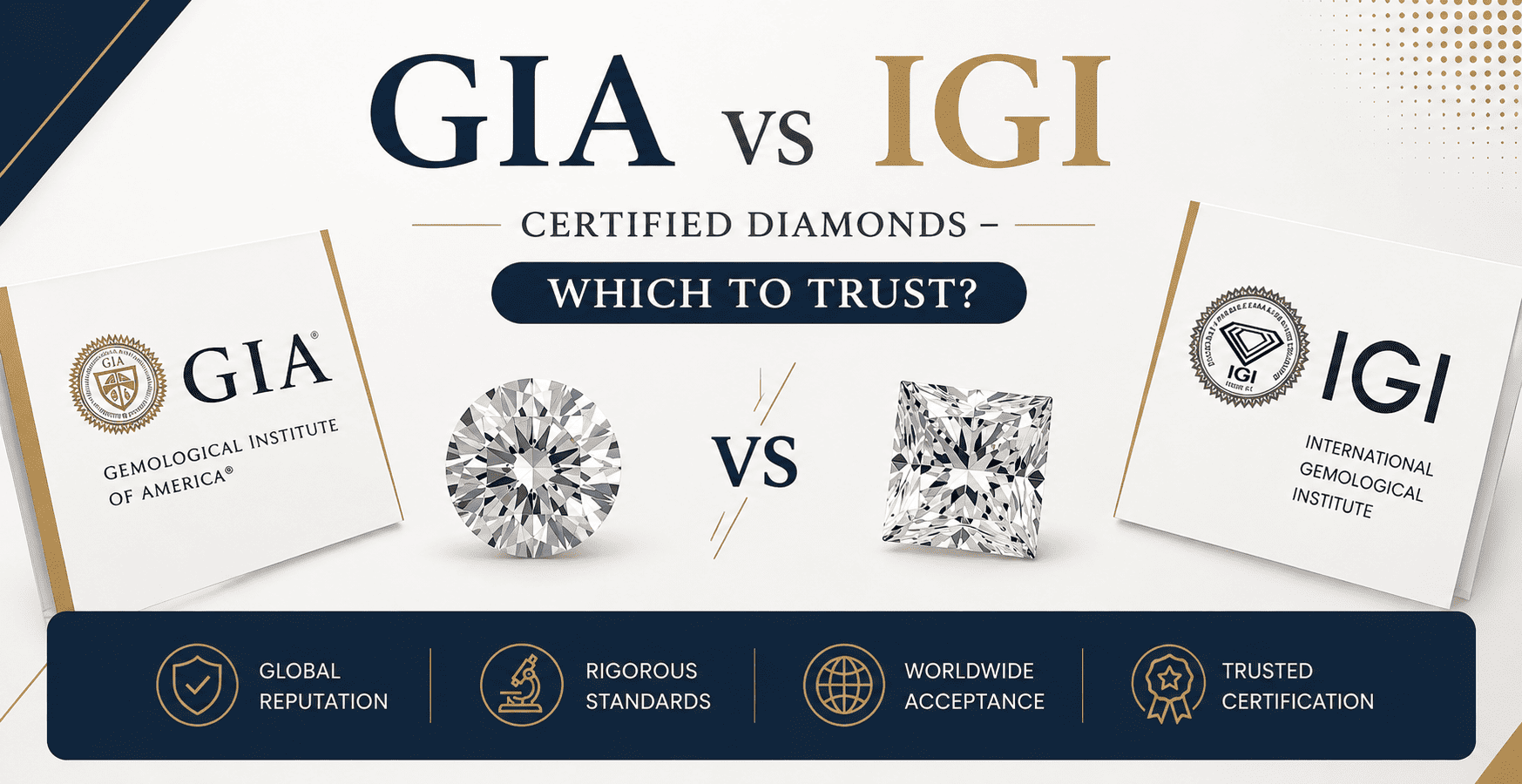
GIA vs IGI Certified Diamonds – Which Should You Trust? 2025–2026 Buyer’s Guide
Why Certification Matters More Than Ever
Buying a diamond – whether for an engagement ring, anniversary gift, or investment – is one of the most significant purchases of a lifetime. Yet without an independent certification, you have no objective guarantee that the diamond you’re paying for actually matches its claimed quality.
That’s where the two titans of diamond grading come in: the Gemological Institute of America (GIA) and the International Gemological Institute (IGI). In 2025 and 2026, the landscape shifted dramatically – GIA introduced a new grading framework for lab-grown diamonds in October 2025, while IGI continued to dominate the lab-grown market with a 70%+ global market share.
At OM Jewels Inc, we’ve guided thousands of buyers through this exact question. This comprehensive guide breaks down everything you need to know so you can buy with confidence.
Understanding Diamond Certification: The Basics
A diamond certificate (also called a grading report) is an objective assessment issued by an independent gemological laboratory. It documents a diamond’s characteristics across the Four Cs:
- Cut – the quality of the diamond’s proportions and symmetry
- Color – graded D (colorless) to Z (light yellow/brown)
- Clarity – measures internal and external flaws (inclusions and blemishes)
- Carat Weight – the physical weight of the stone
Without a reliable certificate from a trusted lab, you have no independent proof of what you’re actually purchasing. The lab that issues the certificate matters enormously – because two labs can grade the same stone differently.
Complete 4CS Guide
About GIA: The Gold Standard Since 1931
The Gemological Institute of America, founded in 1931 and headquartered in Carlsbad, California, is universally regarded as the most authoritative name in diamond grading. GIA literally invented the modern 4Cs system that the entire global industry uses today.
Why GIA is Trusted
- Non-profit organization – no commercial incentive to inflate grades
- Pioneered the 4Cs grading methodology, adopted worldwide
- Extremely conservative and consistent grading standards
- Most recognized certification in the resale and auction market
- Every GIA grader is rigorously trained and tested
GIA certifications are particularly prized for natural diamonds. Retailers like Tiffany & Co., Cartier, and top-tier auction houses like Christie’s and Sotheby’s predominantly list GIA-certified stones for high-value pieces. For investment-grade natural diamonds, GIA is non-negotiable.
GIA’s 2025 Lab-Grown Diamond Update
In October 2025, GIA introduced a new grading framework specifically designed for lab-grown diamonds, moving away from the full 4Cs assessment it had previously applied. According to GIA, using descriptive terms for lab-grown diamond quality is appropriate because most fall into a very narrow color and clarity range. This shift effectively repositioned IGI as the dominant authority for lab-grown grading.
About IGI: The Lab-Grown Diamond Authority Since 1975
The International Gemological Institute, founded in 1975 in Antwerp, Belgium, has grown into one of the world’s largest independent gemological laboratories, with offices across the USA, India, Hong Kong, Europe, and beyond.
Why IGI is the Go-To for Lab-Grown Diamonds
- Over 70% of all lab-grown diamonds worldwide are IGI-certified (as of 2025)
- Early pioneer in lab-grown diamond grading and verification
- Faster turnaround: 3-5 business days vs. GIA’s 10–15 days
- Lower certification fees – savings passed on to consumers
- Advanced spectroscopy and AI optical scanners to detect CVD and HPHT growth types
- Strong trust in key markets: India, Hong Kong, and Europe
IGI reports clearly disclose whether a diamond is lab-grown or natural, its growth type (CVD or HPHT), and any post-growth treatments. Every IGI-certified diamond carries a unique report number verifiable at igi.org.
GIA vs. IGI: Side-by-Side Comparison
Here’s how the two leading certification bodies stack up across the most important factors for buyers:
| Feature | GIA | IGI |
| Founded | 1931 (USA) | 1975 (Belgium) |
| Best For | Natural diamonds | Lab-grown diamonds |
| Grading Strictness | Very strict (gold standard) | Strict, slightly more lenient |
| Price Premium | Higher (investment-grade) | ~12% more affordable |
| Processing Time | 10–15 business days | 3–5 business days |
| Market Share (Lab-Grown) | Limited post-2025 | 70%+ worldwide |
| 4Cs Grading | Full 4Cs (natural) | Full 4Cs (both types) |
| Trust Level | Industry gold standard | Highest trust in lab-grown |
| Recommended By OM Jewels | Natural diamonds | Lab-grown diamonds |
Grading Strictness: How Different Are They Really?
One of the most debated questions in diamond buying is: Does IGI grade more leniently than GIA? The answer is nuanced.
A study of dual-certified diamonds (stones submitted to both labs) showed that IGI’s grading standards are largely comparable to GIA’s. In practice, an IGI “VVS2/E” lab-grown diamond is roughly equivalent in real-world appearance to a GIA “VS2/F” – still a beautiful, eye-clean stone. The key takeaway: when buying IGI-certified lab-grown diamonds, set a quality floor of VVS2 clarity or higher and E color or higher to ensure you’re getting the best value.
For natural diamonds, GIA is known to assign lower (stricter) grades compared to IGI for similar stones. This strictness provides an extra assurance that a GIA-graded natural diamond lives up to its claimed quality.
| Price Insight: An IGI-certified diamond is on average 12% cheaper than a GIA-certified diamond of the same carat, color, and clarity grade – making IGI an excellent value opportunity, particularly for lab-grown stones. |
Natural vs. Lab-Grown Diamonds: Which Certification Fits?
For Natural Diamonds – Choose GIA
If you are purchasing a natural diamond, especially one above 0.5 carats, GIA is the recommended choice. Here’s why:
- Strictest and most consistent grading in the industry
- Highest recognition in the secondary/resale market
- Most trusted by auction houses and estate jewelers
- GIA reports serve as a universal benchmark for diamond valuation
Must Read Full Guide Of Natural Vs Lab Grown Diamond
For Lab-Grown Diamonds – Choose IGI
If you’re buying a lab-grown diamond, IGI is the preferred certification – and the global standard:
- IGI grades over 70% of all lab-grown diamonds worldwide
- Purpose-built for CVD and HPHT diamond verification
- Faster reports at lower fees – savings passed on to consumers
- Widely accepted by all major lab-grown diamond retailers
- Clearly discloses growth type and any post-treatment
| OM Jewels Inc Recommendation: At our stores, we offer both GIA-certified natural diamonds and IGI-certified lab-grown diamonds, carefully curated to meet our strict quality standards. Whether you’re investing in a classic natural stone or choosing the sustainable beauty of a lab-grown diamond, our gemologists will guide you to the right certification for your needs. |
1 to 10 carat natural diamond price guide
How to Verify Your Diamond Certificate
Verifying a GIA Certificate
- Visit gia.edu/report-check
- Enter the unique GIA report number found on the certificate
- Confirm the 4Cs, grading date, and any special notations
Verifying an IGI Certificate
- Visit igi.org/verify-report
- Enter the unique IGI report number inscribed on the diamond’s girdle
- Confirm quality grades, origin disclosure, and growth type
Always verify the certificate online before completing your purchase. A reputable diamond dealer – like OM Jewels Inc — will always provide authentic, verifiable documentation.
What IGI and GIA Do NOT Tell You
Even the best certification has limits. Here’s what neither GIA nor IGI grades cover:
- Beauty or sparkle: Certification grades the diamond’s attributes, not how it looks in person
- Long-term value of lab-grown diamonds: Lab-grown diamonds are supply-driven; certification alone doesn’t guarantee appreciation
- Setting quality: The ring or setting is graded separately
- Cut quality nuances beyond the grade: Two “Excellent” cut diamonds can look very different
This is why working with an experienced jeweler matters. At OM Jewels Inc, our GIA-trained gemologists help you evaluate not just the certificate, but the actual beauty and suitability of the stone for your specific purpose.
The 2025–2026 Market Landscape
The diamond certification landscape has evolved significantly in the past 12 months:
- Lab-grown diamond global production increased by nearly 20% through 2025, making proper certification more critical than ever
- GIA’s October 2025 framework change repositioned IGI as the definitive lab-grown authority
- IGI was listed on stock exchanges and expanded its laboratory network globally in 2024–2025
- Major retailers, including Blue Nile, use GIA for natural diamonds and IGI for lab-grown stones
- Consumer awareness of certification has grown – buyers are asking for certificates more than ever
This rapid market expansion makes choosing a certified diamond – and understanding which certification applies to your purchase – more important than ever before.
Buying Tips from OM Jewels Inc
After years of helping customers navigate diamond certification, our gemologists at OM Jewels Inc offer these practical guidelines:
- Always buy certified: Never purchase a significant diamond without an independent certificate from GIA or IGI
- Match the cert to the type: GIA for natural, IGI for lab-grown – this is the industry consensus in 2026
- Set a quality floor for IGI lab-grown: Aim for VVS2 clarity or higher, E color or higher, 3EX cut
- Verify online: Always confirm your certificate at gia.edu or igi.org before purchase
- Ask about inscription: GIA and IGI both laser-inscribe the report number on the diamond’s girdle
- Consider the 5th C – confidence: Buy from a jeweler you trust, who stands behind the certificate
| Visit OM Jewels Inc today to browse our curated collection of GIA-certified natural diamonds and IGI-certified lab-grown diamonds. Our certified gemologists provide complimentary consultations to help you find the perfect stone with complete confidence. omjewelsinc.com |
Conclusion: Trust the Right Lab for the Right Diamond
In 2025 and 2026, the answer to “GIA vs. IGI” is no longer a competition – it’s a pairing:
- GIA for natural diamonds: The gold standard since 1931, with the strictest grading and highest resale recognition
- IGI for lab-grown diamonds: The global authority with 70%+ market share, faster turnaround, and purpose-built technology for lab-grown verification
Both certifications are legitimate, trusted, and backed by decades of gemological expertise. The key is knowing which to use for your specific diamond purchase – and that’s exactly what the team at OM Jewels Inc is here to help you with.
Whether you’re drawn to the timeless rarity of a natural diamond or the ethical brilliance of a lab-grown stone, make sure your purchase comes with the right certificate. It’s not just a piece of paper – it’s your guarantee of quality, authenticity, and peace of mind.
Related posts
When people talk about diamonds, they often focus on carat, color, and clarity. But the way a diamond is cut can have an equally important... Continue reading
Why Fancy Shape Diamonds Are the Growth Story of 2026 For most of the last century, the round brilliant was the default. It still holds... Continue reading
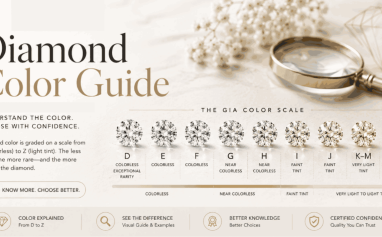
What Diamond Color Actually Measures Diamond color is one of the 4Cs, and it is the one buyers most often misunderstand. For white diamonds, the... Continue reading
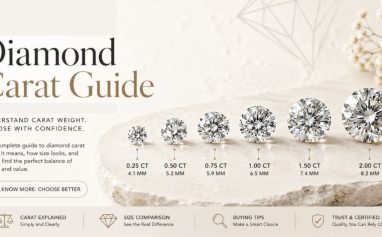
Walk into any jewelry store, and there is one word that gets asked about before anything else. Not cut. Not clarity. Carat.It makes sense. Carat... Continue reading
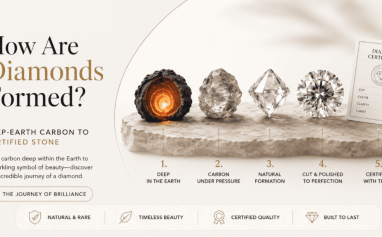
Every natural diamond you have ever seen began as carbon buried between 150 and 700 kilometres beneath your feet, crushed under pressures that would flatten... Continue reading