No products in the cart.

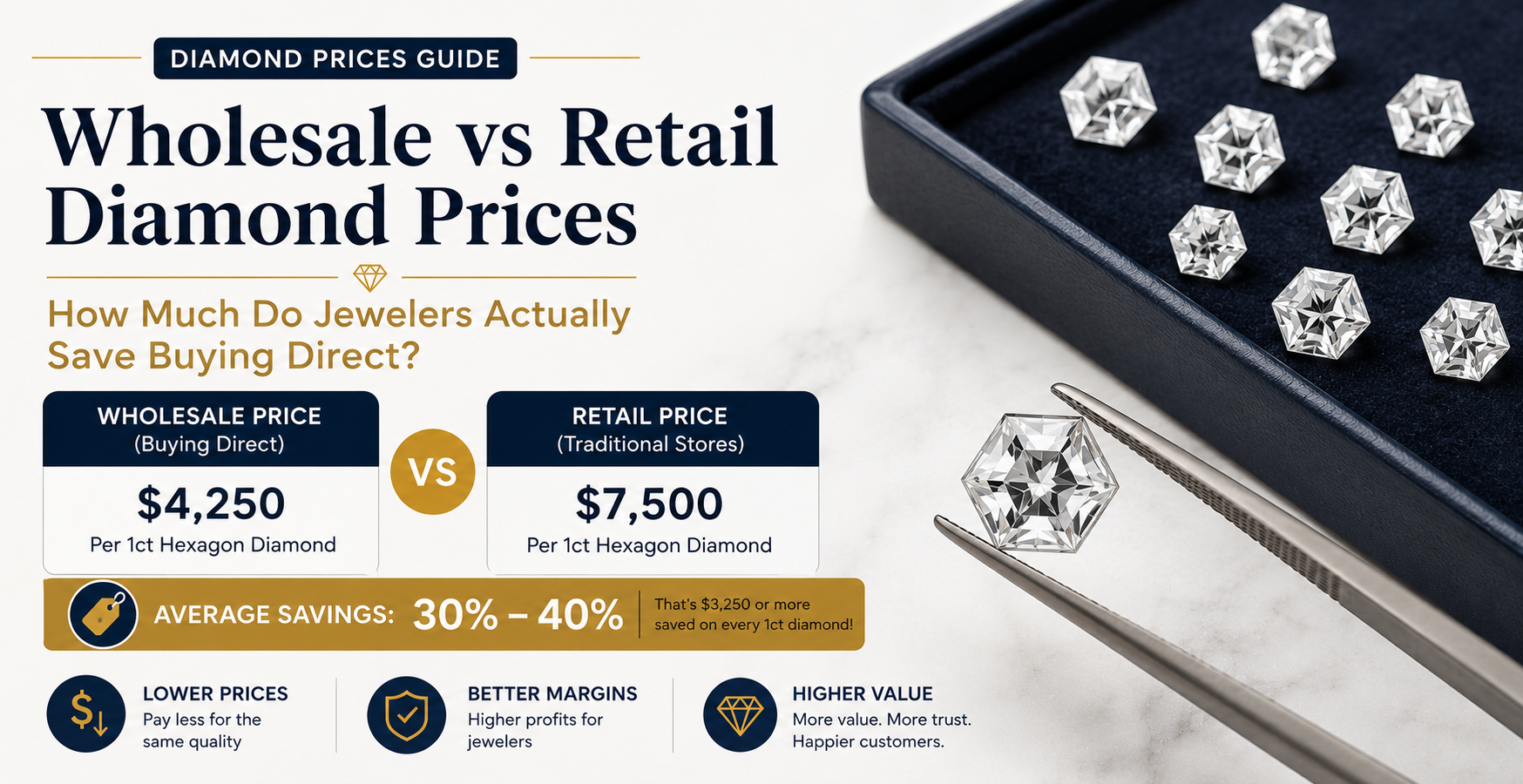
Wholesale vs Retail Diamond Prices – How Much Do Jewelers Actually Save Buying Direct?
Introduction
If you have ever compared the price of the same diamond at a retail jewelry store and a wholesale supplier, you already know the numbers don’t match. The difference isn’t small, either. In 2026, wholesale diamond prices typically run 30–50% below retail, and for some categories – such as lab-grown diamonds and melee stones – the gap is even wider.
For jewelers, designers, and retailers, understanding exactly where that gap comes from – and how to capture it – is the difference between a healthy margin and a struggling business. In this guide, we break down real markup numbers, show side-by-side price comparisons, and explain how buying direct from a diamond manufacturer like OM Jewels Inc changes the math.
What Is the Difference Between Wholesale and Retail Diamond Prices?
Wholesale diamond prices are the prices jewelers, designers, and bulk buyers pay when purchasing directly from diamond manufacturers, cutters, or dealers – before any retail markup is applied.
Retail diamond prices are what the end consumer pays at a jewelry store or online retailer. These prices include the wholesale cost plus the retailer’s markup, which covers rent, staff, marketing, insurance, financing, and profit.
The key point: the diamond itself is identical. A GIA-certified 1-carat F VS1 stone doesn’t change when it moves from a wholesaler’s parcel to a retailer’s display case. Only the price does.
An important legal note: in the United States, FTC regulations prohibit retailers from advertising “wholesale prices to the public.” True wholesale pricing is reserved for trade buyers, which is exactly why B2B suppliers like OM Jewels Inc verify wholesale accounts before revealing pricing.
Diamond Markup in 2026: The Real Numbers
Markup varies dramatically by stone size, category, and where the retailer sits in the market. Here is what the current data shows:
| Diamond Category | Typical Retail Markup Over Wholesale |
| Melee diamonds (under 0.10 ct) | 200% – 400%+ |
| Small stones (0.10 – 0.49 ct) | 150% – 300% |
| Mid-size stones (0.50 – 1.49 ct) | 100% – 250% |
| Large stones (1.50 ct and up) | 50% – 150% |
| Lab-grown diamonds | Often 100% – 1,000% |
| Branded / designer pieces | Additional 200% – 400% premium on top |
A few patterns stand out:
- Smaller stones carry higher percentage markups. Melee and accent stones are cheap per piece, so retailers multiply aggressively.
- The 1.00–1.20 carat range is heavily marked up because it is the most demanded engagement ring size.
- Larger stones have lower percentage markups but far higher dollar markups. A 50% markup on a $30,000 wholesale stone is still $15,000.
- Traditional “keystone” pricing – doubling the wholesale cost – is still standard in brick-and-mortar retail, and 3x wholesale remains common in general jewelry retail.
If you want to see exactly how carat, color, clarity, and shape combine to produce these numbers, our guide on how a diamond price calculator works breaks down the formula step by step.
Wholesale vs Retail Price Comparison Table
Here is what the wholesale-to-retail gap looks like in practical dollar terms for popular natural diamond sizes (illustrative ranges based on 2026 market conditions, G–H color, VS clarity):
| Diamond | Approx. Wholesale Price | Typical Retail Price | Jeweler’s Potential Margin |
| 0.50 ct Natural Round | $900 – $1,300 | $1,800 – $3,200 | ~$900 – $1,900 |
| 1.00 ct Natural Round | $3,500 – $5,500 | $7,000 – $13,000 | ~$3,500 – $7,500 |
| 1.00 ct Fancy Shape (Pear/Oval) | $3,000 – $4,800 | $6,000 – $11,000 | ~$3,000 – $6,200 |
| 2.00 ct Natural Round | $12,000 – $20,000 | $22,000 – $40,000 | ~$10,000 – $20,000 |
| 1.00 ct Lab-Grown | $500 – $1,000 | $1,200 – $3,000 | ~$700 – $2,000 |
| Matching Pair (1.00 ct total) | $2,800 – $4,500 | $6,000 – $10,000 | ~$3,200 – $5,500 |
Prices are indicative market ranges, not quotes. Actual pricing depends on the exact diamond 4Cs, certification, and market timing. Contact OM Jewels Inc for live wholesale pricing.
The takeaway is simple: across the market, wholesale typically runs 30–40% below equivalent retail prices – and jewelers who buy manufacturer-direct can push below even standard wholesale.
1 to 10 Natural Diamond Price Guide
Why Is the Markup So High? Where Your Money Actually Goes
Retail markup isn’t pure profit. When a consumer pays retail, they are funding:
- Real estate and overhead – showrooms in premium locations, security, insurance
- Staff and commissions – trained sales gemologists don’t come cheap
- Marketing and advertising – the diamond industry spends heavily on brand-building
- Inventory carrying costs – the average retail diamond sits 6–12 months before selling, tying up capital the entire time
- Value-added services – warranties, returns, resizing, financing plans
- Brand premium – luxury names can add 200–400% on top of everything else
Interestingly, despite these markups, publicly traded jewelry retailers earn gross margins of roughly 40–57% but keep operating margins of only around 6%. The markup is high, but so are the costs of running retail. This is precisely why cutting out layers of the supply chain creates so much room for savings.
Lab-Grown Diamonds: Where the Gap Is Widest
The lab-grown segment deserves special attention in 2026. Wholesale prices for lab-grown diamonds have fallen dramatically – production capacity has exploded, and as of 2026, the retail market prices lab-grown stones at roughly 80% below equivalent natural diamonds, with the discount still widening.
But here is the catch: retail lab-grown prices haven’t fallen as fast as wholesale prices. That lag means jewelers sourcing lab-grown diamonds at true wholesale are currently enjoying some of the strongest percentage margins in the industry – markups on lab-grown stones can reach 1,000% in extreme retail cases.
For jewelers, this makes direct wholesale sourcing of certified lab-grown fancy shapes, pairs, and layouts one of the highest-margin opportunities in today’s market.
How Much Do Jewelers Actually Save Buying Direct?
Let’s put it all together with a realistic example. Scenario: a jewelry designer needs ten 1.00 ct G VS1 natural fancy-shape diamonds for a bridal collection.
| Sourcing Route | Approx. Cost for 10 Stones | Savings vs Retail |
| Buying at retail | $70,000 – $110,000 | – |
| Standard wholesale dealer | $42,000 – $60,000 | ~35 – 45% |
| Direct from manufacturer (OM Jewels Inc) | $35,000 – $52,000 | ~45 – 55% |
Every intermediary between the cutting factory and the final buyer adds a layer of margin. A typical diamond can pass through a manufacturer, an exporter, a national wholesaler, and a regional dealer before reaching a retailer. Buying manufacturer-direct removes those layers entirely – which is why direct sourcing consistently delivers the deepest trade pricing, plus advantages money can’t always buy: first access to fresh inventory, calibrated consistency across parcels, and custom-cut capability.
Manufacturer-Direct vs Middleman Wholesale
Not all “wholesale” is equal. We’ve covered the differences between sourcing channels in detail in our dealer vs manufacturer vs wholesaler buying guide, but here is how the two wholesale models compare at a glance:
| Factor | Middleman Wholesaler | Direct Manufacturer (OM Jewels Inc) |
| Pricing | Wholesale + dealer margin | True factory-direct pricing |
| Inventory | Limited to purchased parcels | Full production inventory |
| Custom cutting | Rarely available | Calibrated & custom shapes on demand |
| Matching pairs & layouts | Hit-or-miss | Purpose-manufactured sets |
| Certification | Varies | GIA / IGI certified |
| Repeat-order consistency | Unpredictable | Manufacturing-level consistency |
How to Access True Wholesale Diamond Prices
If you are a jeweler, designer, or retailer, accessing genuine wholesale pricing usually requires:
- A verified trade account – legitimate wholesalers vet their buyers
- A relationship with a manufacturer or cutter – the closer to the source, the better the price
- Certification literacy – knowing GIA and IGI reports ensures you compare like-for-like
- Volume flexibility – suppliers with flexible minimum order quantities let smaller businesses buy direct too
Why Jewelers Choose OM Jewels Inc
OM Jewels Inc is a trusted diamond manufacturer and wholesaler based in New York’s Diamond District (20 W 47th St, Suite 405, NYC), serving jewelers, designers, and retailers across the USA, Canada, UK, EU, UAE, Hong Kong, Australia, Singapore, and Japan since 2018.
As a direct manufacturer, we eliminate middleman margins on:
- GIA & IGI certified natural diamonds – rounds, fancy shapes, and rare specialty cuts
- Lab-grown diamonds – HPHT and CVD, at true factory-direct pricing
- Fancy shapes – hexagonal, kite, marquise, pear, oval, lozenge, and more
- Matching pairs – precision-matched for earrings and toi et moi designs
- Diamond layouts & calibrated sets – purpose-manufactured for jewelry production
- Salt & pepper and black diamonds – specialty inventory rarely found at standard wholesalers
- Custom diamond manufacturing – your specifications, cut by our master craftsmen
Every stone is graded by GIA or IGI with laser-inscribed girdle verification, backed by flexible minimum order quantities, insured global shipping, and fast fulfillment.
➤ Unlock Wholesale Pricing at omjewelsinc.com – create your trade account and see factory-direct prices on our full inventory.
How much cheaper are wholesale diamonds compared to retail?
Across the market, wholesale diamond prices typically run 30–40% below equivalent retail prices. Jewelers buying directly from a manufacturer can save 45–55% versus retail, depending on stone size and category.
What is the average retail markup on diamonds?
Retail markups range from roughly 50% on large stones to 300–400% on melee and small diamonds. Traditional keystone pricing (2x wholesale) remains common, and lab-grown diamonds can carry markups of 1,000% in extreme cases.
Can the public buy diamonds at wholesale prices?
Genuine wholesale pricing is reserved for trade buyers. In fact, US federal regulations prohibit retailers from advertising “wholesale to the public.” OM Jewels Inc offers verified wholesale accounts for jewelry professionals and separate retail buyer access for consumers.
Why do lab-grown diamonds have the biggest wholesale-retail gap?
Wholesale lab-grown prices have dropped rapidly due to increased production capacity, but retail prices haven’t fully adjusted – creating unusually wide margins for jewelers sourcing at true wholesale.
Is buying directly from a diamond manufacturer cheaper than buying from a wholesaler?
Yes. Manufacturer-direct sourcing removes dealer and distributor margins entirely, typically delivering the lowest trade pricing available, along with custom cutting and calibrated consistency.
Does OM Jewels Inc have minimum order requirements?
We offer flexible minimum order quantities to accommodate businesses of all sizes. Contact our wholesale team for a tailored quote.
Contact Us
- info@omjewelsinc.com
- www.omjewelsinc.com
- https://www.facebook.com/profile.php?id=61551914615436
- https://www.instagram.com/omjewelsinc/
- https://in.pinterest.com/omjewelsinc/
- https://www.linkedin.com/company/om-jewels-inc
- https://www.youtube.com/@omjewelsinc/
Related posts
Two diamonds can share the same carat weight, the same color grade, and the same clarity – yet look completely different on the finger. One... Continue reading
Radiant Cut Diamond Guide for Beginners: Everything You Need to Know in 2026 If you love the fiery sparkle of a round brilliant but prefer... Continue reading
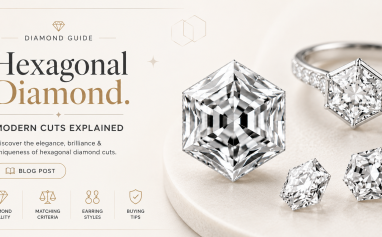
If the round brilliant is the classic little black dress of diamonds, the Hexagonal Diamond is the architectural statement piece – six equal sides, razor-clean... Continue reading
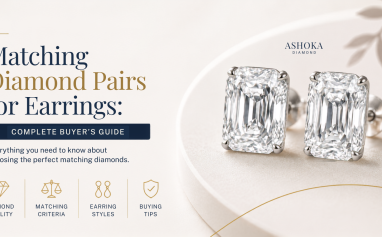
A pair of diamond earrings looks effortless when it is done right – two stones that face up identically, sparkle in unison, and sit perfectly... Continue reading
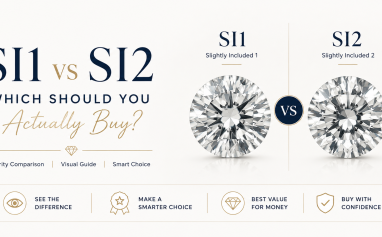
What Do SI1 and SI2 Actually Mean? On the GIA clarity scale, “SI” stands for Slightly Included – the fifth tier down from Flawless, sitting... Continue reading