No products in the cart.

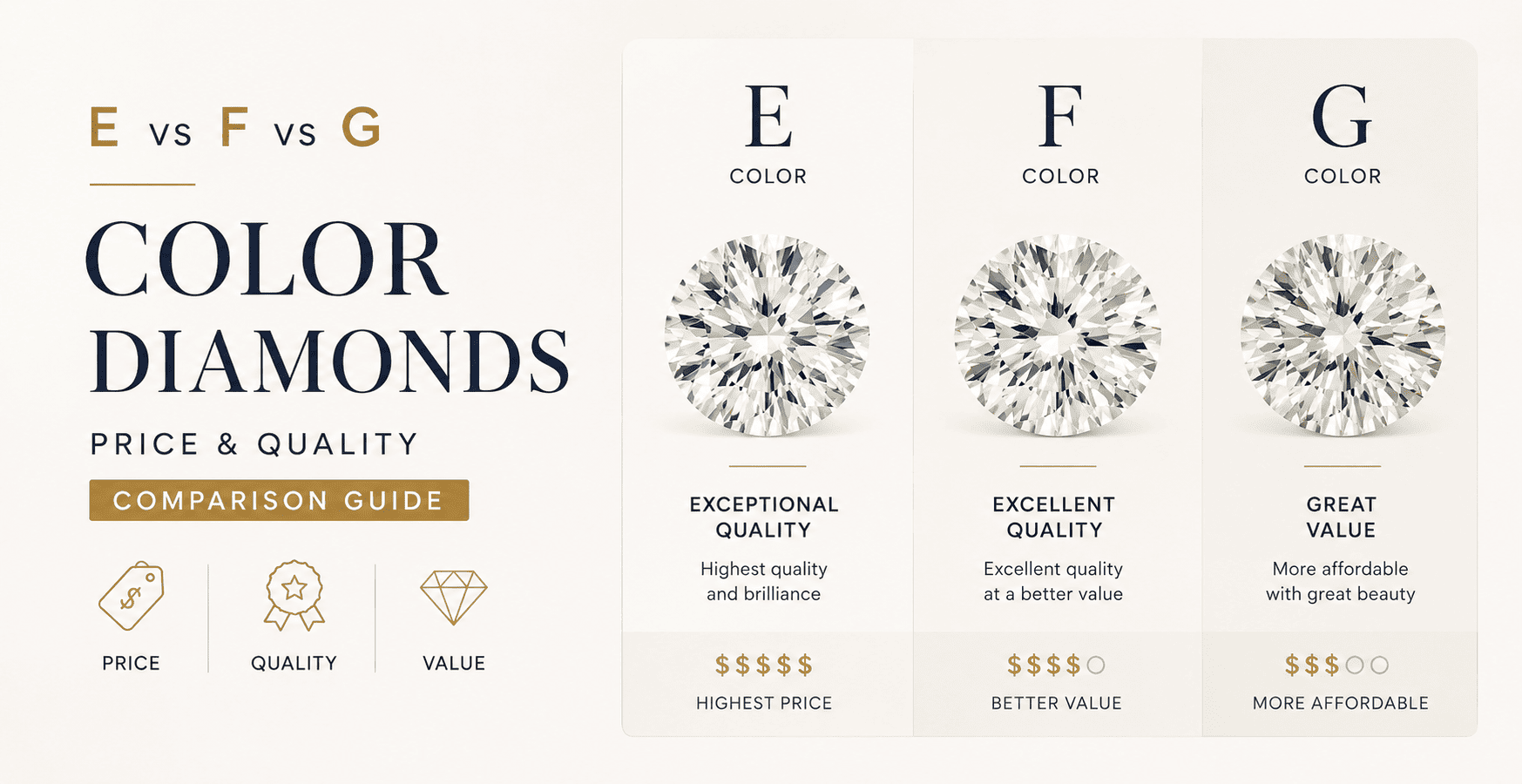
E vs F vs G Color Diamonds – Price & Quality Comparison Guide
Choosing a diamond color grade is one of the most consequential – and most confusing – decisions a buyer makes. The difference between an E, F, and G color diamond can mean thousands of dollars, yet to the naked eye, the three can look nearly identical once mounted in a ring. At OM Jewels Inc, we believe an informed buyer makes a happier buyer, so this guide breaks down exactly how these three grades compare on appearance, pricing, and overall value in 2026.
Understanding the GIA Color Scale
The Gemological Institute of America (GIA) grades diamond color on a scale from D (completely colorless) to Z (light yellow or brown). Color is one of the 4Cs – alongside cut, clarity, and carat weight – and accounts for roughly 20% of a diamond’s overall value.
Diamonds graded D, E, and F fall into the “colorless” category, the rarest and most prized tier on the scale. G color sits at the very top of the “near-colorless” category (G through J), offering an appearance that is virtually indistinguishable from colorless grades to most buyers, at a noticeably lower price.
| Quick Takeaway: E and F color diamonds are part of the colorless tier and look essentially identical to D color. G color is the top near-colorless grade, up to 98% the visual brilliance of D-F at 25-40% less cost. Differences between E, F, and G are nearly invisible to the untrained eye without a side-by-side, face-down comparison under controlled lighting. |
E vs F vs G: Side-by-Side Comparison
The table below compares E, F, and G color diamonds across appearance, recommended settings, and price positioning.
| Attribute | E Color | F Color | G Color |
| GIA Category | Colorless | Colorless | Near-Colorless |
| Visual Appearance | Icy white, no detectable tint to the naked eye | Icy white; only a master-stone test under lab lighting can reveal a trace | Appears white face-up; a trained eye may catch faint warmth next to a D-F stone |
| Best Metal Setting | Platinum / White Gold | Platinum / White Gold | Platinum / White Gold (yellow gold also works well) |
| Typical 1ct Price Range* | $6,000 – $8,500 | $5,500 – $8,000 | $4,500 – $6,500 |
| Price vs D Color | 5-10% less than D | 10-15% less than D | 25-40% less than D |
| Ideal Buyer | Wants flawless colorless certification just under D | Wants a colorless status at the best price within the D-F tier | Wants the best balance of value and near-colorless beauty |
Must Know Diamond 4CS Guide
E Color Diamonds
E color diamonds sit just one grade below the top-tier D color and are considered colorless. Differences between a D and an E stone are typically visible only to an expert gemologist under magnification and controlled lighting – to everyone else, they look the same. E color diamonds are best set in platinum or white gold to preserve their icy, pure appearance.
F Color Diamonds
F color marks the bottom of the colorless category, sitting alongside D and E as the whitest diamonds available. This may show only the faintest trace of color when examined face-down by a professional, but face-up – exactly how a diamond is worn – they appear bright and white. F color is often considered the value “sweet spot” within the colorless tier.
G Color Diamonds
G color diamonds are the highest grade within the near-colorless range and the starting point of real savings. They display nearly no visible color to the naked eye, especially once mounted, and provide approximately 98% of the visual appearance of D-F diamonds at 25-40% lower cost. For buyers who want to put more budget toward carat weight or cut quality, G color is frequently the smartest choice.
VVS vs VS Diamond Price Difference
2026 Pricing Snapshot by Carat Weight
Diamond pricing does not scale linearly with carat weight – larger stones become exponentially rarer and more expensive. Below is an approximate pricing snapshot across common carat weights for E, F, and G color, holding clarity at VS, and cut at excellent.
| Carat Weight | E Color (VS clarity) | F Color (VS clarity) | G Color (VS clarity) |
| 0.50 ct | $1,800 – $2,600 | $1,650 – $2,400 | $1,300 – $1,900 |
| 1.00 ct | $6,000 – $8,500 | $5,500 – $8,000 | $4,500 – $6,500 |
| 1.50 ct | $11,000 – $15,500 | $10,000 – $14,500 | $8,000 – $11,500 |
| 2.00 ct | $22,000 – $28,500 | $20,500 – $26,500 | $16,500 – $21,500 |
Which Color Grade Should You Choose?
Choose E Color If…
- You want a documented colorless status just below D, with a slightly lower price tag.
- You are buying a larger stone (1.5ct+) in platinum or white gold, where subtle color is more noticeable.
- Resale value and prestige matter as much as visual appearance.
Select F Color If…
- You want the colorless certification without paying peak D or E premiums.
- You are setting the diamond in white metal and want guaranteed icy-white results.
- You’re looking for the best value inside the colorless tier.
Choose G Color If…
- You want the best overall value – near-colorless beauty at a meaningfully lower price.
- You would rather invest savings into a larger carat weight or a better cut grade.
| Pro Tip from OM Jewels Inc.: Cut quality affects brilliance more than a one-letter color difference. An Excellent-cut G-color diamond will often outsparkle a poorly cut E- or F-color stone. If budget is a constraint, prioritize cut first, then clarity, then color. |
Quality Beyond Color: What Else to Consider
- Cut Quality: Determines brilliance and fire; an Excellent or Ideal cut maximizes sparkle regardless of color grade.
- Clarity: VS1/VS2 clarity offers eye-clean stones at a more accessible price than VVS or Flawless.
- Fluorescence: Strong blue fluorescence can make a lower color grade appear whiter, but may also create a slight haze in some stones.
- Certification: Always buy GIA- or AGS-certified diamonds to ensure the color and clarity grades are independently verified.
- Metal Setting: Platinum and white gold preserve a colorless look; yellow and rose gold can mask warmth in lower grades.
Final Thoughts
E, F, and G color diamonds each offer an excellent balance of beauty and value, and for the vast majority of buyers, the difference between them is invisible once the stone is set. The right choice comes down to your budget, the size of the stone, and how much you value the prestige of a colorless certification versus the practical savings of a near-colorless grade.
At OM Jewels Inc, our certified gemologists are happy to walk you through real stones side by side so you can see – and feel confident about – exactly what you’re purchasing.
Related posts
When people talk about diamonds, they often focus on carat, color, and clarity. But the way a diamond is cut can have an equally important... Continue reading
Why Fancy Shape Diamonds Are the Growth Story of 2026 For most of the last century, the round brilliant was the default. It still holds... Continue reading
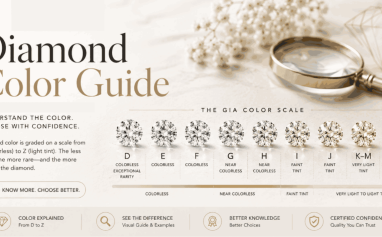
What Diamond Color Actually Measures Diamond color is one of the 4Cs, and it is the one buyers most often misunderstand. For white diamonds, the... Continue reading
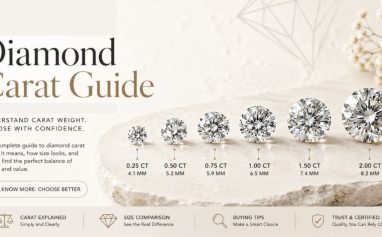
Walk into any jewelry store, and there is one word that gets asked about before anything else. Not cut. Not clarity. Carat.It makes sense. Carat... Continue reading
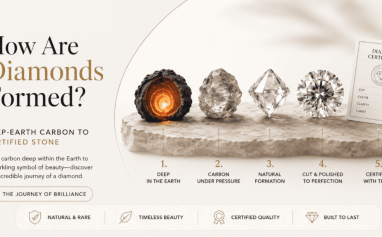
Every natural diamond you have ever seen began as carbon buried between 150 and 700 kilometres beneath your feet, crushed under pressures that would flatten... Continue reading