No products in the cart.

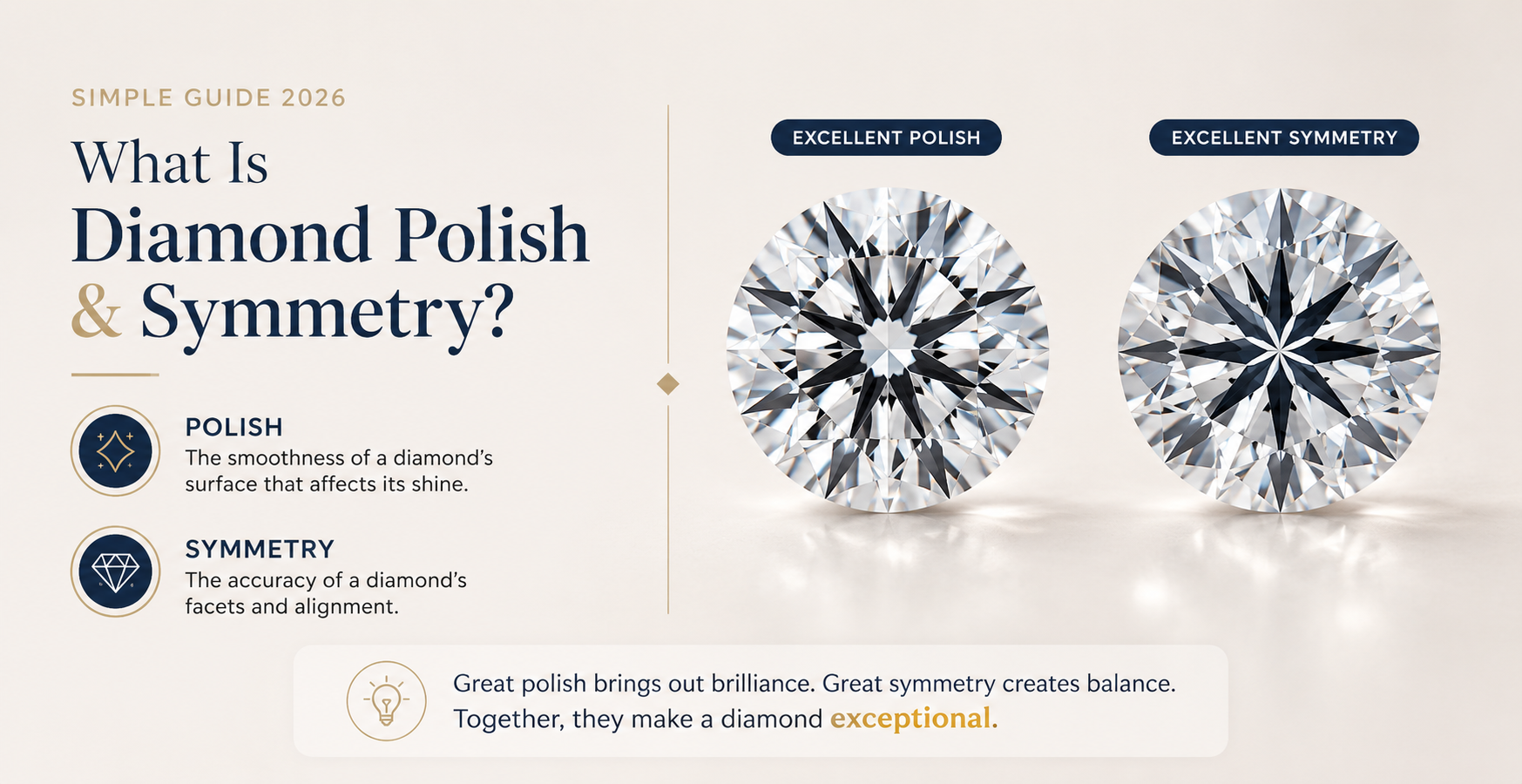
What Is Diamond Polish & Symmetry? Simple Guide 2026
What Is Diamond Polish?
Diamond polish refers to the smoothness of the diamond’s surface after the cutting and faceting process is complete. While a rough diamond is being shaped, the cutter uses spinning wheels coated with diamond dust to smooth each facet. Polish grading reflects how cleanly that process was done.
Under 10x magnification, gemologists look for:
- Polish lines – fine grooves left behind by the polishing wheel
- Scratches – thin, often shallow surface marks
- Nicks – tiny notches where facets meet
- Abrasions – clusters of small nicks along facet edges
- Burn marks – light surface scorching from friction during polishing
A diamond with an Excellent polish grade shows none of these flaws to the naked eye, and only the faintest traces under strong magnification.
VVS vs VS Diamond Price Difference
What Is Diamond Symmetry?
Symmetry describes how precisely a diamond’s facets are shaped, sized, and aligned with one another – and how well the crown (top half) lines up with the pavilion (bottom half) at the girdle. Think of it like the difference between a perfectly folded paper crane and one with slightly mismatched edges: both may look fine from a distance, but the precise one performs better.
Common symmetry issues graders look for include:
- Off-center table – the flat top facet isn’t centered
- Out-of-round outline – the girdle isn’t a true circle (for round diamonds)
- Misshapen or misaligned facets – facets that don’t meet cleanly at the same points
- Extra facets – unintended facets added during cutting
Poor symmetry doesn’t just look uneven – it can cause light to leak out of the side or bottom of the diamond instead of bouncing back to your eye, dulling its sparkle even if the proportions are technically “ideal.”
Polish vs. Symmetry: Side-by-Side
| Factor | Polish | Symmetry |
| What it measures | Smoothness of each facet surface | Alignment & shape of all facets together |
| Caused by | Cutter’s polishing technique & equipment | Precision of facet placement & cutting angles |
| Visible flaws | Scratches, nicks, abrasions, and burn marks | Off-center table, wavy girdle, misshapen facets |
| Effect on look | Surface shine and luster | Brilliance, fire, and how light returns to the eye |
Why Polish & Symmetry Matter for Price and Sparkle
Polish and symmetry feed directly into a diamond’s overall cut grade, and cut has the single biggest effect on how a diamond looks – more than color or clarity in many cases. Labs typically cap the overall cut grade at only one level above the polish or symmetry grade, so a diamond can’t be rated “Excellent” cut if its symmetry is merely “Good.”
How to verify diamond certification?
- Price impact: The jump from Very Good to Excellent polish and symmetry can add roughly 10–12% to a diamond’s price for a similar-looking stone.
- Visual impact: Light enters through the table and bounces between facets before exiting back toward your eye. Misaligned or poorly finished facets scatter that light instead of focusing it, reducing brilliance and fire.
- Durability myth: Polish and symmetry are cosmetic and optical, not structural — they don’t affect how easily a diamond chips or breaks.
GIA Grading Scale at a Glance
| Grade | What It Means | Buying Recommendation |
| Excellent | No visible flaws even under 10x magnification; facets line up almost perfectly | Best choice for maximum sparkle |
| Very Good | Only minor, hard-to-see imperfections | Great value, near-identical look to Excellent |
| Good | Noticeable finish flaws under magnification | Acceptable for budget buyers, less ideal light return |
| Fair | Visible polish lines or facet misalignment | Avoid engagement rings |
| Poor | Significant surface damage or distorted facets | Not recommended |
Natural Diamond Price Per Carat
Latest Diamond Grading Updates (2026)
Diamond grading standards keep evolving as labs refine how they measure light performance. Here’s what’s new heading into the second half of 2026:
| Update | What’s Changing |
| GIA fluorescence comments | Starting Q4 2026, GIA is adding fluorescence comments to reports for natural D-to-Z diamonds, flagging cases where blue fluorescence may brighten appearance or affect clarity visibility under UV light. |
| Lab-grown ‘Premium’ tier | GIA’s new Laboratory-Grown Diamond Quality Assessment labels stones ‘Premium’ only if they have D color, VVS clarity or higher, Excellent polish and symmetry, and (for round brilliants) an Excellent cut grade. |
| Fancy-shape cut grading | GIA plans to launch an official cut grade for select fancy shapes in 2027, building on polish and symmetry data already collected – fancy shapes now make up close to a third of stones submitted for grading. |
How to Choose the Right Grade
| Buying Tip: Engagement rings & solitaires: aim for Excellent or Very Good polish and symmetry – the difference is worth the small premium since these stones are viewed up close every day. Side stones & smaller accents: Good is usually fine, since flaws are far less noticeable in smaller stones. Always view in person or via high-resolution video: two diamonds with the same grade can still look different – request 10x magnified images before buying online. Check who graded it: GIA and AGS are the most trusted labs; grading consistency varies between gemological labs. |
Frequently Asked Questions
Does polish or symmetry matter more?
Both matter, but symmetry generally has a slightly larger effect on light performance, while polish has a more direct effect on surface shine. Ideally, look for strong grades in both.
Can a diamond have Excellent cut but Good symmetry?
No. Grading labs cap the overall cut grade at one level above the lowest of polish or symmetry, so a diamond with good symmetry cannot receive an Excellent cut grade.
Do polish and symmetry affect lab-grown diamonds the same way?
Yes – lab-grown and natural diamonds are graded on the same polish and symmetry scale, and both factor into GIA’s lab-grown “Premium” versus “Standard” classification introduced in 2026.
Polish and symmetry might not get the spotlight that carat weight or clarity do, but they’re often what separates a diamond that merely looks good on paper from one that truly comes alive in person. When in doubt, prioritize Excellent or Very Good grades on a GIA report, and always ask to see the stone under magnification before you buy.
Related posts
Choosing a diamond color grade is one of the most consequential – and most confusing – decisions a buyer makes. The difference between an E,... Continue reading
What Is a Baguette Diamond? A baguette-shaped diamond is a thin, elongated, rectangular-shaped diamond belonging to the step-cut family. Unlike round brilliant diamonds with 58... Continue reading
The diamond industry uses a lot of language that confuses first-time buyers. “Diamond layout,” “loose diamond,” “mounted stone,” “preset ring” – these terms get used... Continue reading