No products in the cart.

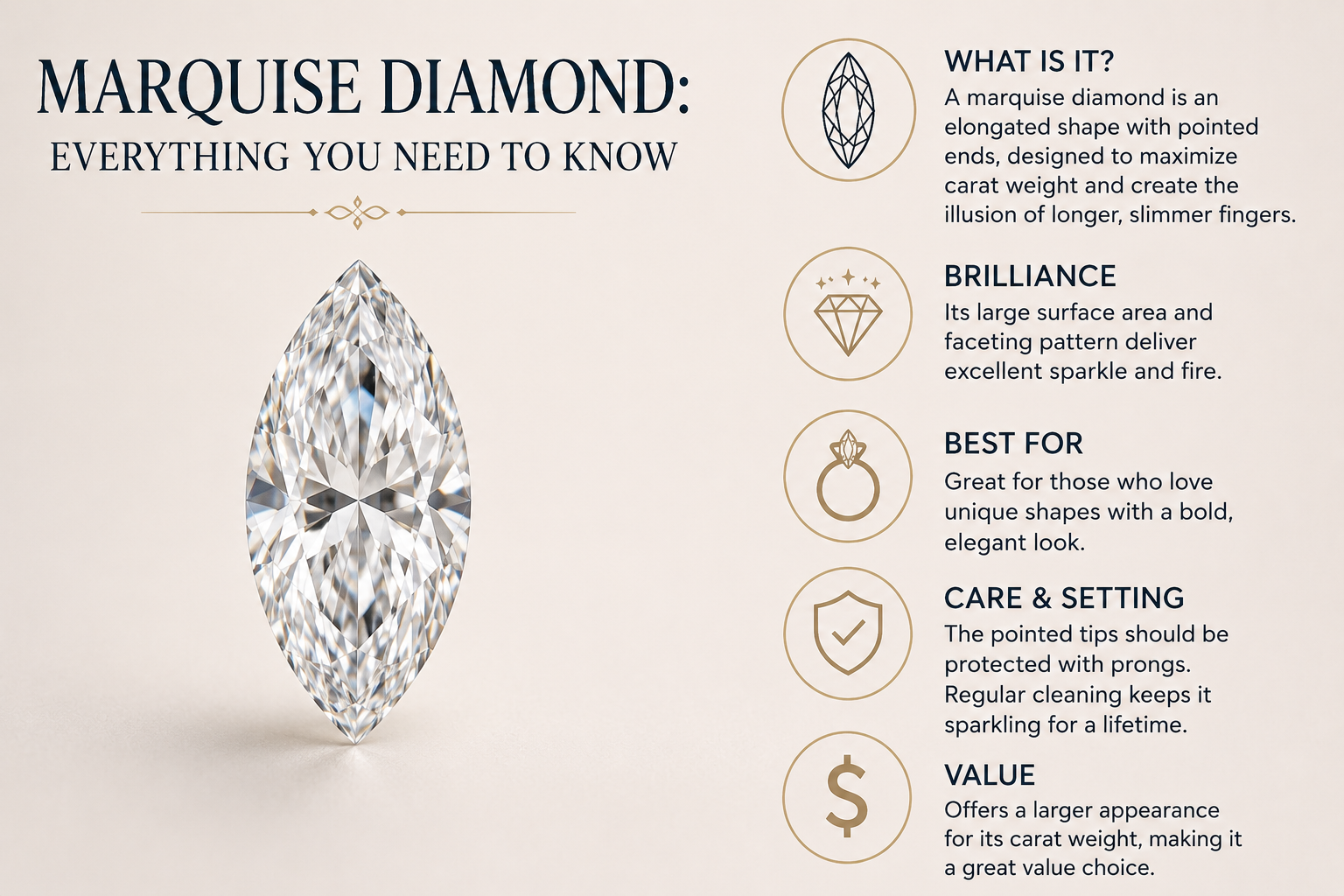
MARQUISE DIAMOND – Everything You Need to Know
Introduction: Why the Marquise Diamond Stands Apart
Few diamond shapes carry a story as romantic and royal as the marquise diamond. Born in the court of 18th-century France, shaped by a king’s devotion, and now experiencing a powerful resurgence in 2025–2026, the marquise diamond is a cut that demands attention. Its elongated silhouette, pointed tips, and remarkable brilliance make it one of the most distinctive and sought-after fancy diamond shapes in the world.
Whether you are drawn to its storied history, its remarkable ability to appear larger than its actual carat weight, or its flattering effect on the hand, this guide covers everything – from understanding the cut’s anatomy and the bowtie effect, to choosing between a natural or lab-grown stone, selecting the perfect ring setting, and knowing exactly what to look for when buying. Read on to discover why the marquise diamond might just be the boldest, most elegant choice you will ever make.
| ✦ Quick Facts: Marquise Diamond at a Glance Origin: France, c. 1745 | Facets: 56–58 | Ideal L:W Ratio: 1.75–2.25 | Surface Area: Largest of any diamond shape per carat | Market Share: ~1.5% of all GIA-certified diamonds | Price vs Round: 20–30% less per carat | Celebrity Fans: Selena Gomez, Catherine Zeta-Jones, Victoria Beckham |
The Royal History of the Marquise Diamond
A King’s Commission – 18th-Century France
The marquise cut’s origin story is one of the most romantic in the entire world of gemology. In approximately 1745, King Louis XV of France commissioned a master cutter to create a diamond shape that mirrored the smile of his beloved mistress, Jeanne Antoinette Poisson – better known by her noble title, the Marquise de Pompadour. The result was a long, narrow shape with two sharp, elegant points at either end – a silhouette said to perfectly echo the curve of her lips.
The title ‘marquise’ refers to a rank of French nobility sitting between a duke and a count, lending the stone an air of aristocratic distinction no other diamond shape can claim. The cut was also given the name ‘navette’ (French for ‘little boat’ or ‘little ship’) because its elongated outline with pointed ends resembles a small vessel gracefully cutting through water.
From Royal Courts to Hollywood – A Timeline
- 1745 – King Louis XV commissions the first marquise cut for Madame de Pompadour
- Late 1700s–1800s – The shape spreads through the European aristocracy and royal courts
- Early 1900s – Art Deco movement embraces the marquise’s geometric elegance
- 1970s–1980s – Peak popularity period; marquise becomes a top engagement ring choice
- 1990s–2010s – Temporarily overshadowed by round, oval, and cushion cuts
- 2020s – Vintage revival trend brings marquise back into the spotlight
- 2024 – Selena Gomez’s 8-carat marquise engagement ring sparks a global resurgence
- 2025–2026 – Marquise firmly re-established as a top trending fancy shape
The Marquise’s Enduring Symbolic Legacy
Beyond its visual appeal, the 1 CT marquise diamond has always carried rich symbolism. It has long been associated with royalty, passion, and distinction. For modern buyers, wearing a marquise is a statement – it signals confidence, individuality, and an appreciation for history. In a jewelry landscape dominated by round brilliants and ovals, a marquise wearer chooses the path less traveled, and the diamond rewards that choice with a truly extraordinary presence.
Anatomy of the Marquise Cut: Understanding the Shape
Shape Characteristics
The marquise is classified as a ‘modified brilliant cut’ – an elongated elliptical shape with two sharp points at each end and curved sides creating a football or boat-like silhouette. At its core, it is a variation of the round brilliant, adapted to maximize surface area and visual impact.
| Characteristic | Marquise Diamond | Round Brilliant | Oval Cut |
| Facets | 56–58 | 57–58 | 56–58 |
| Shape | Elongated, pointed ends | Circular | Elongated, rounded ends |
| L:W Ratio (ideal) | 1.75–2.25 | 1.0 (circle) | 1.30–1.50 |
| Surface Area / Carat | Largest of all shapes | Moderate | Large |
| Finger Effect | Elongates significantly | Neutral | Slight elongation |
| Bowtie Effect | Present (varies) | None | Present (varies) |
| Price vs Round | 20–30% less | Benchmark | 10–15% less |
The 58 Facets – How Brilliance is Achieved
The marquise cut typically features 56 to 58 expertly placed facets, arranged to maximize light performance across its unique elongated shape. When properly cut, these facets create the same brilliant sparkle associated with round diamonds but with a distinctive, dramatic flair. Modern cutting technology has refined the marquise to handle light almost as perfectly as a round brilliant – a remarkable achievement given how different the shapes are.
Some marquise diamonds feature a ‘French tip’ variation – a style in which several small facets replace one large bezel facet at each pointed tip. This variation improves the appearance of the points and is a hallmark of high-quality cutting craftsmanship.
Ideal Length-to-Width Ratio
The length-to-width (L: W) ratio is one of the most important factors in determining how a marquise looks on the hand. The classic ideal range is 1.75:1 to 2.25:1, which produces the graceful, elongated shape most associated with the cut. Personal preference, however, should always be the final guide:
- Below 1.75:1 – Shorter, wider look; more dramatic on a finger; modern and chunky aesthetic
- 1.75–2.00:1 – Classic proportions; balanced elegance; universally flattering
- 2.00–2.25:1 – Traditional elongated look; maximizes finger-slimming effect
- Above 2.25:1 – Very narrow and dramatic; bold statement look; may feel fragile at tips
The Bowtie Effect — What It Is and How to Avoid It
| ⚠️ Understanding the Bowtie Effect Almost all elongated diamond shapes – including marquise, oval, and pear – can exhibit a ‘bowtie effect’: a dark, shadow-like band across the center of the stone that resembles a bowtie in shape. The severity ranges from barely visible to quite prominent, and it CANNOT be identified from a grading certificate or listed dimensions alone. Always view the stone in person or request a video before purchasing. A well-cut marquise will minimize the bowtie to near-invisible levels. |
Symmetry – The Non-Negotiable Quality Marker
Symmetry is absolutely critical in a marquise diamond. The two pointed ends must align perfectly with each other when viewed straight on, and the left and right sides must form a near-perfect mirror image. Even a slight asymmetry is glaringly visible in this shape. When evaluating a marquise, always check that the center axis runs precisely through both tips and that both curved sides have identical profiles.
Marquise Fancy Natural Diamond – The Classic Choice
What Makes Natural Marquise Diamonds Special
A natural marquise diamond is formed deep within the Earth over billions of years under extreme heat and pressure. Every natural diamond is unique – no two stones are identical, and each carries microscopic characteristics (inclusions, growth patterns, fluorescence) that make it truly one of a kind. For many buyers, this natural origin story adds profound meaning to the stone, especially for a piece as significant as an engagement ring.
Natural marquise diamonds are extraordinarily rare in the diamond market. According to GIA certification data, only approximately 1.5% of all GIA-certified diamonds are marquise cut. This rarity gives a natural marquise owner a genuinely distinctive stone – the kind that stands out even among other fancy-shaped diamond buyers.
The 4Cs for Natural Marquise Diamonds
Cut Quality
Unlike round brilliants, the GIA does not assign an official ‘Excellent’ or ‘Ideal’ cut grade to marquise diamonds. However, the following proportions serve as expert guidelines:
| Parameter | Excellent | Very Good | Good |
| Table % | 53–63% | 52–64% | 51–65% |
| Depth % | 58–62% | 57–63% | 56–64% |
| Crown Height | 12–15% | 11–16% | 10–17% |
| Girdle | Thin to Medium | Thin to Slightly Thick | Very Thin to Thick |
| Culet | None to Pointed | None to Pointed | Very Small |
Color Grading
Because the marquise’s elongated shape and large surface area can show color more readily than a round brilliant, color grading takes on extra importance. General recommendations for natural marquise diamonds:
- D–F (Colorless) – Ideal for platinum or white gold settings; maximum prestige
- G–H (Near Colorless) – Excellent value; color difference from D–F is invisible to the naked eye
- I–J (Near Colorless) – Good value choice; slight warmth visible in larger stones (2ct+)
- K and below – Noticeably warmer tone; may suit yellow gold settings where warmth is desired
Clarity Grading
The marquise’s elongated shape can concentrate inclusions in the pointed tips (since those areas were originally at the outer edge of the rough diamond crystal). Pay particular attention to clarity at the tips when evaluating a stone:
- FL–IF – Flawless; rarely necessary and very expensive
- VVS1–VVS2 – Excellent choice; inclusions invisible to the naked eye
- VS1–VS2 – Best value for most buyers; eye-clean in virtually all cases
- SI1 – Acceptable if eye-clean; always verify with high-resolution imagery or video
- SI2 and below – Caution required; inclusions may be visible, especially near tips
- Carat Weight & Perceived Size
- One of the most significant advantages of the marquise shape is its face-up size. Because of its elongated profile and large crown surface area, a marquise diamond appears noticeably larger than a round diamond of the same carat weight – sometimes up to 15% larger. This means a 1-carat marquise can have the visual presence of a 1.15–1.20-carat round brilliant, offering exceptional perceived value.
Natural Marquise Diamond Pricing (2026 Reference)
| Carat Weight | Good Quality (SI1, I-J) | Mid Quality (VS2, G-H) | Premium (VVS, D-F) |
| 0.50 ct | $800–$1,200 | $1,200–$1,800 | $2,000–$3,500 |
| 1.00 ct | $2,000–$3,500 | $3,500–$5,500 | $5,500–$10,000 |
| 1.50 ct | $4,000–$6,500 | $6,500–$10,000 | $10,000–$18,000 |
| 2.00 ct | $7,000–$11,000 | $11,000–$18,000 | $18,000–$35,000 |
| 3.00 ct | $15,000–$22,000 | $22,000–$35,000 | $35,000–$70,000+ |
Note: Prices are approximate retail ranges for loose natural marquise diamonds in 2026. Final prices depend on exact cut proportions, fluorescence, certification, and vendor.
Natural Diamond Price Per Carat
Natural Diamond Certification
Always purchase a natural marquise diamond with a reputable grading certificate. The two leading authorities are:
- GIA (Gemological Institute of America) – The global gold standard for diamond grading. GIA reports are the most trusted and widely recognized worldwide.
- AGS (American Gem Society) – Also highly respected; known for detailed cut grading.
- IGI (International Gemological Institute) – Common for larger jewelry chains; generally reliable, though some consider slightly more lenient than GIA.
- HRD (Antwerp World Diamond Centre) – Respected European authority; strong reputation in the EU market.
Easy tutorial on how to verify a diamond.
Marquise Fancy Lab-Grown Diamond – The Modern Choice
What Is a Lab-Grown Diamond?
A lab-grown (also called lab-created or synthetic) diamond is chemically, physically, and optically identical to a natural diamond. Both are pure crystalline carbon; both pass every standard diamond tester. The only difference is origin: natural diamonds form over billions of years in the Earth’s mantle, while lab-grown diamonds are produced in controlled laboratory environments over a matter of weeks using two primary methods:
- HPHT (High Pressure High Temperature) – Simulates the Earth’s natural diamond-forming conditions using extreme heat and pressure
- CVD (Chemical Vapor Deposition) – Grows a diamond layer by layer from a carbon-rich gas in a vacuum chamber
Lab-Grown vs Natural: The Critical Differences
| Factor | Natural Marquise Diamond | Lab-Grown Marquise Diamond |
| Origin | Earth-mined (billions of years) | Laboratory (weeks to months) |
| Chemical Composition | 100% carbon (same) | 100% carbon (same) |
| Visual Difference | None to naked eye | None to naked eye |
| Price (1ct, VS2, G) | ~$3,500–$5,500 | ~$500–$1,200 |
| Price Difference | Benchmark | 70–81% less expensive |
| Resale Value | 40–60% of retail | 10–15% of retail |
| Rarity | Finite; naturally scarce | Can be produced on demand |
| Certification | GIA, AGS, IGI | GIA, IGI (lab-specific reports) |
| Environmental Impact | Mining required | Lower mining impact |
| Investment Value | Appreciates over time | Generally depreciates |
Natural Vs Lab Grown Diamond – Complete Guide For You
The Lab Diamond Market in 2025–2026
The lab-grown diamond market has undergone a dramatic transformation. In 2025, a premium 1-carat lab-grown diamond averaged under $1,000 – compared to approximately $4,200 for a comparable natural 1-carat diamond. The price gap between lab and natural is now approximately 70–81%, making lab-grown diamonds an extraordinarily compelling choice for buyers who prioritize size and quality over long-term resale value.
One significant trend: the average lab-grown center stone in engagement rings grew from 1.31 carats in 2019 to 2.45 carats by 2025 – an 87% increase in average weight. Buyers are using the cost savings to purchase dramatically larger stones than they could otherwise afford.
| 📊 Market Reality 2026: Who Should Choose Lab-Grown? Lab-grown marquise diamonds are the ideal choice if: (1) You prioritize size and visual impact over investment value; (2) You believe diamond value lies in what it represents, not what it’s worth; (3) You want the highest possible quality (D-F color, VVS clarity) within your budget; (4) Environmental considerations matter to you. Choose natural if: (1) Investment and resale value matters; (2) You want a stone with a unique natural origin story; (3) You’re purchasing a significant heirloom piece intended to appreciate over decades. |
Quality Advantage of Lab-Grown Diamonds
In a notable quality shift, 85.9% of lab-grown diamonds sold in 2025 were colorless (D–F color grade), compared to only 37.7% in 2020. Because growth conditions are controlled, lab-grown diamonds consistently achieve higher average color and clarity grades than natural diamonds at equivalent price points. For a marquise buyer on a budget, this means access to near-flawless, colorless stones that would cost many times more in natural form.
Full Guide For Lab Grown Diamond
Lab-Grown Marquise Diamond Pricing (2026 Reference)
| Carat Weight | Good Quality (SI1, I-J) | Mid Quality (VS2, G-H) | Premium (VVS, D-F) |
| 0.50 ct | $150–$250 | $250–$450 | $400–$700 |
| 1.00 ct | $400–$700 | $700–$1,200 | $1,000–$1,800 |
| 1.50 ct | $700–$1,200 | $1,200–$2,000 | $1,800–$3,200 |
| 2.00 ct | $1,200–$2,000 | $2,000–$3,500 | $3,000–$5,500 |
| 3.00 ct | $2,500–$4,000 | $4,000–$7,000 | $6,000–$10,000 |
Note: Lab-grown diamond prices stabilized in late 2025 after years of rapid decline. A functional price floor is now established. 2026 prices are driven by certification and retail structure rather than continuing market drops.
Marquise Diamond Ring Settings & Layouts
Choosing the right setting for a marquise diamond is both an aesthetic decision and a practical one. Because of the two pointed tips, which are the most vulnerable points on the stone, the setting choice directly impacts not only how the ring looks but also how protected and wearable it will be over time. Here are the most popular and beautiful options:
1. Solitaire Setting – Classic Elegance
The solitaire setting showcases the marquise diamond in its purest form, allowing the stone’s distinctive shape to be the undisputed focal point. A six-prong solitaire is the most popular configuration for marquise diamonds – four prongs hold the curved sides while two V-shaped prongs (or claw tips) protect the pointed ends. This is the timeless, unfussy choice that lets the cut’s inherent drama speak for itself.
- Best for: Minimalists, traditionalists, those who want the diamond as the sole statement
- Metal recommendations: Platinum or white gold to maximize D–H color stones; yellow gold for warmer I–J tones
- Pro tip: Ask specifically for V-prongs at the tips – they protect the points far better than standard round prongs
2. Halo Setting — Maximum Glamour & Size
A ring of smaller diamonds (or gemstones) encircles the marquise center stone, amplifying its brilliance, increasing the apparent size, and adding a glamorous, vintage-inspired character. The halo also provides additional protection to the curved edges of the stone. A pavé halo – where tiny diamonds are set closely together in a continuous band – is the most popular variation.
- Best for: Those who want maximum visual impact and sparkle; vintage aesthetic lovers
- Double halo – Two concentric rings of accent diamonds; even more dramatic
- Hidden halo – Diamonds set underneath the center stone, visible only from an angle; subtle and modern
- Gemstone halo – Sapphires or other colored stones create a Victorian or Art Deco look
3. East-West (Horizontal) Setting – The Modern Statement
The east-west orientation turns the marquise 90 degrees so the pointed tips face left and right across the finger rather than up and down. This contemporary setting has seen an explosion in popularity since being popularized by Portia de Rossi’s ring from Ellen DeGeneres. It creates a clean, architectural, modern aesthetic while still celebrating the marquise’s unique shape.
- Best for: Contemporary brides; those who want something unmistakably modern and different
- Practical advantage: The sideways orientation makes the points less likely to snag on clothing or hair
- Bezel-set east-west rings are especially popular – the metal wrap protects the tips and creates a sleek silhouette
- Band recommendation: Use a thinner band so the points are fully visible and not obscured by metal
Checklist Before Buying Any Diamond
4. Three-Stone Setting – Past, Present & Future
A classic and deeply symbolic choice: the marquise center stone is flanked by two smaller side stones (often trillion-cut, baguette, or round diamonds). The three stones symbolize the past, present, and future of the relationship. The marquise’s elongated shape pairs beautifully with tapered side stones that echo its pointed profile.
- Best for: Those who value symbolism; those wanting a more elaborate, statement ring
- Classic pairing: Tapered baguette side stones for an Art Deco look
- Modern pairing: Trillion (triangular) side stones for maximum visual drama
- Budget tip: Side stones can be lab-grown while the center stone is natural – or vice versa
5. Bezel Setting – Modern & Maximum Protection
In a bezel setting, a continuous band of metal wraps around the entire perimeter of the marquise diamond, securing it completely. This is the most protective setting for the vulnerable pointed tips and gives the ring a sleek, contemporary look that feels distinctly modern. Full bezel and half bezel (open metal on the north and south sides) are both popular.
- Best for: Active wearers; those concerned about tip damage; modern minimalists
- Practical note: A bezel slightly reduces the visible surface area of the stone but adds considerable wearability
- Popular pairing: East-west orientation + bezel = one of the most modern marquise configurations available
6. Pavé & Split Shank Settings
A pavé band (tiny diamonds set closely along the band itself) adds continuous sparkle and elevates the entire ring. A split shank band – where the band divides into two as it approaches the center stone – creates an elegant, tiara-like effect that many describe as truly regal. Both settings complement the marquise’s natural glamour perfectly.
- Pavé bands: Add sparkle without adding too much visual complexity around the center stone
- Split shank: Creates a miniature tiara effect; extremely popular for marquise settings
- Cross-split shank: Adds a whimsical, romantic twist to the classic split design
How Diamond Prices Have Changed 2025-2026
Setting Comparison at a Glance
| Setting Style | Best Aesthetic | Protection Level | Price Range | Trending? |
| Solitaire | Classic/Minimal | Good (with V-prongs) | $ | Always |
| Halo | Glamorous/Vintage | Very Good | $$ | Always |
| East-West | Modern/Architectural | Good–Excellent | $–$$ | Hot in 2026 |
| Three-Stone | Symbolic/Elegant | Good | $$–$$$ | Classic |
| Bezel | Contemporary | Excellent | $$ | Rising |
| Pavé/Split Shank | Regal/Romantic | Good | $$–$$$ | Popular |
The Complete Marquise Diamond Buying Guide
Step 1 – Set Your Budget
Before evaluating diamonds, establish a clear budget range. The marquise’s significant price advantage over round brilliants (20–30% less per carat) and its face-up size advantage (~15% larger appearance per carat) means your budget goes further with a marquise than with almost any other shape. Decide early whether natural or lab-grown aligns with your values and budget – the choice dramatically affects what you can afford.
Step 2 – Choose Your Shape Preference
Decide on your preferred length-to-width ratio before shopping. If possible, try on rings with different ratios on the hand – the difference between a 1.75:1 and a 2.25:1 marquise is visually dramatic and highly personal. There is no universally ‘correct’ ratio; the ideal is the one that feels right on your specific hand and finger length.
Step 3 – Prioritize the 4Cs Wisely
For marquise diamonds specifically, the recommended priority order is:
- Cut/Symmetry (highest priority) – Asymmetry is immediately visible; never compromise here
- Color – Marquise shows color more than round; stay G or above for white metals
- Clarity – VS2 to VS1 is the sweet spot; eye-clean SI1 can work with careful selection
- Carat – The marquise’s face-up size advantage means you can often go slightly lower in carat without losing visual impact
Step 4 – Always View the Stone in Person or Via Video
The bowtie effect is the most critical factor that cannot be assessed from a certificate alone. Always request a high-resolution video of any marquise diamond you are seriously considering. The video should show the stone in motion under different lighting conditions to reveal how the bowtie appears in real life. A good vendor will always provide this without hesitation.
Step 5 – Verify Symmetry
Ask your vendor to confirm that the diamond’s two points are perfectly aligned along the central axis and that both curved sides are mirror images. This can usually be verified visually on a well-lit photograph or video, but ask specifically about the symmetry grade on the grading report.
Step 6 – Check the Certification
Never purchase a loose marquise diamond (natural or lab-grown) without a reputable grading certificate. GIA certification is the global standard. For lab-grown diamonds, both GIA and IGI issue lab-specific certificates. Ensure the certificate number is laser-inscribed on the girdle of the stone and matches the certificate you receive.
Step 7 – Consider the Setting Last
Select your center stone first, then build the setting around it. Many buyers make the mistake of falling in love with a setting photograph and then trying to force a stone into it – a process that often leads to compromises. The stone should drive the setting choice, not the reverse.
| 🔑 Expert Buying Tips: What Jewelers Won’t Always Tell You 1. The marquise’s size advantage is real – a 1ct marquise has visually more presence than a 1ct round. Don’t be talked into a larger carat weight than you need. 2. Yellow gold can ‘mask’ slightly warm color grades (I–J) beautifully in a marquise, saving significant money. 3. For the tips: always insist on V-prongs or a bezel. Regular round prongs at the tips are inadequate and a common cause of tip chipping. 4. If buying lab-grown, prioritize IGI or GIA certification – third-tier certificates can be unreliable. 5. A slight bowtie is not necessarily a flaw — a very faint bowtie can add character and depth to the stone. |
Caring for Your Marquise Diamond Ring
Daily Wear Considerations
The marquise’s pointed tips are the most vulnerable part of the stone. While diamonds are the hardest natural material on Earth (10 on the Mohs scale), they are not indestructible – they can chip if struck sharply at the tips. Sensible daily habits significantly extend the life and beauty of your ring:
- Remove your ring during heavy manual work, gardening, gym workouts, or any activity involving risk of impact
- Store your ring separately from other jewelry – diamonds scratch softer metals and gemstones
- Apply lotions, perfumes, and hairsprays before putting on your ring; these products create film on the diamond and reduce brilliance
- Check prongs regularly – especially the V-prongs at the tips – for signs of wear or loosening
Cleaning Your Marquise Diamond
Diamonds attract oils and grease (from skin, lotions, and daily handling), which significantly dull their brilliance over time. Regular cleaning is essential:
- Home cleaning: Soak in warm water with a drop of dish soap for 20–30 minutes, then gently brush with a very soft toothbrush. Rinse thoroughly and pat dry with a lint-free cloth.
- Ultrasonic cleaners: Safe for most marquise diamonds set in prong settings; avoid with stones that have significant fracture-filled inclusions
- Professional cleaning: Have your ring cleaned and prongs checked by a jeweler at least once per year
- Frequency: Clean your ring at home every 2–4 weeks if worn daily
Celebrity Marquise Diamonds & 2025–2026 Trends
Famous Marquise Diamond Rings
| Celebrity | Ring Details | Notable Feature |
| Selena Gomez | ~8 carat marquise, pavé band, yellow gold (2024) | Sparked 2024-2026 marquise resurgence |
| Catherine Zeta-Jones | 10 carat marquise, east-west, hidden halo | Classic Hollywood vintage glamour |
| Victoria Beckham | Pear-marquise combination ring | Multiple engagement rings including marquise |
| Portia de Rossi | East-west marquise solitaire (from Ellen DeGeneres) | Popularized the east-west trend globally |
| Anne Hathaway | Marquise diamond engagement ring | Elegant solitaire style |
Top 2025–2026 Marquise Trends
- East-West Revolution – Horizontal marquise settings are the single biggest jewelry trend of 2025–2026 among non-traditional engagement ring buyers
- Toi et Moi Marquise – Two stones (often a marquise paired with a round, oval, or pear) on a single band; ultra-romantic and highly individual
- Yellow Gold Resurgence – Warm yellow gold settings are pairing beautifully with marquise diamonds for a vintage-luxe look
- Colored Stone Accents – Marquise diamonds flanked by sapphire, emerald, or ruby side stones are trending for bold, colorful rings
- Vintage Filigree Settings – Art Deco and Edwardian-inspired milgrain and filigree work perfectly with the marquise’s historical pedigree
- Super-Elongated Ratios – Ratios of 2.25:1 and above are gaining popularity for a bold, dramatic, maximalist statement
Frequently Asked Questions
Is a marquise diamond good for everyday wear?
Yes, with the right setting. The key is tip protection – choose V-prongs, a bezel, or a halo setting to protect the pointed ends. With proper care and regular prong checks, a marquise diamond in a good setting is perfectly suitable for daily wear.
Do marquise diamonds look bigger than round diamonds?
Yes. Because of the marquise’s elongated shape and large surface-area-to-carat ratio, a marquise diamond appears approximately 15% larger face-up than a round diamond of the same carat weight. Additionally, the elongated shape creates a visual slimming and lengthening effect on the wearer’s finger.
Are marquise diamonds more affordable than round diamonds?
Yes. Natural marquise diamonds typically cost 20–30% less per carat than comparable round brilliants. This is because round brilliants require more of the rough diamond to be cut away during the cutting process, and because round brilliants command a premium as the most popular shape. The marquise’s relatively lower demand translates directly into lower prices for buyers.
What is the best metal for a marquise diamond ring?
Platinum is the top choice for D–H color stones, offering a cool white metal that maximizes colorlessness. White gold (14K or 18K) is a more affordable alternative with a similar appearance. Yellow gold pairs beautifully with I–J color stones, where a slightly warm tone is acceptable, and the warm gold color complements the marquise’s vintage heritage. Rose gold offers a romantic, fashionable alternative to yellow gold.
Can I set a marquise diamond in an east-west orientation?
Absolutely – and it is one of the most popular settings in 2025–2026. The east-west marquise creates a clean, modern look and has the practical advantage of making the pointed tips less likely to snag on clothing or hair. A bezel or V-prong setting in an east-west orientation offers both contemporary aesthetics and maximum wearability.
How do I know if the bowtie effect is acceptable in a stone I’m considering?
Always request a video of the stone in natural light, artificial light, and in motion. A slight, barely visible bowtie is acceptable and may even add character. Avoid stones where the bowtie is a prominent dark shadow that distracts from the overall brilliance of the stone. If purchasing online, a reputable vendor will always provide a video – if they won’t, do not purchase from them.
Is a marquise cut suitable as a solitaire without any accent diamonds?
Yes, and many experts consider the solitaire the most elegant expression of the marquise cut. The shape is so distinctive and beautiful that it needs no embellishment to command attention. A solitaire marquise makes a bold, confident statement precisely because it allows the stone to stand completely on its own terms.
Final Thoughts: Is the Marquise Diamond Right for You?
After centuries of history, the marquise diamond has earned its reputation as one of the most romantic, distinctive, and brilliant fancy shapes in the world. It is not for the timid – this is a cut that announces itself, that carries history in its shape, and that rewards the wearer with a presence unlike any other stone.
If you want a diamond that combines maximum visual impact with a romantic origin story, that stretches your budget with its size advantage, that flatters the hand with its finger-slimming silhouette, and that ensures you will virtually never encounter someone with the same stone, the marquise diamond is an extraordinary choice.
Whether you choose a breathtaking natural stone formed over billions of years in the Earth, or a chemically identical lab-grown diamond that makes a 2-carat stone accessible at any budget, the marquise shape will reward you with a ring that turns heads, starts conversations, and carries the legacy of a 278-year history with every glance.
Related posts
The One-Carat Obsession – and What It Costs You Ask most first-time diamond buyers what they want, and the answer is almost automatic: “a one-carat... Continue reading
Introduction If you have ever compared the price of the same diamond at a retail jewelry store and a wholesale supplier, you already know the... Continue reading
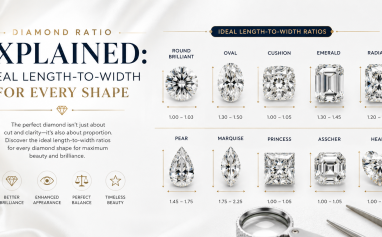
Two diamonds can share the same carat weight, the same color grade, and the same clarity – yet look completely different on the finger. One... Continue reading
Radiant Cut Diamond Guide for Beginners: Everything You Need to Know in 2026 If you love the fiery sparkle of a round brilliant but prefer... Continue reading
If the round brilliant is the classic little black dress of diamonds, the Hexagonal Diamond is the architectural statement piece – six equal sides, razor-clean... Continue reading