No products in the cart.

Hexagonal Diamond: Modern Cuts Explained
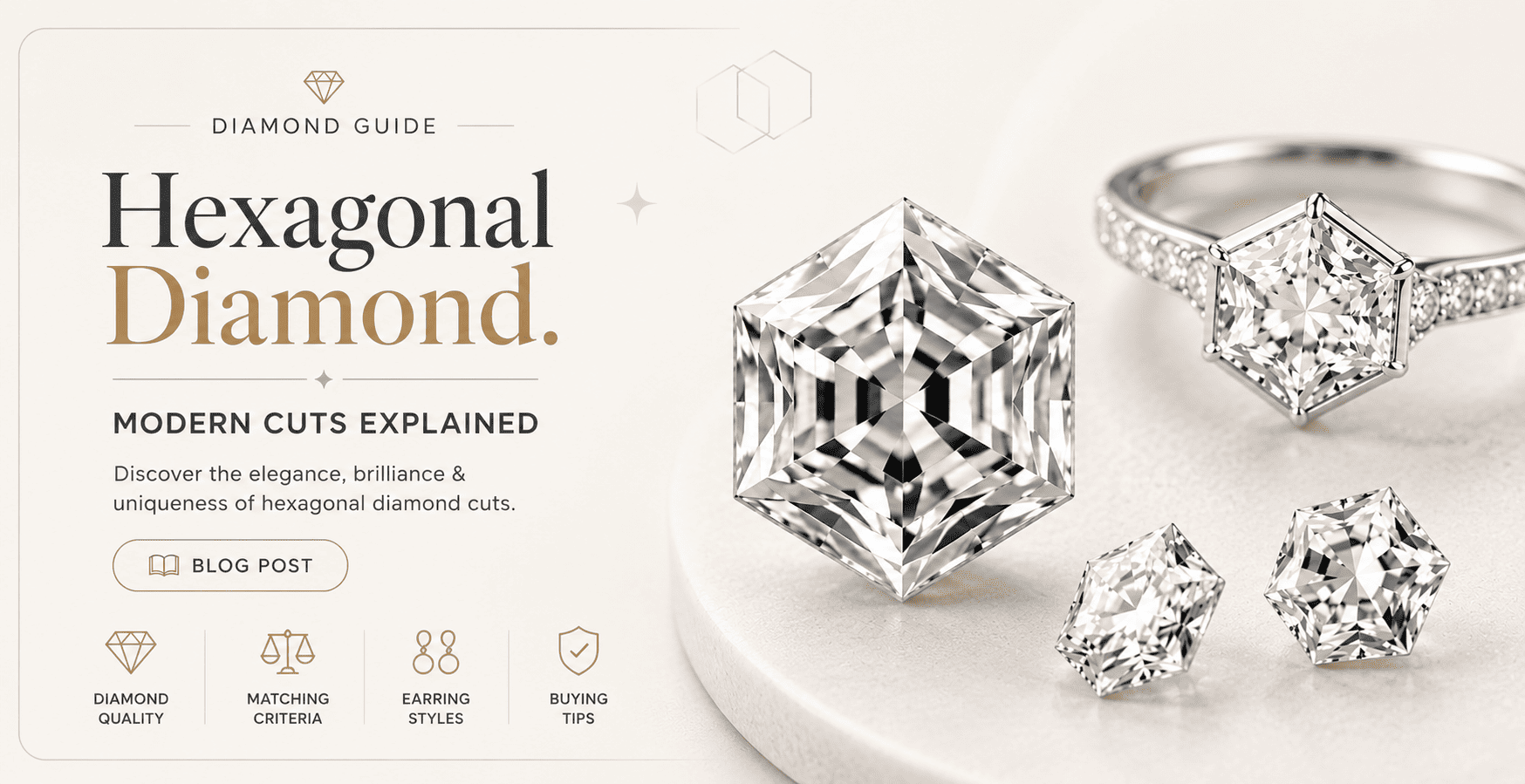
If the round brilliant is the classic little black dress of diamonds, the Hexagonal Diamond is the architectural statement piece – six equal sides, razor-clean symmetry, and a silhouette that instantly signals individuality. Once a rarity confined to Art Deco showcases, the hexagon cut has become one of the most-searched alternative diamond shapes in 2026, driven by the custom-jewelry movement, social media, and the rise of lab-grown diamonds, which make unconventional cuts more accessible than ever.
In this guide, the gemologists at OM Jewels Inc explain everything you need to know about hexagon cut diamonds – the faceting styles, how they compare with other shapes, what to look for in the diamond 4Cs, the best settings, and why this geometric marvel may be the perfect centerpiece for your next ring.
| ✦ Quick Answer Box: What is a Hexagonal Diamond? A hexagon-cut diamond is a fancy-shape diamond fashioned into a six-sided polygon with equal sides. It can be faceted as a brilliant cut (maximum sparkle), a step cut (elegant hall-of-mirrors effect), a rose cut (vintage charm), or a portrait cut (glass-like clarity). It has no standardized GIA cut grade, so symmetry and craftsmanship matter most. |
What Exactly Is a Hexagonal Diamond?
A hexagonal diamond is a fancy-cut diamond shaped into a six-sided polygon. Unlike round brilliants or princess cuts, which are engineered purely to maximize light return, the hexagon cut is built around geometric symmetry and architectural precision. Each of its six sides is equal in length, and the faceting underneath can vary dramatically – which is why no two hexagon diamonds ever look quite alike.
A quick note on terminology: in materials science, “Hexagonal Diamond” also refers to lonsdaleite – an extremely rare carbon allotrope with a hexagonal crystal lattice, found mostly in meteorites. In jewelry, however, “hexagonal diamond” almost always means the hexagon cut: an ordinary diamond crystal expertly cut into a six-sided shape. This guide focuses on the cut.
A Brief History: From Art Deco to Instagram
Hexagonal motifs first captured the jewelry world during the Art Deco era of the 1920s and 1930s, when designers embraced bold geometry, straight lines, and angular forms. True hexagon-cut center stones were rare in that period – artisans more often used hexagonal halos and bezels to frame round diamonds – but the shape became a lasting symbol of avant-garde style.
The hexagon’s rise as a center-stone shape is largely a 21st-century story. From roughly 2020 onward, elongated and step-cut hexagons gained major traction through independent designers, custom jewelers, and social media, appealing equally to vintage-inspired romantics and modern minimalists. Advances in precision cutting technology and the growing availability of lab-grown rough, which can be fashioned into unusual shapes with less waste anxiety, have accelerated the trend into 2026.
The 4 Modern Hexagon Cutting Styles
“Hexagon cut” is not a single style. The faceting approach determines everything from light performance to overall mood:
| Cutting Style | Facet Structure | Light Performance | Best For |
| Brilliant Cut Hexagon | Triangular facets, similar to a round brilliant cut | Maximum sparkle, fire, and star-like scintillation | Buyers who want bold geometry without sacrificing brilliance |
| Step Cut Hexagon | Long, parallel facets (like emerald/Asscher cuts) | Broad, deliberate flashes; “hall-of-mirrors” effect | Art Deco lovers; sleek, architectural elegance |
| Rose Cut Hexagon | Flat base with a domed, triangular-faceted top | Soft, subtle, romantic glow; appears larger per carat | Vintage-inspired and antique-style designs |
| Portrait Cut Hexagon | Large flat table, very shallow profile | Glass-like transparency rather than sparkle | Minimalists; showcasing exceptional clarity |
| 💎 OM Jewels Inc Expert Tip Step-cut and portrait-cut hexagons have large, open facets that act like windows into the stone. They reveal inclusions and body color far more readily than brilliant cuts – so budget for a higher clarity grade (VS2 or better) and a higher color grade (G–H or better) when choosing these styles. Brilliant-cut hexagons, by contrast, camouflage inclusions well, letting you safely consider SI1 clarity and save meaningfully on price. |
Hexagon Cut vs. Other Popular Diamond Shapes
How does the hexagon stack up against the shapes it is most often cross-shopped with?
| Feature | Hexagon Cut | Round Brilliant | Emerald Cut | Princess Cut |
| Silhouette | Six-sided, geometric | Circular | Rectangular, cut corners | Square |
| Sparkle Level | Medium–High (varies by facet style) | Highest | Medium (mirror flashes) | High |
| Rarity | Rare/distinctive | Very common | Common | Common |
| Face-Up Size | Large spread per carat | Standard | Large spread | Smaller spread |
| GIA Cut Grade | Not graded (craftsmanship matters) | Yes | No | No |
| Price per Carat | Often 15–30% below round | Highest | Lower than round | Lower than round |
| Style Vibe | Modern + Art Deco | Classic | Vintage elegance | Contemporary |
The size advantage is real: hexagon diamonds – especially elongated hexagons with a length-to-width ratio between 1.2:1 and 1.5:1 – spread their carat weight across a broader visible surface. Two stones of identical carat weight can look noticeably different on the finger, and the elongated hexagon almost always wins the face-up size comparison against compact cuts.
Lozenge Diamond – All Jewellers Need to Know
The 4Cs for Hexagonal Diamond: A 2026 Buying Guide
Because the hexagon sits outside standardized grading, smart buying means knowing exactly which quality factors carry the most weight:
| The 4Cs | What to Look For in a Hexagon | OM Jewels Inc Recommendation |
| Cut & Symmetry | Six crisp, equal sides; aligned facets; no lopsidedness. Hexagons reveal asymmetry more than any other shape. | Insist on “Very Good” or “Excellent” symmetry on the certificate |
| Clarity | Step/portrait cuts show inclusions easily; brilliant cuts hide them. | VS1–VS2 for step cuts; SI1 acceptable for brilliant cuts |
| Color | Open facets show body color; yellow/rose gold settings forgive lower grades. | D–F for icy white; G–H best value; I–J beautiful in warm metals |
| Carat | Prioritize spread (mm dimensions) over raw weight. | Compare face-up measurements, not just carat weight |
| ✓ Pre-Purchase Checklist • Certification: Ask for an IGI or GIA report verifying carat, color, and clarity. • Ratio: 1:1 for a balanced, symmetrical look; 1.2:1–1.5:1 for an elongated, finger-lengthening silhouette. • Corners: The six points are the most vulnerable areas – confirm your setting protects them. • Video, not photos: Always view a 360° video or the actual stone; hexagon character varies enormously. • Lab-grown option: Lab-grown hexagons deliver the same optics at a fraction of the price – ideal for larger carats. |
Best Settings for a Hexagon Cut Diamond
- Bezel Setting: A sleek metal frame that traces the six sides – the most secure and most modern option, and OM Jewels Inc’s best diamond seller for hexagons.
- Six-Prong Setting: One prong at each point protects the corners while maximizing the visible diamond.
- East-West Setting: Mounting an elongated hexagon horizontally creates a bold, editorial look trending strongly in 2026.
- Halo Setting: A geometric halo of pavé diamonds amplifies both size and Art Deco drama.
- Toi et Moi & Stacks: Hexagons pair beautifully with pears, kites, and baguettes in two-stone and stacked designs.
Why Hexagonal Diamond Are Trending in 2026
- Individuality first: Couples increasingly want one-of-a-kind rings; the hexagon’s rarity guarantees distinction.
- The lab-grown boom: Affordable lab-grown rough lets cutters experiment with unconventional geometry at accessible prices.
- Symbolism: Hexagons appear in nature’s strongest structures – honeycombs and snowflakes – symbolizing balance, harmony, and strength: a fitting metaphor for partnership.
- Design versatility: One shape spans four aesthetics – Art Deco, minimalist, bohemian, and futuristic – depending on the faceting and setting.
- Value: Fancy shapes typically price below rounds per carat while facing up to larger, more diamonds for the money.
How Diamond Prices Have Changed in 2025-2026
Frequently Asked Questions (FAQ)
Are hexagon-cut diamonds more expensive?
Generally no. Like most fancy shapes, hexagons usually cost less per carat than round brilliants. However, exceptional craftsmanship and perfect symmetry can command a premium, since fewer cutters specialize in the shape.
Do hexagonal diamonds sparkle like round diamonds?
A brilliant-cut hexagon comes closest to round-brilliant sparkle while keeping the bold six-sided silhouette. Step-cut hexagons trade rapid scintillation for broad, elegant flashes of light – a different but equally captivating beauty.
Is a hexagon diamond durable for daily wear?
Yes. Diamond remains a 10 on the Mohs scale. The six corner points are the only vulnerability, which a bezel or six-prong setting fully addresses.
Natural or lab-grown – which is better for a hexagon cut?
Both are chemically identical diamonds. Lab-grown hexagons offer larger sizes at lower prices and are widely available in this shape; natural hexagons carry rarity value. OM Jewels Inc offers certified stones in both categories.
What ring styles suit a hexagonal diamond best?
Bezel-set solitaires for modern minimalists, geometric halos for Art Deco drama, and east-west elongated hexagons for fashion-forward statement rings.
The Final Word
The hexagonal diamond proves that fine jewelry can honor tradition and break from it at the same time. With its Art Deco lineage, contemporary geometry, generous face-up size, and four distinct faceting personalities, the hexagon cut is far more than a passing trend – it is the modern cut for people who refuse to blend in.
Related posts
If you are shopping for a diamond, designing an engagement ring, or sourcing stones for a jewelry collection, you will quickly encounter two terms that... Continue reading
When people talk about diamonds, they often focus on carat, color, and clarity. But the way a diamond is cut can have an equally important... Continue reading
Why Fancy Shape Diamonds Are the Growth Story of 2026 For most of the last century, the round brilliant was the default. It still holds... Continue reading
What Diamond Color Actually Measures Diamond color is one of the 4Cs, and it is the one buyers most often misunderstand. For white diamonds, the... Continue reading
Walk into any jewelry store, and there is one word that gets asked about before anything else. Not cut. Not clarity. Carat.It makes sense. Carat... Continue reading