No products in the cart.

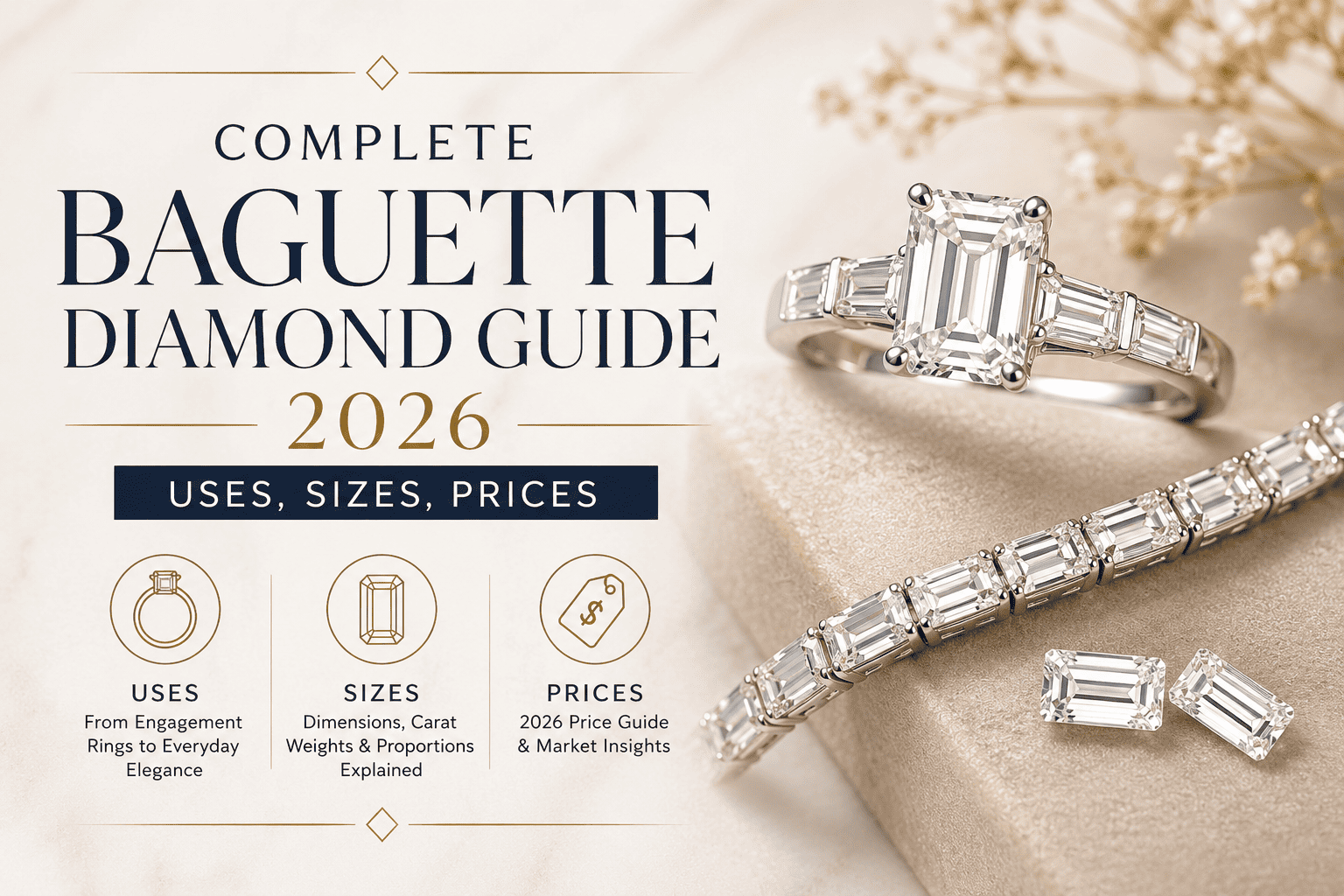
Baguette Diamond Guide 2026 – Uses, Sizes, Prices
What Is a Baguette Diamond?
A baguette-shaped diamond is a thin, elongated, rectangular-shaped diamond belonging to the step-cut family. Unlike round brilliant diamonds with 58 facets, baguette diamond feature only 14 facets – giving them a sleek, mirror-like ‘hall of mirrors’ effect rather than the classic sparkle. Their name comes from the French word for the iconic long bread loaf.
Baguette diamonds are most commonly used as accent or side stones alongside a center diamond. Their clean, geometric lines make them a perfect fit for Art Deco, minimalist, and modern fine jewelry designs. As of 2026, baguette diamonds remain one of the most popular side-stone shapes in engagement rings and eternity bands worldwide.
| ⭐ Quick Facts Shape: Rectangular, step-cut Facets: 14 (vs. 58 for round brilliant) Common Length-to-Width Ratio: 5:1 Typical Use: Side/accent stones, eternity rings, tennis bracelets Price Range: 12%–42% more affordable per carat than round diamonds Trending in 2026: Baguette solitaires & all-baguette eternity stacks |
History & Art Deco Heritage
The baguette cut became popular in the 1920s during the Art Deco movement. Jewelers were inspired by Modernism and geometric precision, favoring clean lines over ornate curves. Baguette diamonds perfectly captured this aesthetic – sleek, architectural, and bold. Icons like Cartier and Van Cleef & Arpels used baguette diamonds extensively in their flagship collections during this era.
By the 1950s and ’60s, baguettes were a hallmark of Hollywood glamour, adorning the wrists and fingers of legendary actresses. The cut never truly faded from fashion – it experienced a massive revival in the 2010s and continues to dominate fine jewelry trends in 2025–2026, particularly in minimalist stacking rings and solitaire settings.
Straight vs. Tapered Baguette Diamond
There are two main varieties of baguette diamonds. Understanding the difference helps you choose the right stone for your jewelry design:
| Feature | Straight Baguette | Tapered Baguette |
| Shape | Perfect rectangle, parallel sides | Trapezoid; one end narrower than the other |
| Corners | Perfectly square (90°) | Angled on the width sides |
| Best For | Side stones set in line | Flanking round or oval center stones |
| Setting Style | Channel, bezel, pavé | Three-stone, halo, shoulder |
| Popularity | Classic choice | Highly popular for engagement rings |
| Price | Slightly lower | Slightly higher due to custom cutting |
The 4Cs For Baguette Diamond
When evaluating baguette diamonds, the traditional 4Cs (Color, Cut, Clarity, Carat) apply – but with different priorities compared to round brilliants.
🎨 Color
Because baguette diamonds have fewer facets and larger, open facets, color is more visible. Aim for G–H color (near-colorless) or higher, especially when pairing alongside a colorless center stone. GIA grades D–F offer the cleanest look for platinum and white gold settings.
3.99 CT Baguette Statement Diamond – E Color VS 1 Clarity – 13.02*7.19*3.81 MM
✂️ Cut
Baguette cut quality focuses on symmetry, polish, and proportion. Look for Very Good or Excellent symmetry grades. The parallel facets must align precisely – uneven facets create a muddy, distorted ‘hall of mirrors’ effect.
🔍 Clarity
Clarity is the single most important factor for baguette diamonds. The open, step-cut facets act like windows – inclusions are highly visible to the naked eye. Recommended minimum: VS2 (Very Slightly Included). VS1 or VVS grades are ideal for fine jewelry.
⚖️ Carat
Baguette diamonds are typically used in small carat weights – commonly 0.05 ct to 0.50 ct per stone when used as side or accent stones. Larger baguettes (1–4 ct) are increasingly used as solitaire center stones in modern 2025–2026 designs.
You must read all things about the 4CS Diamond
| 💡 Pro Tip – Clarity First! Unlike round brilliants, where sparkle can hide inclusions, baguette diamonds’ open facets reveal every flaw. Always prioritize VS2 clarity or higher for baguette stones. For accent stones, match color to within 1–2 grades of your center stone. |
Baguette Diamond Sizes & MM-to-Carat Conversion Chart
Baguette diamonds are sized by millimeter dimensions (Length × Width). The table below provides a comprehensive MM-to-Carat conversion guide for straight baguette diamonds — an essential reference for jewelers and buyers.
| Length × Width (mm) | Approx. Carat Weight | Common Use |
| 1.50 × 0.80 mm | ~0.02 ct | Micro-pavé, channel bands |
| 2.00 × 1.00 mm | ~0.04 ct | Side accents, eternity rings |
| 2.50 × 1.25 mm | ~0.06 ct | Accent stones, side rows |
| 3.00 × 1.50 mm | ~0.10 ct | Wedding bands, bracelets |
| 3.50 × 1.75 mm | ~0.12 ct | Three-stone rings |
| 3.90 × 2.00 mm | ~0.13 ct | Side stones for solitaires |
| 4.00 × 2.00 mm | ~0.15 ct | Classic engagement side stones |
| 4.50 × 2.25 mm | ~0.20 ct | Statement bands |
| 5.00 × 2.50 mm | ~0.25 ct | Side stones, tennis bracelets |
| 5.50 × 2.75 mm | ~0.30 ct | Halo settings, bangles |
| 6.00 × 3.00 mm | ~0.40 ct | Feature accent stones |
| 7.00 × 3.50 mm | ~0.60 ct | Solitaire baguette rings |
| 8.00 × 4.00 mm | ~0.90 ct | Statement rings, pendants |
| 9.00 × 4.50 mm | ~1.20 ct | Center stone use |
| 10.00 × 5.00 mm | ~1.60 ct | High-end center stone designs |
Note: Carat weights are approximate and vary based on depth. Always select baguette diamonds by MM size for accurate fitting.
Baguette Diamond Price Guide 2026
Baguette diamond prices vary significantly based on quality (4Cs), origin (natural vs. lab-grown), and certification. Step-cut diamonds like baguettes are typically 12%–42% more affordable per carat compared to round brilliants of equivalent quality.
| Carat Weight | Natural – Good Quality | Natural – Premium (VS/VVS) | Lab-Grown – Good Quality |
| 0.05 ct | $80–$150 | $180–$280 | $30–$70 |
| 0.10 ct | $200–$400 | $450–$700 | $80–$150 |
| 0.15 ct | $350–$550 | $600–$900 | $130–$220 |
| 0.20 ct | $500–$800 | $900–$1,400 | $180–$320 |
| 0.25 ct | $700–$1,100 | $1,200–$1,900 | $250–$450 |
| 0.50 ct | $1,200–$2,000 | $2,500–$4,000 | $450–$900 |
| 1.00 ct | $2,500–$4,500 | $5,500–$9,000 | $900–$2,000 |
| 2.00 ct | $6,000–$11,000 | $14,000–$22,000 | $2,200–$4,500 |
Natural Diamond Price Guide Per Carat
| 📊 2026 Market Update Lab-grown baguette diamonds are 55%–75% less expensive than natural equivalents. Demand for baguette-cut accent diamonds increased 28% in 2025 (industry estimate). Salt & pepper baguette diamonds are a top emerging trend in 2025–2026. Wholesale pricing from certified suppliers (like OM Jewels Inc.) can be 30%–50% below retail for B2B buyers. |
Top Uses of Baguette Diamond in Jewelry
💍 Engagement Ring Side Stones
The most classic use – baguette diamonds flank a round, oval, or cushion center stone in three-stone (trilogy) rings, adding architectural elegance without competing with the centerpiece.
💎 Eternity Rings & Wedding Bands
All-baguette eternity bands are a leading 2026 trend. Channel-set baguettes create a sleek, continuous diamond surface that catches light beautifully.
⌚ Tennis Bracelets
Baguette diamond tennis bracelets offer a sophisticated alternative to round-brilliant styles. Mixed baguette and round layouts are especially popular.
📿 Necklaces & Pendants
Bar-style baguette pendants and baguette station necklaces are minimalist staples. Single baguette solitaire pendants are trending in 2025–2026.
🔵 Stud & Drop Earrings
Baguette stud earrings offer a modern geometric look. Drop earrings featuring baguette clusters are popular in both fine jewelry and fashion segments.
👑 Halo Settings
Baguettes are used in angular halo settings to frame princess, cushion, or radiant center stones for a sharp, geometric aesthetic.
🎽 Men’s Jewelry
Baguette diamonds in men’s rings, bracelets, and watches are a growing segment. Their bold, linear look suits masculine designs perfectly.
Exclusive Rare and Unique Natural Diamond Matching Pairs for a Luxury Look Engagement Ring
Best Ring Settings for Baguette Diamond
Because baguette diamonds have square corners – which are more vulnerable to chipping than rounded cuts – choosing the right setting is critical for both beauty and protection.
| Setting Type | Description | Protection Level | Best For |
| Channel Set | Diamonds sit between two metal rails, protected on sides | ★★★★★ | Eternity bands, wedding rings |
| Bezel Set | Metal rim fully encircles each stone | ★★★★★ | Active wearers, modern look |
| Bar Set | Thin metal bars between each stone, tops exposed | ★★★★☆ | Bracelets, bands |
| Pavé/Micro-Pavé | Small prongs hold each baguette; more sparkle visible | ★★★☆☆ | Accent rows, halo designs |
| Prong Set | 2–4 prongs per stone; maximum diamond visibility | ★★☆☆☆ | Statement pieces, pendants |
| Tension Set | Stone held by metal pressure from two sides | ★★★☆☆ | Modern minimalist rings |
Baguette vs. Emerald Cut – Key Differences
Baguette and emerald cuts are often confused because both are step-cut rectangles. Here is a clear side-by-side comparison:
| Feature | Baguette Diamond | Emerald Cut Diamond |
| Shape | Long, narrow rectangle (5:1 ratio) | Wider rectangle, more square-ish (1.5:1) |
| Corners | Perfectly square (90°) | Cropped/clipped corners (octagon shape) |
| Facets | 14 facets | 57–58 facets |
| Size | Typically small (accent/side stone) | Large center stones possible |
| Brilliance | Glowing ‘hall of mirrors’ effect | Similar effect, more depth |
| Price | Lower (accent sizes) | Higher as center stones |
| Best Use | Side stones, bands, accents | Center stone, solitaire rings |
Diamond Layout Vs Loose Diamond
Lab-Grown vs. Natural Baguette Diamonds
In 2026, lab-grown diamonds account for a significant share of the baguette diamond market, especially for side and accent stones where volume matters.
| 🔬 Lab-Grown Baguette Diamonds ✅ Chemically identical to natural diamonds (same hardness, brilliance) ✅ 55%–75% less expensive than natural equivalents ✅ Eco-friendly: no mining, reduced carbon footprint ✅ Created via HPHT or CVD technology ✅ GIA and IGI certified options available ✅ Ideal for high-volume jewelry production ⚠️ Lower resale value compared to natural diamonds |
| ⛏️ Natural Baguette Diamonds ✅ Mined from earth; each stone is unique ✅ Higher resale/investment value ✅ Preferred for heirloom and luxury jewelry ✅ GIA/IGI certified for full transparency ⚠️ More expensive per carat ⚠️ Environmental considerations of mining |
Natural Vs lab Grown Diamond – Full Guide for You
OM Jewels Inc. Baguette Diamond Collection
OM Jewels Inc, headquartered in New York’s prestigious Diamond District, is a leading diamond manufacturer, exporter, and wholesale supplier operating since 2018. Their baguette diamond inventory covers both natural and lab-grown stones in a comprehensive range of sizes and quality grades.
Available Baguette Diamond Types at OM Jewels Inc
- Straight Baguette Diamonds – Natural & Lab-Grown
- Tapered Baguette Diamonds – Natural & Lab-Grown
- Salt & Pepper Baguette Diamonds – Unique inclusions, one-of-a-kind look
- Black Baguette Diamonds – Bold, modern aesthetic
- Matching Baguette Pairs – Perfectly calibrated for three-stone rings
- Diamond Layouts & Calibrated Sets – Ready-to-set parcels for jewelry manufacturing
- Custom Shape Baguette Diamonds – Cut to your exact specifications
- Certified Diamonds – GIA and IGI grading available
Sample Product Range & Wholesale Pricing
(Prices are indicative wholesale rates. Contact OM Jewels for current quotes and bulk pricing.)
| Product | Shape | Size Range | Quality | Est. Wholesale Price/ct |
| Natural Straight Baguette | Straight | 1.5×0.8 – 5×2.5 mm | G-H / VS | $600–$2,500 |
| Natural Tapered Baguette | Tapered | 2×1 – 7×3.5 mm | G-H / VS | $700–$3,000 |
| Lab-Grown Straight Baguette | Straight | 2×1 – 8×4 mm | E-F / VVS | $200–$900 |
| Lab-Grown Tapered Baguette | Tapered | 2×1 – 7×3.5 mm | F-G / VS | $180–$850 |
| Salt & Pepper Baguette | Straight | 3×1.5 – 6×3 mm | Natural inc. | $80–$300 |
| Black Baguette Diamond | Straight/Tap | 3×1.5 – 7×3.5 mm | Treated/Natural | $100–$400 |
| Matching Baguette Pair | Both | 4×2 – 7×3.5 mm | G-H / VS | $1,200–$6,000/pr |
How to Buy Baguette Diamonds Wholesale?
Buying baguette diamonds wholesale – directly from a manufacturer like OM Jewels Inc – can save jewelry businesses 30%–50% versus retail pricing. Here is a step-by-step guide:
✅ Step 1: Define Your Requirements
Determine shape (straight/tapered), size range (MM dimensions), quality grade (color & clarity), origin preference (natural/lab-grown), and budget.
✅ Step 2: Request a Wholesale Catalog
Contact OM Jewels Inc. directly for their current baguette diamond inventory, pricing sheets, and available certification options.
✅ Step 3: Verify Certifications
Ensure stones are GIA or IGI certified for transparency on color, clarity, and cut. OM Jewels Inc. offers fully certified natural and lab-grown diamonds.
✅ Step 4: Request Samples or Videos
For high-value purchases, request individual photos or an HD video of each stone. OM Jewels provides detailed media for accurate online assessment.
✅ Step 5: Place Your Order & Confirm Delivery
All OM Jewels diamonds are individually packed, labeled by size, and shipped with full insurance worldwide. Delivery typically takes 5–10 business days.
| 🌍 Who Buys Wholesale from OM Jewels Inc.? Independent jewelry designers and studios, Retail jewelry store owners, online jewelry retailers (Etsy sellers, DTC brands) Watch manufacturers and luxury accessory brands Engagement ring specialists and bridal jewelers International buyers across the USA, UK, Canada, Europe, and beyond |
Frequently Asked Questions (FAQs)
Q: What is the ideal clarity for a baguette diamond?
A: VS2 or higher is recommended. Because baguette diamonds have open, step-cut facets, inclusions are more visible than in brilliant-cut stones. VVS2 or VS1 is ideal for fine jewelry.
Q: Are baguette diamonds good for engagement rings?
A: Absolutely. While rarely used as center stones (though that is trending in 2026), baguette diamonds are the most popular side stones for engagement rings, especially in three-stone and trilogy designs.
Q: How much does a baguette diamond cost per carat?
A: Natural baguette diamonds (G-H/VS) typically cost $2,500–$4,500/ct for 1-carat stones. Lab-grown equivalents are $900–$2,000/ct. Accent-size stones (under 0.25 ct) range from $80–$1,100/ct depending on quality.
Q: What is the difference between straight and tapered baguettes?
A: Straight baguettes are perfect rectangles. Tapered baguettes are narrower at one end (trapezoid shape), designed to flank round or curved center stones naturally.
Q: Can baguette diamonds be used as center stones?
A: Yes! Large baguette diamonds (1–2+ ct) as solitaire center stones are a major trend in 2025–2026, particularly in modern minimalist and Art Deco-inspired designs.
Q: How do I choose the right metal for baguette diamond jewelry?
A: Platinum or white gold is best for D–G color stones to maximize their icy white appearance. Yellow or rose gold pairs beautifully with G–J near-colorless stones, adding warmth. All metals are great — choose based on your style preference.
Q: What is OM Jewels Inc. and why buy from them?
A: OM Jewels Inc. is a New York Diamond District-based diamond manufacturer, exporter, and wholesale supplier since 2018. They offer certified natural and lab-grown baguette diamonds with direct factory pricing, GIA/IGI certifications, and worldwide shipping.
Q: What certifications should I look for in baguette diamonds?
A: Look for GIA (Gemological Institute of America) or IGI (International Gemological Institute) certificates. These provide verified 4Cs grading and conflict-free assurance.
Contact OM Jewels Inc. – Your Trusted Baguette Diamond Supplier
| 🏢 Company: OM Jewels Inc. 📍 Address: 20 W 47th St, Suite 405, New York, NY 10036, US 🌐 Website: www.omjewelsinc.com 🛒 Shop: omjewelsinc.com/shop/?filter_diamond-shape=baguette 📧 Email: info@omjewelsinc.com 📞 Phone: tel:+12016801878 | tel:+19176393354 🏆 Since: 2018 | GIA & IGI Certified | Serving 1,150+ International Clients |
📱 Follow & Connect with OM Jewels Inc.
| 💎 Ready to Source Premium Baguette Diamonds? Visit omjewelsinc.com |
Related posts
Choosing a diamond color grade is one of the most consequential – and most confusing – decisions a buyer makes. The difference between an E,... Continue reading
What Is Diamond Polish? Diamond polish refers to the smoothness of the diamond’s surface after the cutting and faceting process is complete. While a rough... Continue reading
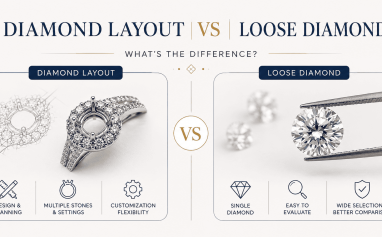
The diamond industry uses a lot of language that confuses first-time buyers. “Diamond layout,” “loose diamond,” “mounted stone,” “preset ring” – these terms get used... Continue reading