No products in the cart.

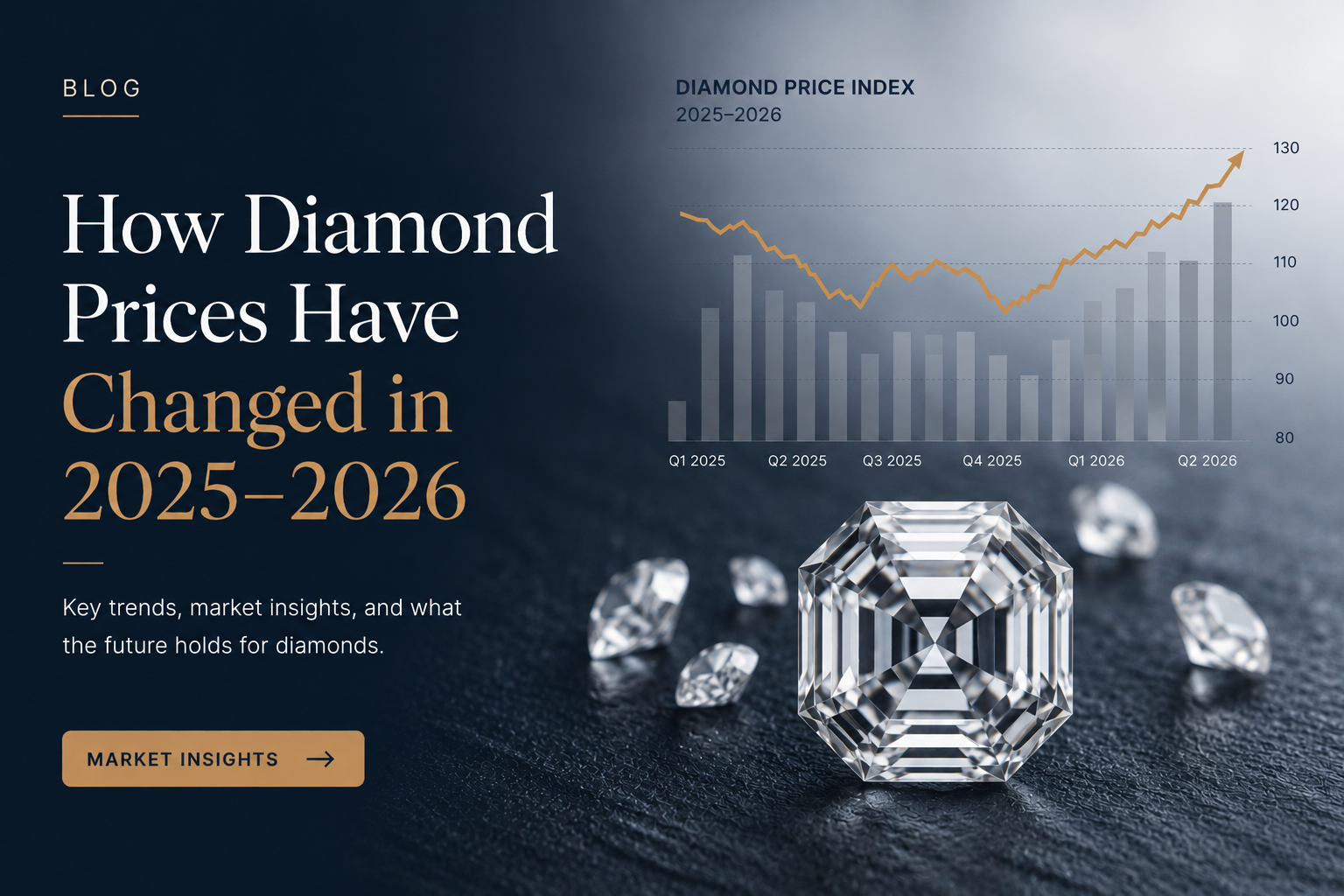
How Diamond Prices Have Changed in 2025–2026
Market in Transition
The diamond market in 2025 and 2026 tells a story of two parallel worlds, one defined by geological scarcity and brand heritage, the other by accelerating technology and shifting consumer values. At OM Jewels Inc, we have watched these trends unfold in real time, and this guide gives you the complete picture.
The global diamond industry entered 2025 already navigating significant headwinds. After a period of post-pandemic luxury spending, the market faced a sobering correction – subdued consumer demand, cautious retail spending, and a fundamental structural challenge: the dramatic mainstreaming of lab-grown diamonds.
By the close of 2025, the Rapaport Diamond Price Index recorded an overall decline of 11.3% for 1-carat natural diamonds. Yet the story beneath that headline number is far more nuanced. Large, high-quality, and rare natural stones held their ground, while smaller commercial-grade diamonds were squeezed hard.
| OM JEWELS INC EXPERT INSIGHT The market is not declining uniformly. Diamonds above 1.2 carats – especially fancy shapes like long ovals and elongated cushions – remained in strong demand throughout 2025. The real pressure is on commodity-grade stones under 0.5 carats, where pricing fell the hardest. |
Natural Diamond Prices: Quarter by Quarter
To understand where diamond prices stand today, it helps to trace the journey through 2025 and into 2026.
Through Q4 2025, natural diamond prices in the US reached approximately $4,407 per carat in December – reflecting softened luxury jewelry demand and retailers managing inventory conservatively with last-minute ordering. The smaller the stone, the steeper the drop:
- 0.30-carat stones fell 20.3% over 2025
- 0.50-carat prices tumbled 26% over the year
- 3-carat goods only edged down 0.3%
- Diamonds in the 7–15 carat range saw strong demand
Then, in Q1 2026, prices began a measured recovery. By March 2026, the US natural diamond price index reached $4,456 per carat – as retailers shifted focus to higher-value natural stones ahead of bridal and gifting season. Identify a natural diamond with the east steps at home.
1-Carat Diamond Price Comparison: 2020 to Q1 2026
| Year | Natural Diamond (Avg) | Lab-Grown Diamond (Avg) |
| 2020 | ~$5,500 | ~$3,410 |
| 2022 | ~$5,100 | ~$1,800 |
| 2025 | ~$4,200 | ~$1,000 |
| Q1 2026 | ~$4,456 | ~$800 – $1,200 |
Sources: Rapaport Diamond Price Index, IMARC Group, BriteCo, MadisonDia (2026). Approximate retail averages, 1ct round brilliant mid-quality.
1 to 10 Natural Diamond Price Guide
Lab-Grown Diamonds: The Price Floor Has Arrived
If natural diamond pricing tells a story of gradual correction, the lab-grown diamond story over the same period is nothing short of revolutionary – and in 2025–2026, it reached a pivotal new chapter.
For years, the defining narrative around lab-grown diamonds was one of continuous, double-digit annual price declines. Consumers learned to wait, expecting cheaper stones next quarter. That era is now over – at least for premium specifications. By late 2025, premium 1-carat lab-grown diamonds (D-E color, VVS1-VVS2 clarity) reached what analysts are calling a functional price floor.
The numbers are still striking: a natural 1-carat D/VVS2 round brilliant retails for approximately $4,600 in the US, while a chemically identical lab-grown equivalent starts from as little as $305 from direct-to-consumer brands, with the broader market averaging $800-$1,200. That is an 80-85% price gap – a structural divide that now defines the entire category.
“Lab-grown diamonds have transitioned from a niche alternative to a mainstream category. By 2026, these stones are widely used in engagement rings and daily-wear jewelry alike.”
1 Carat Lab Grown Diamond Price Guide
Why Did Lab-Grown Prices Fall So Far?
The answer lies in the Infinite Supply paradox. Unlike natural diamonds, which require billions of years of geological formation and increasingly difficult extraction, lab-grown diamonds can be produced at an industrial scale. Global production capacity grew over 300% between 2020 and 2023. Inventory overhangs reached 18-24 months of forward demand at the wholesale level. Prices collapsed.
By mid-2025, wholesale prices for select lab-grown stones fell as low as $80-$105 per carat. While retail prices remain higher due to certification and marketing, the structural reality is clear: lab-grown diamonds behave more like consumer electronics than precious gems.
| RESALE VALUE REALITY CHECK Lab-grown diamonds currently hold only 10-15% of their purchase price at resale, with some jewelers declining buy-backs entirely. Natural diamonds, by contrast, retain considerably more value. For buyers considering a diamond as a long-term store of value, this distinction matters enormously. |
Natural vs Lab-Grown: Side-by-Side Comparison
| Factor | Natural Diamond | Lab-Grown Diamond |
| 1ct retail price (2026) | $3,000 – $6,000+ | $800 – $1,500 |
| Price trend (2025-26) | Stabilizing | Price floor reached |
| 2025 annual change (1ct) | -11.3% | -30% to -50% |
| Resale value | 30-50% of purchase | 10-15% of purchase |
| Chemical composition | 100% carbon | 100% carbon (identical) |
| Rarity | Finite, geological | Unlimited production |
| Engagement ring share (2025) | 57.3% | 42.7% |
| Market growth outlook | Selective, premiumizing | +13.87% CAGR to 2035 |
For You – Natural Vs Lab Grown Diamond Complete Guide
What Is Driving the Diamond Market in 2026?
Several converging forces are shaping diamond prices right now – and will continue to do so through the rest of 2026.
1. Supply Constraints
Global diamond mining has fallen to multi-decade lows of roughly 100 million carats annually. Major mines in Botswana, Canada, and Russia are approaching maturity with declining ore grades. Discoveries are becoming technologically and economically more difficult.
2. Small Stone Pressure
Diamonds under 0.5 carats have borne the sharpest price drops, down 26% in 2025 – squeezed by lab-grown alternatives dominating fashion jewelry and tennis bracelets. Tennis bracelet lab-grown sales grew 240% in market share between 2020 and 2025.
3. Engagement Ring Natural Comeback
Natural diamonds are regaining ground in bridal: their share of engagement ring sales climbed back to 57.3% in 2025, reversing a multi-year decline. The commoditization of lab-grown diamonds appears to be reinforcing the prestige of natural stones for milestone purchases.
4. Asia Pacific Growth
Asia Pacific dominated the lab-grown market share at 34% in 2025, with the lab-grown diamond market projected to reach $33.9 billion globally in 2026 and grow at a 13.87% CAGR through 2035. Meanwhile, Indian domestic natural diamond demand weakened, partly due to US tariff pressures on exports.
5. Premium Natural Stone Resilience
Rare, large, and fancy-colored natural diamonds are bucking broader trends. Stones of 7-15 carats and vivid-colored diamonds ended 2025 with robust demand. Sustainability concerns are also driving interest in ethically certified natural mining, with nearly 60% of luxury buyers now considering mining practices in their decision.
What This Means for Buyers in 2026
The divergence between natural and lab-grown diamonds has never been more pronounced – and that creates a genuine opportunity for informed buyers.
If you are buying for sentiment and enduring value
Natural diamonds remain the clear choice for buyers who value geological rarity, brand heritage, and long-term resale stability. The 2025 price correction has made entry into the natural diamond market more accessible – particularly for 1 to 1.2 carat stones. Focus on GIA-certified stones with strong cut grades.
If you are buying brilliance on a budget
Lab-grown diamonds offer extraordinary value for buyers who prioritize the visual and chemical properties of a diamond over its geological origin or long-term resale value. With the price floor now established for premium lab-grown stones, the wait-for-lower-prices strategy is no longer rewarding. A 1-carat lab-grown with excellent cut and VVS clarity can be purchased for $800-$1,500.
The size effect to know
The pricing split between small and large natural diamonds is more pronounced than ever. If you are looking at diamonds under 0.5 carats, lab-grown alternatives dominate value. But above 1.5 carats, the natural diamond market has held up considerably better.
| EXPERT GUIDANCE FROM OM JEWELS INC. Let Us Help You Find the Perfect Diamond At OM Jewels Inc, we carry both exceptional natural diamonds and premium certified lab-grown stones. Our expert gemologists track market pricing weekly, so you always receive transparent, up-to-date guidance – and the right stone at the right value for your budget and lifestyle. Visit us: www.omjewelsinc.com | Call: +1-800-OM-JEWELS |
Frequently Asked Questions
Are diamond prices going up or down in 2026?
Natural diamond prices are showing early signs of stabilization in Q1 2026, recovering modestly after an 11.3% decline across 2025. Larger stones (1.2ct+) are faring best. Lab-grown diamond prices have largely reached a price floor for premium specifications after years of sharp declines.
How much does a 1-carat diamond cost in 2026?
A natural 1-carat diamond averages around $4,200-$4,600 in the US, depending on quality grades, with high-clarity stones reaching $6,000+. A comparable lab-grown 1-carat diamond retails for $800-$1,500, with premium direct-to-consumer brands offering certified stones from as low as $305.
Will lab-grown diamond prices keep falling?
For premium 1-carat lab-grown stones, analysts broadly agree that a price floor was established in late 2025. The era of double-digit annual price drops is largely over for top-specification lab-grown diamonds, though commodity grades may continue to soften.
Are lab-grown diamonds a good investment?
Generally, no. Lab-grown diamonds hold only 10-15% of their purchase price at resale, and many jewelers decline buy-backs. They are excellent value for buyers focused on the beauty and chemistry of a diamond, but should not be purchased with investment or resale value in mind.
Is now a good time to buy a natural diamond?
Yes – many analysts and jewelers consider the current market a favorable entry point for natural diamonds. Prices have pulled back from 2021 peaks, supply is constrained by declining mine output, and bridal demand is recovering. Stones in the 1-1.5 carat range represent particularly good current value.
The Bottom Line
The diamond market of 2025-2026 is one of the most fascinating and dynamic in decades. Natural diamonds are navigating a genuine correction – pressured by lab-grown competition and shifting consumer preferences – but the fundamentals of geological scarcity, cultural significance, and premium demand for large and fancy stones remain intact.
Meanwhile, lab-grown diamonds have completed their transformation from disruptive novelty to mainstream market force, with pricing stability finally arriving after years of volatility. At OM Jewels Inc, we believe the best diamond purchase is an informed one. Whether your heart is set on a rare natural stone with a billion-year story, or a brilliant lab-grown diamond that lets you size up without compromise, understanding the market you are buying in makes all the difference.
Related posts
Introduction: Why the Marquise Diamond Stands Apart Few diamond shapes carry a story as romantic and royal as the marquise diamond. Born in the court... Continue reading
The diamond industry uses a lot of language that confuses first-time buyers. “Diamond layout,” “loose diamond,” “mounted stone,” “preset ring” – these terms get used... Continue reading
Pear shape diamonds have remained one of the most elegant and distinctive diamond cuts in the jewelry industry. Combining the brilliance of a round diamond... Continue reading
What Is a Diamond Layout? A diamond layout is a matched collection of fancy-shaped diamonds, arranged and sold as a coordinated set. Every stone in... Continue reading
JCK Las Vegas 2026 Diamond Exhibition – OM Jewels Inc Booth Details Natural & Lab-Grown Diamonds | Fancy Shapes | Matching Pairs | Custom Layouts... Continue reading