No products in the cart.

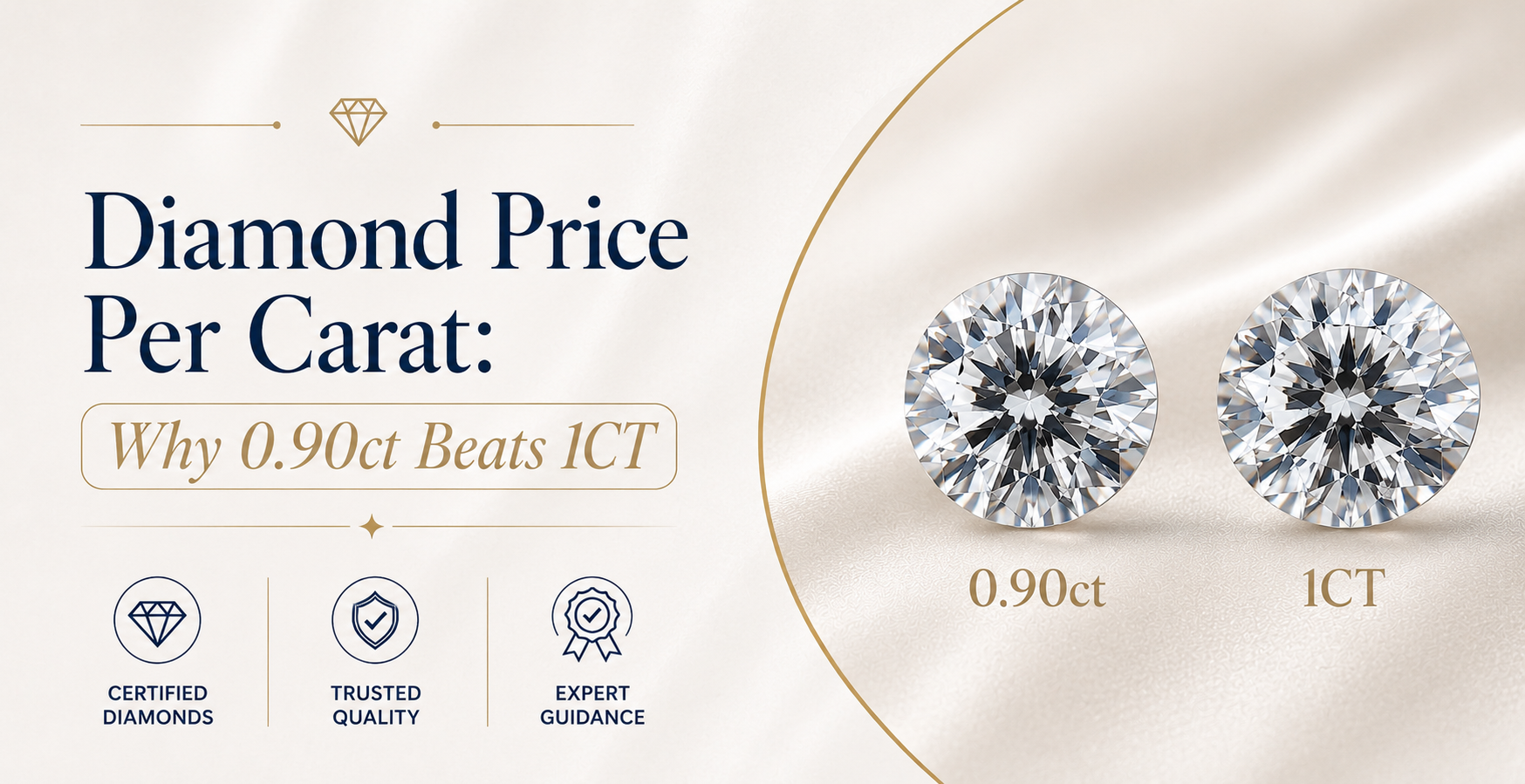
Diamond Price Per Carat: Why a 0.90 Carat Can Be a Smarter Buy Than a 1 Carat
The One-Carat Obsession – and What It Costs You
Ask most first-time diamond buyers what they want, and the answer is almost automatic: “a one-carat diamond.” The 1.00 carat mark has become a cultural finish line – a round number that feels like the “real” diamond threshold. Jewelers know it, cutters know it, and the market prices it accordingly.
Here is the problem: that round number carries a premium that has nothing to do with beauty, brilliance, or visible size. A well-cut 0.90 carat diamond is virtually indistinguishable from a 1.00 carat on the hand, yet it can cost 15-30% less – not just less in total, but less per carat. Understanding why is one of the highest-value lessons in diamond buying, and it comes down to how the industry prices weight.
How Diamond Pricing Really Works: Price Per Carat, Not Price Per Stone
Diamonds are not priced linearly. The trade quotes them in price per carat, and that per-carat rate climbs in steps as stones cross defined weight brackets. A diamond’s total price is simply:
Total Price = Carat Weight × Price Per Carat (for that weight bracket)
Because larger rough crystals are rarer, the per-carat rate rises with size – a 2 carat stone costs far more than twice a 1 carat. But the rate does not rise smoothly. It jumps at specific thresholds: 0.50ct, 0.70ct, 0.90ct, 1.00ct, 1.50ct, 2.00ct and so on. The industry calls these “magic weights,” and the single largest jump in the entire sub-2-carat market happens at exactly 1.00 carat.
Wholesale Vs Retail Diamond Price
The “Magic Weight” Cliff: What Happens at 1.00 Carat
The moment a diamond crosses from 0.99ct to 1.00ct, its per-carat price can leap by 10–20% or more, even though nothing about the stone’s appearance has changed. Three forces create this cliff:
- Emotional demand. Buyers specifically request “a one carat,” so demand concentrates at and just above 1.00ct while stones just below it are comparatively overlooked.
- Cutting economics. Cutters will often sacrifice ideal proportions to keep a rough crystal above the 1.00ct line, because the weight premium outweighs the cut penalty. Ironically, this means many 1.00 -1.05ct stones are cut deeper or thicker than they should be – while 0.90ct stones are more likely to be cut purely for beauty.
- Scarcity just below the line. Because cutters avoid finishing stones at 0.95-0.99ct, the 0.90-0.94ct range becomes a genuine sweet spot: heavy enough to face up like a one-carat, priced in the lower bracket.
Price Comparison Table: 0.90ct vs 1.00ct
The figures below are illustrative retail-market ranges for a round brilliant natural diamond of identical quality (G color, VS2 clarity, Excellent cut). Exact prices move with the market, but the structure of the gap is remarkably consistent.
| Carat Weight | Typical Price / Carat | Typical Total Price | Face-Up Diameter |
| 0.70 ct | $3,200 – $3,800 | $2,250 – $2,650 | ≈ 5.7 mm |
| 0.90 ct | $4,200 – $4,900 | $3,800 – $4,400 | ≈ 6.2 – 6.3 mm |
| 0.95 ct | $4,400 – $5,100 | $4,200 – $4,850 | ≈ 6.3 mm |
| 1.00 ct | $5,500 – $6,800 | $5,500 – $6,800 | ≈ 6.4 – 6.5 mm |
| 1.20 ct | $5,900 – $7,200 | $7,100 – $8,650 | ≈ 6.8 mm |
Read that middle of the table carefully: moving from 0.90ct to 1.00ct adds roughly $1,500–$2,400 to the price – a 30–45% jump in total cost – in exchange for about 0.15 mm of extra diameter. That is thinner than a human hair is wide.
How Diamond Prices Have Changed In 2025-2026
Can You Actually See the Difference?
Carat is a unit of weight (0.20 grams), not size – and weight hides in the depth of the stone, where no one can see it. What the eye registers is the face-up spread, and there the 0.90ct holds its own:
| What You’re Comparing | 0.90 ct Round | 1.00 ct Round | Real-World Difference |
| Average diameter | 6.2 – 6.3 mm | 6.4 – 6.5 mm | ≈ 0.15 mm (≈2.5%) |
| Face-up area | ≈ 30.7 mm² | ≈ 32.2 mm² | ≈ 5% – invisible at arm’s length |
| Weight difference | 0.90 ct | 1.00 ct | 0.10 ct – hidden in depth |
| Visible on the hand? | – | – | No, not once the ring is set |
Once a diamond is set in prongs or a halo, even trained jewelers cannot reliably tell a well-cut 0.90ct from a 1.00ct by eye. In fact, a 0.90ct with an Excellent cut will often face up larger and brighter than a deep-cut 1.00ct that was shaped to protect weight rather than beauty.
Where the Savings Go: Upgrading Cut, Color, and Clarity
The smartest buyers do not simply pocket the difference – they reinvest part of it into the factors that genuinely change how a diamond looks:
- Cut comes first. Cut quality controls sparkle more than any other factor. The savings from choosing 0.90ct can move you from a Very Good to an Excellent or ideal cut – a difference you will see every single day.
- A color grade up. Stepping from H to G, or G to F, buys visible whiteness for a fraction of the 1.00ct premium.
- A better setting. The same budget can now cover a finer band, a halo, or pavé details – all of which make the center stone look larger.
In short: the 1.00ct buyer pays for a number on a certificate; the 0.90ct buyer pays for what the eye actually sees. Diamond 4CS Guide
When a Full 1.00 Carat Still Makes Sense
Honesty matters: the 0.90ct strategy is not for everyone. A full one-carat is the better choice if the milestone itself is the point – some buyers simply want to say “one carat,” and that sentiment is legitimate. Resale and trade-in programs also tend to treat 1.00ct+ stones more favorably, since demand concentrates there. And if you are buying a lab-grown diamond, the price cliff is far smaller, so the argument for stopping at 0.90ct weakens considerably. For natural diamonds bought primarily to be worn and admired, however, the 0.90ct remains one of the best value plays in the market.
Smart-Buyer Checklist for 0.90ct Diamonds
- Target 0.90 – 0.96 ct – close enough to face up like a full carat, safely below the price cliff.
- Insist on cut quality – Excellent / Ideal cut only; this is where your savings should go.
- Check the measurements, not just the weight – for a round, look for roughly 6.2 mm or more in diameter and a depth around 59–62.5%.
- Demand certification – buy only stones graded by GIA or IGI, with the certificate number laser-inscribed on the girdle.
- Compare per-carat, not per-stone – quoting price per carat instantly exposes which stones carry the magic-weight premium.
- Buy from a source with wholesale access – importers and dealers who sit close to the cutting centers can price sharper than retail chains.
Frequently Asked Questions
Is a 0.90 carat diamond considered “almost one carat”?
Yes – the trade calls 0.90–0.99ct stones “under-carats” or “shy carats.” Set in a ring, they read as one-carat diamonds to virtually every observer.
Will a 0.90ct hold its value?
It appreciates and depreciates with the same market forces as any certified natural diamond. You may see slightly less trade-in demand than a 1.00ct, but since you paid meaningfully less to begin with, your value retained per dollar spent is typically better.
Does this logic apply to fancy shapes?
Even more so. Ovals, pears, and emerald cuts spread their weight across a larger face, so a 0.90ct fancy shape can look distinctly bigger than a 1.00ct round – at a fraction of the price.
Does it apply to lab-grown diamonds?
Partially. Lab-grown pricing has softer weight cliffs, so the saving is smaller – but comparing price per carat across sizes is still the right habit.
About OM Jewels Inc
Established in 2018, OM Jewels Inc is a first-generation diamond import company founded by Navneet Suhagiya. From its base in New York’s Diamond District, the company began by importing diamonds from India – home of the world’s cutting and polishing industry – and has since expanded globally. OM Jewels Inc supplies natural diamonds, lab-grown diamonds, salt-and-pepper diamonds, black diamonds, matched pairs, fancy shapes, and custom layouts to both wholesale and private clients, with a commitment to quality, transparency, and honest per-carat pricing.
If you are weighing a 0.90ct against a 1.00ct – or any sizing decision – our team will happily pull comparable certified stones side by side so you can judge the value for yourself.
Contact Details
| Channel | Details |
| Address | 20 W 47th St, Suite 405, New York, NY 10036, USA |
| Phone | +1 201 680 1878 | +1 917 639 3354 |
| info@omjewelsinc.com | omjewelsinc@gmail.com | |
| Website | www.omjewelsinc.com |
Related posts
Introduction If you have ever compared the price of the same diamond at a retail jewelry store and a wholesale supplier, you already know the... Continue reading
Two diamonds can share the same carat weight, the same color grade, and the same clarity – yet look completely different on the finger. One... Continue reading
Radiant Cut Diamond Guide for Beginners: Everything You Need to Know in 2026 If you love the fiery sparkle of a round brilliant but prefer... Continue reading
If the round brilliant is the classic little black dress of diamonds, the Hexagonal Diamond is the architectural statement piece – six equal sides, razor-clean... Continue reading
A pair of diamond earrings looks effortless when it is done right – two stones that face up identically, sparkle in unison, and sit perfectly... Continue reading