No products in the cart.

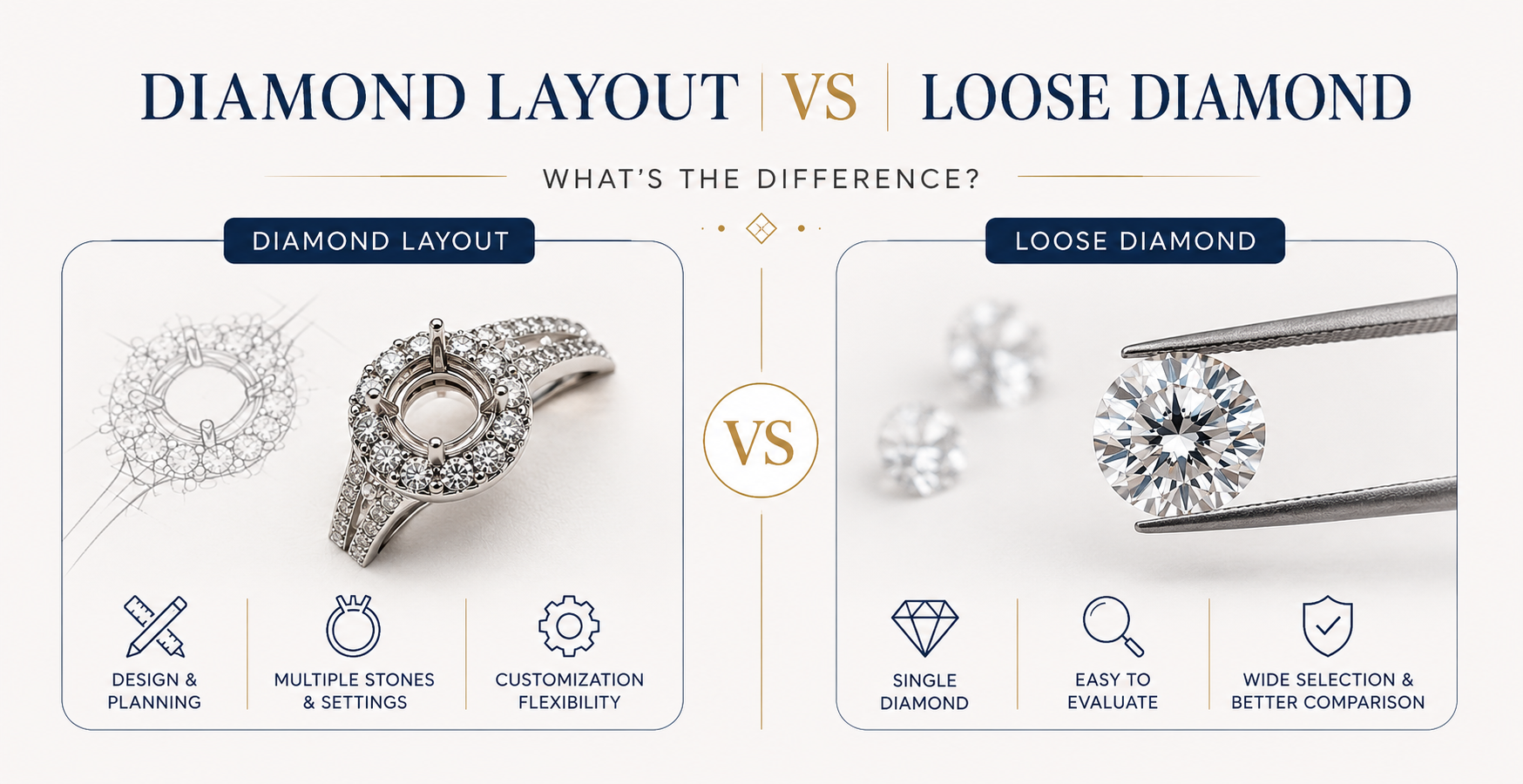
Diamond Layout vs Loose Diamond – What’s the Difference?
The diamond industry uses a lot of language that confuses first-time buyers. “Diamond layout,” “loose diamond,” “mounted stone,” “preset ring” – these terms get used interchangeably in conversation, but they mean very different things.
What is a Loose Diamond?
A loose diamond is a cut and polished diamond stone that has not yet been set into any jewellery. It stands alone – graded, certified, and ready to be placed into a setting of your choice. You can examine every facet, every inclusion, every angle before committing.
Loose diamonds are sold by the 4Cs – cut, colour, clarity, and carat weight – and are always accompanied by an independent grading report from GIA (Gemological Institute of America) or IGI (International Gemological Institute).
What is a Diamond Layout (Set Diamond)?
A diamond layout is a diamond that has been mounted and secured into a finished jewellery piece – a ring, pendant, bangle, or earring. The stone is fixed inside a metal setting using techniques such as prong (claw), bezel, channel, or pavé, and sold as a complete, ready-to-wear item.
When you walk into most jewellery stores, almost everything in the display case is a diamond layout – a finished piece combining stone and setting.
| “When a stone is already set, prongs can cleverly disguise inclusions or chips near the girdle. By inspecting a stone independently, you see every facet and flaw with absolute clarity – something impossible to achieve with a finished piece.” – OM Jewels Inc Gemology Division |
The 8 Key Differences
Once you understand the definitions, the real question becomes: which is better for your specific situation? The answer depends entirely on what matters most to you. Here is a complete, honest breakdown across every major buying factor.
| Factor | Loose Diamond | Diamond Layout (Set) | Winner |
| Price | 10–30% more affordable – no setting or labour costs | Higher cost – includes metal, craftsmanship, markup | ✔ Loose |
| Quality Check | Full 360° inspection of every facet and inclusion | Setting can hide chips or inclusions near girdle | ✔ Loose |
| Customisation | Total freedom – any setting, metal, and design | Limited – stone and setting already fixed | ✔ Loose |
| Convenience | Requires extra step of choosing and commissioning a setting | Ready-to-wear immediately – buy and gift same day | ✔ Set |
| Investment | Much higher liquidity – easier to evaluate and resell | Value tied to stone AND setting – harder to liquidate | ✔ Loose |
| Certification | Always with GIA or IGI grading report | Not always provided with pre-set pieces | ✔ Loose |
| Emotional Appeal | Takes more time – not everyone wants this journey | Immediate visual impact – beautiful and complete | ✔ Set |
| Setting Choice | Pair with any metal: yellow, white, rose gold, platinum | Setting already chosen – cannot be changed easily | ✔ Loose |
| 10–30% Average price saving buying loose vs pre-set | 360° Full visual inspection only possible with loose | 100% GIA/IGI certification on all OM Jewels Inc loose diamonds |
3. Loose Diamond – Pros & Cons
Buying a loose diamond puts you in the driver’s seat. Starting your journey with a loose stone allows you to step into the role of the architect – you aren’t limited by what’s currently in a display case.
| ✔ Advantages | ✘ Considerations |
| ✓ Complete transparency – examine every facet and include yourself ✓ 10–30% lower price than equivalent pre-set diamonds ✓ Choose your own setting, metal, style, and jeweller ✓ Always accompanied by official GIA or IGI certification ✓ Higher resale value and investment liquidity ✓ Custom sizing – a setting built to your exact measurement ✓ No hidden flaws masked by metal prongs or settings ✓ Compare multiple stones side-by-side before deciding | ✗ Requires additional time to find and commission a setting ✗ Not immediately ready to present or gift ✗ Requires some knowledge to evaluate quality independently ✗ More decisions can feel overwhelming for first-time buyers ✗ Loose stones need careful handling to avoid scratches |
Why Savvy 2026 Buyers Prefer Loose Diamonds
In the modern market, trust is built through data and visual proof. Every high-quality diamond should be accompanied by a grading report from the GIA or IGI – these documents act as the stone’s birth certificate, detailing the 4Cs of diamond quality with scientific precision.
Loose diamonds are generally cheaper than mounted diamonds because the cost of the setting, labour, and other materials associated with creating jewellery is not factored into the price. Additionally, loose diamonds offer more flexibility in terms of selection, allowing buyers to choose specific characteristics that suit their preferences and budget.
Diamond Layout (Set Diamond) – Pros & Cons
A diamond layout is the choice most people make by default. Walk into any jewellery store, and every display case is full of diamond layouts. They are beautiful, immediate, and emotionally compelling. But knowing their limitations makes you a smarter buyer.
| ✔ Advantages | ✘ Considerations |
| ✓ Ready to wear and gift immediately – maximum convenience ✓ Visually complete – you see exactly what you are buying ✓ No additional decisions – stone and setting already matched ✓ Perfect for buyers who prefer a ready-made experience ✓ Wide variety of styles available in-store or online ✓ Setting protects diamond edges from accidental damage | ✗ Prongs and metal can conceal inclusions or chips near girdle ✗ 10–30% more expensive due to setting, labour, and markup ✗ Very limited customisation – cannot easily separate stone from setting ✗ Setting metal reflects light, distorting colour and clarity assessment ✗ Lower resale liquidity than loose diamonds ✗ Certification not always included with pre-set pieces |
Which Should You Choose?
There is no universally “better” option – the right choice depends entirely on your priorities, timeline, and how you approach the buying experience. Use this framework to decide.
Choose a Loose Diamond If…
- You want full transparency and to inspect the stone yourself before buying
- Budget matters – you want maximum value for your money
- You want a completely custom piece built to your exact vision
- You are buying as an investment or for long-term resale value
- You want the setting metal of your choice – yellow, rose, white gold, or platinum
- You are not in a rush and have time for the custom process
- You want a full GIA or IGI certification documenting the stone’s exact grade
- You want to compare multiple diamonds side by side before deciding
Choose a Diamond Layout If…
- You want a ready-to-wear, ready-to-gift piece immediately
- You prefer a curated, finished look without multiple decisions
- It is for a surprise proposal, and timing is critical
- You love a specific design that already comes with a great stone
- You trust the jeweller, and the setting’s quality is verified and guaranteed
- You are replacing or upgrading an existing piece in a similar style
How to Buy a Loose Diamond the Right Way
If you have decided that a loose diamond is the right path for you, here is the exact process our experts at OM Jewels Inc recommend for every buyer in 2026.
| 1 | Set Your Budget First – Then Pick Your Priority C Decide your total budget before anything else. Then decide which of the 4Cs matters most to you. Most experts agree: never compromise on cut quality, as it determines brilliance above all else. |
| 2 | Choose Your Diamond Shape Round, oval, moval, emerald, cushion, pear – each shape performs differently under light. Elongated shapes like oval and marquise appear larger per carat. Our gemologists can guide your choice based on hand shape and personal style. |
| 3 | Demand Certification – GIA or IGI Only Every high-quality diamond should be accompanied by a grading report from the GIA or IGI. These documents are the stone’s birth certificate. Never buy an uncertified loose diamond. |
| 4 | Inspect the Stone Physically or via HD Video Always view the diamond in person or request a 360° HD video before purchasing. For fancy shapes like oval and marquise, look for the ‘bow-tie effect’ – invisible on a certificate but obvious in person. |
| 5 | Choose Your Setting Last Once you have your loose stone, choose a setting that complements its shape, protects its edges, and matches your lifestyle. At OM Jewels Inc, we guide you through every setting option. |
| 6 | Work With a Reputable Gemologist You Trust At OM Jewels Inc, our GIA-certified team walks you through every step – comparing stones side by side, explaining grading nuances, and ensuring you select a diamond that aligns perfectly with your expectations and budget. |
Which Holds Value Better?
If investment potential matters to you – even slightly – the answer is unambiguous.
When considering diamonds as an investment, you should not buy a preset ring or setting. Loose diamonds have greater liquidity and are easier for buyers to evaluate for value. A loose diamond can be independently evaluated by any gemologist in the world using its certification. A preset diamond’s value is tied to both the stone and the setting, resulting in lower offers.
In 2026, natural diamonds have remained price-stable for the past 18 months, with modest fluctuations driven by mining output and luxury demand cycles. For natural loose diamonds, long-term value retention remains strong.
| ↑ Higher Resale liquidity for loose vs set diamonds | 18mo Natural diamond price stability as of mid-2026 | GIA/IGI Certification required for investment-grade loose diamonds |
Frequently Asked Questions
What exactly is a “diamond layout” in jewellery?
A diamond layout refers to a diamond that has been set and mounted inside a finished jewellery piece – most commonly a ring, pendant, bracelet, or earrings. The stone is secured by a setting technique such as prong (claw), bezel, channel, or pave. The term ‘layout’ is also used in the wholesale trade to describe a pre-arranged design showing where diamonds will be placed before manufacture.
Is a loose diamond cheaper than a pre-set diamond?
Yes – consistently. Loose diamonds are generally 10–30% more affordable than pre-set diamonds of equivalent quality. When you buy loose, you only pay for the diamond itself, not the metal setting, craftsmanship labour, or the retailer’s margin on the complete item.
Can a setting hide diamond flaws?
Yes – this is one of the most important reasons to inspect a loose diamond before buying. Metal prongs and bezel settings can physically conceal inclusions, chips, or surface scratches near the girdle. Additionally, metal settings reflect light into the stone, which can make the colour appear whiter or the stone appear more brilliant than it truly is.
Which is better for a custom engagement ring?
A loose diamond is the definitive choice for a custom engagement ring. Starting with the stone gives you complete freedom over the setting style, metal type, band design, and sizing. You can pair the diamond you love with a mounting that perfectly reflects the recipient’s personality – something impossible with a pre-set piece.
Which is better for investment – loose or set diamond?
Loose diamonds are significantly better for investment. They have greater liquidity, are easier to evaluate and resell, and hold their value independently from the setting. Any gemologist or buyer worldwide can evaluate a certified loose stone independently and quickly.
Final Thoughts
The difference between a diamond layout and a loose diamond is not just technical – it determines your price, your customisation freedom, your ability to inspect quality, and your long-term investment return.
In 2026, with more buyers than ever choosing personalised, intentional jewellery, the case for starting with a loose diamond has never been stronger. That said, a beautifully crafted diamond layout has its place – for buyers who want convenience, a specific finished design, or are working to a tight timeline.
At OM Jewels Inc, we offer both, along with expert guidance to help you decide which path is right for you. Our GIA-certified gemologists are here to walk you through every option, every grade, and every question, so you buy with complete confidence.
Related posts
The One-Carat Obsession – and What It Costs You Ask most first-time diamond buyers what they want, and the answer is almost automatic: “a one-carat... Continue reading
Introduction If you have ever compared the price of the same diamond at a retail jewelry store and a wholesale supplier, you already know the... Continue reading
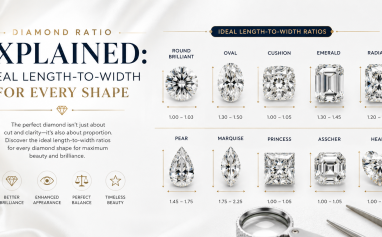
Two diamonds can share the same carat weight, the same color grade, and the same clarity – yet look completely different on the finger. One... Continue reading
Radiant Cut Diamond Guide for Beginners: Everything You Need to Know in 2026 If you love the fiery sparkle of a round brilliant but prefer... Continue reading
If the round brilliant is the classic little black dress of diamonds, the Hexagonal Diamond is the architectural statement piece – six equal sides, razor-clean... Continue reading