No products in the cart.

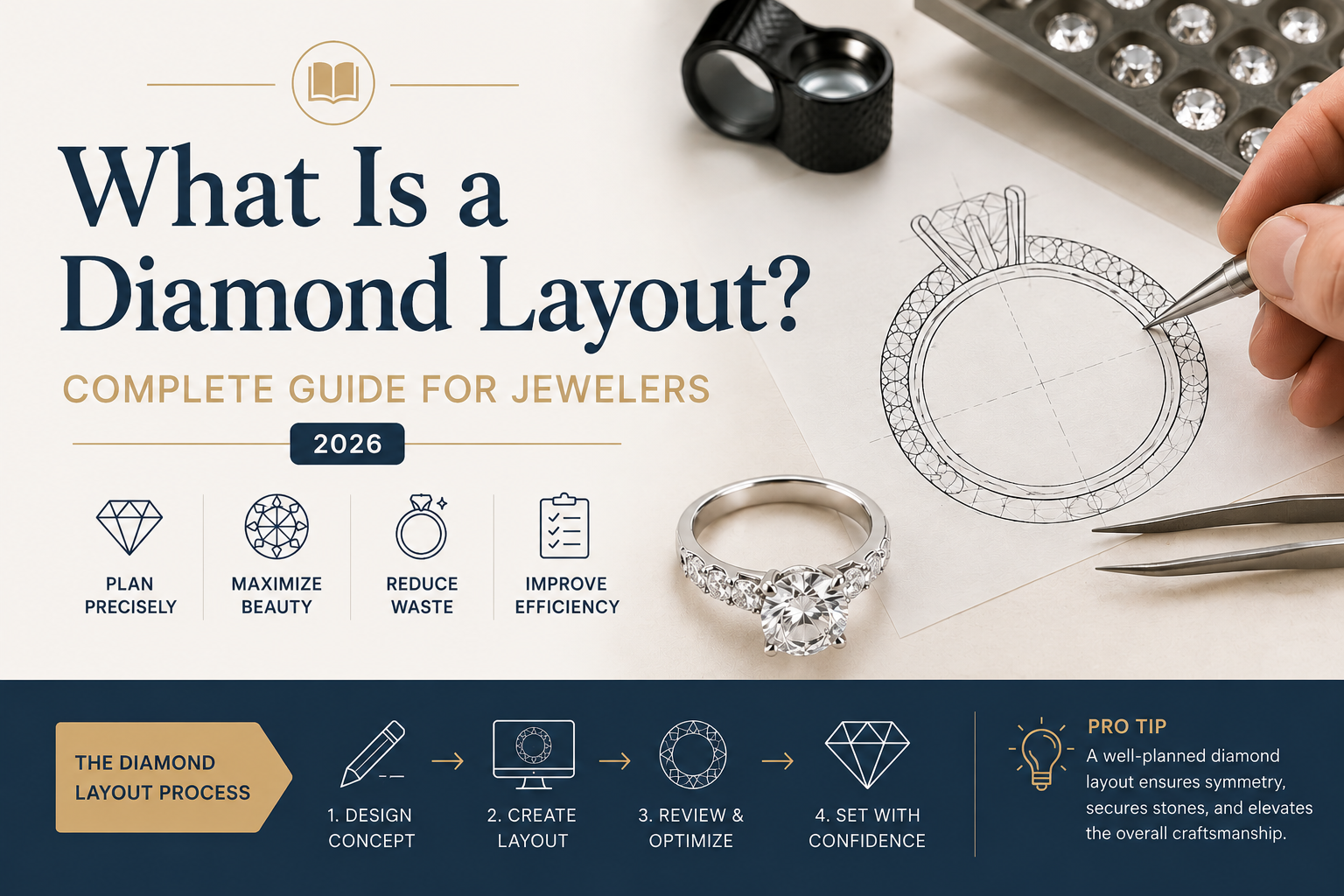
What Is a Diamond Layout? Complete Guide for Jewelers (2026)
What Is a Diamond Layout?
A diamond layout is a matched collection of fancy-shaped diamonds, arranged and sold as a coordinated set. Every stone in a layout is calibrated to be uniform in shape, size (length × width × depth in millimeters), color grade, and clarity grade.
Unlike buying loose diamonds individually, a diamond layout gives a jeweler a ready-to-set group of stones that will look consistent and harmonious in the final piece of jewelry. This saves time, reduces the effort of hand-matching individual stones, and ensures visual uniformity across the finished product.
| Think of a diamond layout like a matched set of tiles – each piece is cut from the same quality standard so that when placed together, the result is seamless and polished. |
Diamond Layout vs Loose Diamond – What Is the Difference?
These three terms are commonly confused. Here is how they compare:
| Term | Definition | Typical Use |
| Diamond Layout | Matched set of calibrated fancy shapes | Side stones, pave designs, accent rows |
| Loose Diamond | A single unmounted diamond of any size | Center stone, individual setting |
| Diamond Pair | Two matching diamonds sold together | Earrings, side stones for solitaire rings |
The main distinction of a layout is that it is fancy-shaped (not round), pre-matched, and intended for use as a coordinated group rather than a single feature stone.
Shapes Available in Diamond Layouts
Diamond layouts are available in a wide range of fancy shapes. Each shape serves a different design purpose:
| Shape | Description | Best Used In |
| Pear | Teardrop silhouette, brilliant cut | Drop earrings, ring halos, pendants |
| Marquise | Football/navette shape with pointed ends | Engagement ring side stones, eternity bands |
| Baguette | Rectangular step cut, clean lines | Art deco rings, channel settings, tennis bracelets |
| Trilliant | Triangular shape with brilliant facets | Three-stone rings, statement earrings |
| Radiant | Rectangular with brilliant facets, clipped corners | Halo rings, multi-stone bracelets |
| Princess | Square with brilliant cut | Channel-set bands, geometric jewelry |
| Oval | Elongated ellipse, brilliant cut | Elongating ring designs, cocktail rings |
| Lozenge | Diamond/rhombus shape | Art deco and geometric pieces |
| Kite | Chevron-shaped, angular | Modern statement rings, architectural designs |
| Trapezoid | Trapezoid shape, step cut | Side stones flanking emerald or cushion centers |
| Hexagonal | Six-sided geometric shape | Contemporary and minimalist jewelry |
| Emerald | Rectangular step cut, open table facets | Luxury side stones, elegant settings |
4. How Diamond Layouts Are Graded
Diamond layouts are graded using the standard 4 Cs – Cut, Color, Clarity, and Carat – but with some nuances specific to fancy shapes and matched sets.
Color
Most high-quality layouts are graded in the D-to-N color range. The most commonly used grades in wholesale layouts are:
- E / F / G – Near colorless, premium grade, used in white gold and platinum settings
- H / I – Slightly warmer, still very attractive, often used in yellow gold settings
- J / K / L – Visible warmth, used for budget-conscious designs
Clarity
Clarity grades found in layouts typically range from VVS (Very Very Slightly Included) to VS (Very Slightly Included) and SI (Slightly Included). For side stones where inclusions are less visible:
- VVS1 / VVS2 – Excellent clarity, inclusions invisible even under magnification
- VS1 / VS2 – Very minor inclusions, eye-clean in most cases
- SI1 / SI2 – Slight inclusions visible under 10x, but often eye-clean in small stones
Carat & Size Calibration
In layouts, calibration (size in millimeters) is as important as carat weight. All stones in a layout must match in length, width, and depth so they sit uniformly in the setting. Common size notations look like:
| Example: “8PT E/F/G VVS/VS Trilliant Natural Diamond Layout 3×3×1.8MM” means – 8 pointer (0.08 ct), E/F/G color, VVS to VS clarity, trilliant shape, each stone measuring 3mm × 3mm × 1.8mm deep. |
What Are Diamond Layouts Used For?
Diamond layouts are essential building blocks in fine jewelry manufacturing. Here are the primary applications:
Engagement Ring Layouts
Pear, marquise, and trapezoid layouts are commonly used as side stones flanking a center diamond. A matched layout ensures both sides look identical in brilliance and color.
Eternity Bands and Tennis Bracelets
Baguette, princess, and radiant layouts are ideal for channel-set or bezel-set eternity bands where uniform sizing is critical for an even, continuous line.
Earrings
Trilliant, pear, and oval layouts are popular for drop earrings and cluster earrings where multiple stones must match visually.
Necklaces and Pendants
Lozenge, kite, and hexagonal layouts are used in geometric pendant designs and statement necklaces popular in contemporary fine jewelry.
Halo Settings
Small pear and marquise layouts form the halo around a center stone in engagement rings, creating a distinctive starburst or floral effect.
6. Natural vs Lab Grown Diamond Layouts
Both natural and lab grown diamonds are available in layout form. Here is how they compare for jewelers:
| Factor | Natural Diamond Layout | Lab Grown Diamond Layout |
| Origin | Mined from the earth | Grown in controlled laboratory |
| Price | Higher – reflects natural rarity | 30–70% less than natural equivalent |
| Certification | GIA, IGI, or internal grading | IGI, GCAL, or internal grading |
| Availability | Limited by mining | Scalable and increasingly available |
| Consumer Preference | Traditional buyers, heirloom jewelry | Value-conscious, eco-aware buyers |
| Resale Value | Stronger long-term hold | Currently declining due to supply increase |
For luxury and high-end jewelry brands, natural diamond layouts remain the preferred choice. For fashion jewelry or budget-conscious collections, lab grown layouts offer excellent visual quality at a lower cost.
7. How to Read a Diamond Layout Specification
When buying layouts wholesale, you will encounter product names with specific notations. Here is how to decode them:
| 📋 Example Specification Decoded: “16PT E/F/G VVS/VS Marquise Natural Diamond Layout 5×3×1.9MM” • 16PT = 16 pointer = approximately 0.16 carats per stone • E/F/G = Color range (near colorless, top grade) • VVS/VS = Clarity range (very high clarity) • Marquise = Shape • Natural = Earth-mined, not lab grown • 5×3×1.9MM = Length × Width × Depth of each stone |
Always confirm the number of stones per lot, total carat weight, and whether the specification refers to the size per stone or total parcel weight before placing a wholesale order.
How to Source Diamond Layouts Wholesale
For jewelry manufacturers and designers, sourcing consistent, quality layouts at competitive prices is critical to profitability. Here is what to look for in a wholesale diamond layout supplier:
- Choose a diamond supplier who stocks all major fancy shapes – pear, marquise, baguette, trilliant, radiant, kite, lozenge, trapezoid, and more. Wide shape selection
- Every stone in the lot must be uniform. Ask the supplier about their matching tolerance (ideally ±0.1mm). Calibrated matching
- Reputable suppliers grade by color and clarity ranges. Avoid vague descriptions – insist on specific grade ranges like “E/F/G VVS/VS.” Transparent grading
- Because layout pricing depends on volume, shape, and grade, trusted wholesalers offer a Request for Price model rather than fixed retail pricing. Request for Price (RFP) system
- The best suppliers stock both, allowing you to source for different client budgets. Natural and Lab Grown options
| OM Jewels Inc, based, New York, specializes in wholesale natural and lab grown diamond layouts across all major fancy shapes – pear, marquise, baguette, trilliant, radiant, princess, oval, kite, lozenge, trapezoid, and hexagonal. Request for price at omjewelsinc.com. |
Frequently Asked Questions (FAQ)
Q1: What is the difference between a diamond layout and a diamond parcel?
A diamond parcel is any bulk lot of diamonds sold together – which may or may not be matched in shape or size. A diamond layout, however, is specifically a matched, calibrated set of fancy-shaped diamonds intended for use together in a jewelry setting. All layouts are parcels, but not all parcels are layouts.
Q2: Can I order a diamond layout in a custom size?
Many wholesale diamond suppliers can source or cut layouts to specific millimeter dimensions if you place a sufficient order quantity. Discuss your specifications with the supplier, including exact dimensions (L×W×D), shape, color range, and clarity range. Expect longer lead times for custom calibrations.
Q3: Are diamond layouts sold by weight or by lot?
Diamond layouts are typically quoted per carat (price per carat × total carat weight of the lot). The specification shows the carat weight per individual stone (e.g., 8PT = 0.08 ct per stone), and the total price depends on how many stones you order multiplied by the per-carat rate.
Q4: Do natural diamond layouts come with GIA certification?
Individual stones in a layout are typically not GIA-certified because the cost of certifying each small stone would exceed its value. Instead, reputable suppliers grade them in-house or by IGI in ranges (e.g., E/F/G color, VVS/VS clarity). For larger stones above 0.30 ct, certification is more common and recommended.
Q5: What is the minimum order for natural diamond layouts?
Minimum order quantities vary by supplier. Most wholesale diamond dealers require a minimum parcel value or carat weight. At OM Jewels Inc, wholesale accounts can request pricing for any quantity – contact via the website to discuss your specific requirement.
Q6: Which diamond layout shape is most popular among jewelers?
Pear and marquise layouts are consistently the most popular fancy shapes for side stones in engagement ring design. Baguette layouts are the top choice for channel-set bands and Art Deco-inspired pieces. Trilliant layouts are growing in popularity for three-stone rings and geometric jewelry trends in 2025-2026.
Q7: Is it better to use natural or lab grown diamond layouts for luxury jewelry?
For jewelry positioned as luxury, heirloom, or investment-grade, natural diamond layouts are strongly prefer by both jewelers and end consumers. For fashion collections, diffusion lines, or price-sensitive markets, lab grown layouts offer excellent visual quality at a fraction of the cost. Many jewelers offer both options under separate product lines.
Conclusion
A diamond layout is an essential product category for any jewelry manufacturer or designer working with fancy-shaped diamonds. Understanding the terminology – shape, calibration, color range, clarity grade, and carat weight – allows you to source more efficiently and communicate more clearly with your supplier.
Whether you are setting pear-shaped side stones in an engagement ring, channel-setting baguettes in an eternity band, or creating a geometric pendant with trilliant and kite shapes, having a reliable source of matched, calibrated diamond layouts is the foundation of consistent, high-quality jewelry production.
| 🔗 Ready to Source Natural Diamond Layouts? OM Jewels Inc offers a complete collection of natural and lab grown diamond layouts across all major fancy shapes – pear, marquise, baguette, trilliant, radiant, princess, oval, kite, lozenge, trapezoid, hexagonal, and more. All layouts are available in E/F/G color and VVS/VS clarity grades. Visit omjewelsinc.com/collections/natural/layout/ to browse our current inventory or submit a Request for Price. |
Related posts
The One-Carat Obsession – and What It Costs You Ask most first-time diamond buyers what they want, and the answer is almost automatic: “a one-carat... Continue reading
Introduction If you have ever compared the price of the same diamond at a retail jewelry store and a wholesale supplier, you already know the... Continue reading
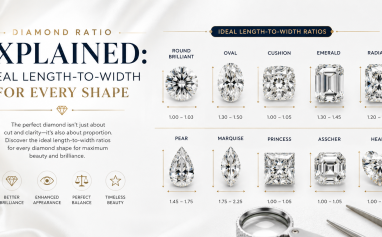
Two diamonds can share the same carat weight, the same color grade, and the same clarity – yet look completely different on the finger. One... Continue reading
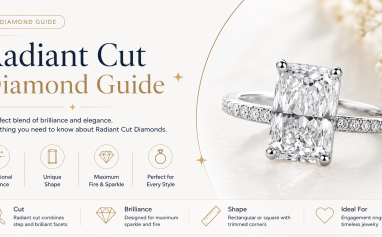
Radiant Cut Diamond Guide for Beginners: Everything You Need to Know in 2026 If you love the fiery sparkle of a round brilliant but prefer... Continue reading
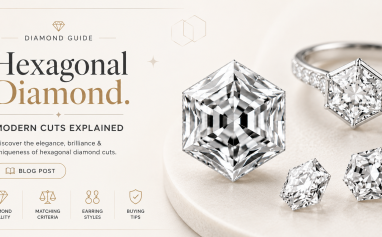
If the round brilliant is the classic little black dress of diamonds, the Hexagonal Diamond is the architectural statement piece – six equal sides, razor-clean... Continue reading